
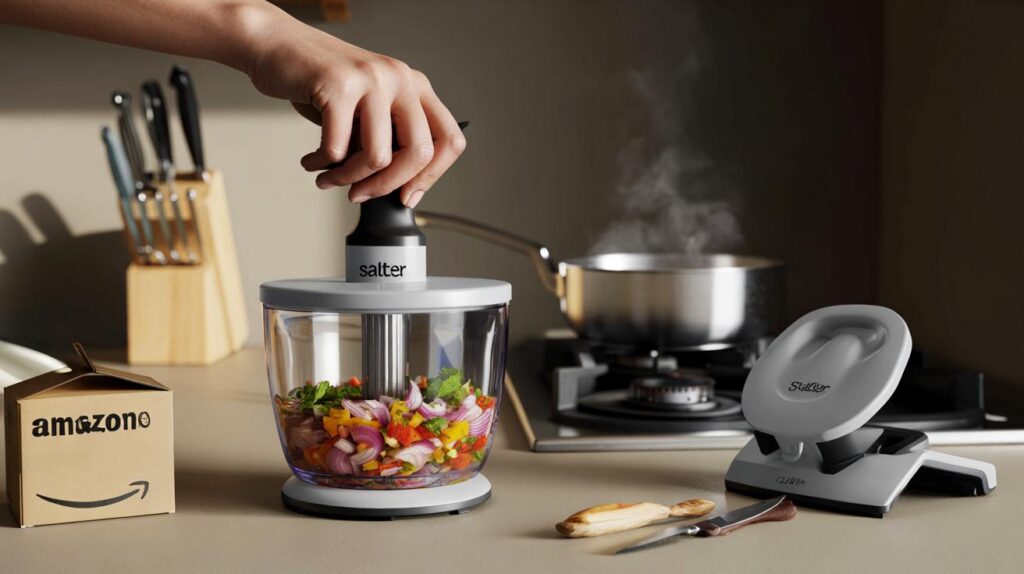
Weeknight dinners are a rush, counter space is tight and sharp knives are a worry. A small plastic bowl could help.
Busy households want quicker prep without the knife block on display. That’s why a mini manual chopper from Salter, now coming in under a tenner on Amazon, is drawing attention. Two models — a pull‑cord design and a push‑down version — aim to dice, chop and mince in seconds, then tuck safely into a cupboard with blades sealed away.
What shoppers are grabbing for under £10
Salter’s manual food choppers keep things straightforward. You get a compact BPA‑free bowl, a lid with the mechanism and a stack of razor‑sharp stainless‑steel blades fixed to a central spindle. A grippy base stops wandering on the worktop. The pull‑cord model uses a string you tug to spin the blades; the push‑down model compresses a spring‑loaded handle to do the same job.
Under £10 buys a BPA‑free bowl, a non‑slip base and a triple‑blade stack sharp enough for onion, garlic and more.
For parents wary of knives near little hands, the appeal is obvious. The blades live inside the bowl with the lid locked on. Pop it in a cupboard and you don’t have exposed steel on the counter, unlike a traditional knife block.
How the pull‑cord design speeds up prep
The pull‑cord unit is the one most people picture. You quarter an onion, drop in whole garlic cloves or chunks of pepper, secure the lid and pull. Each tug spins the blades fast, so you can pace the result.
- Two or three pulls: coarse chop for chunky sauces and stews.
- Five to eight pulls: small, even dice for bolognese, chillies and fritters.
- Ten or more pulls: near‑minced paste that melts into soups and curry bases.
Stop early for neat dice; keep pulling for a spoonable mince that vanishes into sauces kids won’t pick at.
There are limits by design. Uniform slices for salads are not on the cards. This is a chopper, not a mandoline. It excels when looks don’t matter — think soffritto, salsa, fajita prep and any dish where you want flavour to disperse evenly.
What it won’t handle well
Overfilling stops the blades from doing their job. Aim for roughly half the bowl to give the stack room to spin. Very hard ingredients like ice cubes or bones are not suitable and risk damage. For nuts, small quantities and short pulses help prevent turning the lot into butter.
The push‑down alternative in simple terms
The push‑down model swaps the string for a plunger. You press the handle repeatedly; inside, the mechanism spins the blades with each push. It feels natural if you prefer both hands on the worktop rather than a pulling action. It’s marginally taller with the handle, so it may need a bit more storage height.
In the bowl, results are comparable: chopped onion without tears, fine garlic without faff, peppers and carrots ready for soup. If you have limited grip strength, the push‑down design can be kinder on wrists because you use body weight rather than a firm tug.
Same sharp blades, two motions: pull for rapid bursts, or press for steady, rhythmic control.
Safety and storage for family kitchens
Knife blocks look smart but bring risk on open counters. With these choppers, the sharp edge only appears when you lift the blade stack out to clean. Store the unit fully assembled in a cupboard and curious fingers won’t reach steel. That can be reassuring in homes with children, pets or shared spaces.
Cleaning and care without the faff
Both models break down into lid, blade stack and bowl. A quick wash in warm soapy water and a rinse usually does it. Dry the blade column carefully — it is seriously sharp — and leave the lid to air dry before reassembly. Hand washing protects the mechanisms inside the lid, especially any cord or spring components, which don’t love soaking.
| Feature | Pull‑cord chopper | Push‑down chopper |
|---|---|---|
| Action | Short, fast pulls | Repeated downward presses |
| Control | Easy to “pulse” for rough chop | Steady rhythm for consistent mince |
| Storage | Lower profile, smaller footprint | Taller handle needs extra shelf height |
| Noise | Soft whirr and clicks | Soft thump and whirr |
| Price band | Commonly under £10 | Commonly under £10 |
| Cleanup | Disassembles fully, hand wash advised | Disassembles fully, hand wash advised |
Who gets the most benefit
Parents hiding veg in sauces. Students in halls without full knife sets. Campers and caravanners working on a tiny hob. Anyone who avoids fine knife work. If you cook from scratch a few nights a week, a compact chopper covers the boring bits — onions, garlic, carrots, herbs — and earns its space.
Those who love paper‑thin slices for salads or carpaccio‑style fruit will still reach for a specialist slicer or a chef’s knife. This tool is about speed, safety and consistent small pieces, not showpiece plating.
Tips that make a £9.99 chopper feel like a pro tool
- Cut large items into chunks first so the blades catch evenly.
- Pulse in short bursts; check texture often to avoid over‑processing.
- Keep the fill to around half the bowl for best results.
- Add soft herbs near the end to keep colour bright and flavour fresh.
- Drain watery veg like tomatoes to avoid a soupy mix when you want a chop.
- Use a tea towel under the base if your counter is extra slippery.
- Remove the blade stack before scooping to protect fingers and spatulas.
The value maths under the cost‑of‑living lens
A sub‑£10 tool that handles onions, garlic and peppers three nights a week racks up quick wins. At 150 uses a year, that’s roughly 7p per session after twelve months. Stretch it to two years and you’re under 4p a use. You also avoid the replacement cycle of blunt bargain knives and reduce the urge to order takeaway when prep feels like a chore.
What to check before you buy
Scan the product page for BPA‑free materials, a non‑slip base and a secure lid lock. Look for a removable blade column for proper cleaning. If storage is tight, note the height of the push‑down handle. If you have wrist issues, try to gauge whether tugging a cord or pressing down suits you better. As with all kitchen kit, keep the blade edge away from children, and never leave the blade loose in a drawer.
If presentation matters, reach for a chef’s knife. If speed and safety matter, reach for the chopper.
Smart add‑ons and realistic limits
Pair the chopper with a stick blender and you cover most daily prep: chopped aromatics, blitzed soups and smooth sauces. Use the chopper for nuts in small batches if you’re making a crunchy topping; for nut butter, a food processor fits better. Avoid frozen items and bones entirely — these blades are sharp, not indestructible. For hard root veg, cut into small chunks first and pulse.
Thinking beyond dinner, the bowl is handy for quick breadcrumb mixes, crushed biscuits for cheesecakes or a speedy pico de gallo. Keep the motions short when you want texture. Long, repeated pulls or presses take you towards a paste — great for marinades, not ideal for chunky salads.



Just grabbed the pull-cord version for £9.99 and it’s a game‑changer—five pulls and my onions are tiny dice, no tears 🙂 Does it handle small nut batches without turning into butter?