
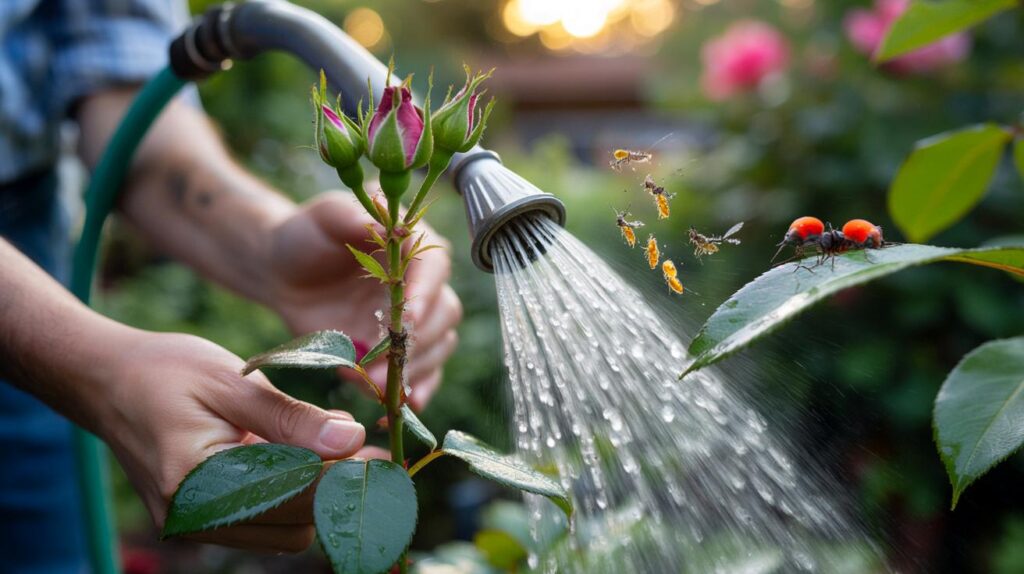
Aphids massed on brand-new buds is the gardening version of a leaky tap: small, constant, maddening. You watch the tight green spirals get sticky. Ants show up like tiny bouncers. And there you are, hovering with a £14.99 “miracle” spray, hoping it won’t scorch petals or wipe out ladybirds. We’ve all had that moment when hope costs more than it should.
I noticed them first by the glint. Early light on honeydew, a sugar sheen across the rose buds by the kitchen window. The ants were already commuting up the stems. I had a mug of tea, slippers damp on the stone, and a familiar itch to buy something clever in a nice bottle. My neighbour, Jax, leaned over the fence with a smile I’d seen before — the one that says you’re about to spend nothing at all. She picked up the hose, clicked the nozzle to a firm spray, and angled under the bud clusters. Little green commas lifted off like lint from a jumper. It took two minutes. She shrugged, as if to say: that’s it. I stood there with my tea cooling and my eyebrows somewhere near my hairline. Just water.
Why a hose beats a bottle on bud-munching aphids
Aphids are soft-bodied and cling by habit, not by hooks. Buds are tender and full of sap, so aphids crowd them like Saturday at the market. A directed burst of water dislodges entire colonies without bruising petals, if you get the angle right. No chemicals. No residue. Less drama for you and for the plant. The buds keep forming, and the ladybirds don’t take a hit.
Last spring on my allotment, two plots down ran an expensive experiment by accident. Elsie sprayed her roses with a premium “natural” oil blend. I used the hose on mine, every other morning for a week. We compared notes at the compost heap. Her blooms were fine, but a few petals showed faint spotting where the sun caught the oil. Mine opened clean, with fewer ants, and the aphids just… didn’t come back in force. She switched to water by June and told me she felt almost daft for not trying it earlier. That stuck.
It works for simple reasons. Water knocks aphids off and breaks the sticky honeydew film they farm on. Without that film, ants lose interest and stop defending the pests. Knocked-off aphids can’t fly; many struggle to climb back before predators find them. You also dodge the “collateral” effect of sprays that can bother pollinators or scorch tender growth. Buds are delicate. A clean rinse and a reset is often all they need to get ahead.
The water trick: step by step
Pick a cool window: early morning is ideal. Fit a nozzle with a firm, fan-shaped spray — not a needle jet. Hold it about 30–60 cm from the plant. Tilt the stream up under the buds and the leaf undersides, then sweep sideways so the aphids are lifted, not hammered. Support the stem with your other hand if it’s whippy. Work around the plant in slow circles. Repeat every two to three days for a week. *It feels almost too simple.*
Don’t blast. Think toothbrushing, not pressure washing. If your plant is young or top-heavy, dial the flow down and use a trigger bottle indoors. Angle is everything: coming from below strips aphids off their “feeding seats”. Let the plant drip-dry in shade. If honeydew has gummed a few leaves, wipe them gently with a damp cloth to stop sooty mould. Pair the rinse with a quick check for ant trails and snip any touching leaves that make a bridge. Let’s be honest: nobody does that every day. A couple of mindful minutes twice a week is enough.
“People underestimate water. Used with a bit of care, it’s both a tool and a truce — you protect the bud without picking a fight with the whole garden.”
- Quick kit: a hose with a fan nozzle; a hand sprayer for pots; soft ties to steady stems.
- Best timing: cool mornings or late afternoon; skip blazing midday.
- Extra help: shake off old flower heads, keep mulch tidy, and invite ladybirds with mixed planting.
Keep it real in the garden
There’s a quiet joy in choosing the fix that costs nothing and leaves the garden calmer. A water rinse doesn’t turn you into a purist. It just buys time — for buds to push on, for hoverflies to move in, for you to keep your wallet in your pocket. If you garden long enough, you notice most problems shrink when you respond early and lightly. This trick is that, in action. It won’t impress a shelf of glossy products, yet it will impress your roses, dahlias and chillies. Share it with a neighbour, swap a cutting, swap a story. The best ideas travel by fence-line. **Use water, win time.** And see what else gets easier when you stop overcomplicating simple things.
| Key points | Details | Interest for reader |
|---|---|---|
| Directed water works | Firm, angled spray lifts aphids off buds without harming petals | Free, fast, safer for pollinators |
| Routine beats rescue | Repeat every 2–3 days for a week to break the cycle | Fewer flare-ups, cleaner growth |
| Pair with small tweaks | Cut ant bridges, wipe honeydew, steady stems | Better results with almost no extra effort |
FAQ :
- Does this work on thick, sticky clusters?Yes. Start with a gentler fan spray from below, circle the plant, then do a second pass a touch firmer. If some cling, pinch the worst clusters off and bin them.
- Will I damage buds with water pressure?Not if you use a fan pattern and support the stem. Keep 30–60 cm away and sweep, don’t stab. Buds can handle a rinse; it’s the needle jet that bruises.
- How often should I repeat the rinse?Every two to three days across a week usually breaks the rush. After that, a weekly check-in keeps things steady during peak growth.
- What about houseplants or balcony pots?Take them to the sink or shower. Use a hand sprayer with a firm mist and rotate the plant as you spray. Let it drain and dry out of direct sun.
- Do I need soap in the water?No for the basic bud rinse. Plain water does the heavy lifting. A tiny drop of mild soap in a litre can help on tough cases, but test a leaf first and avoid flower faces.



Tried this on my dahlias this morning—fan setting, angled from below—and the little green commas literaly slid off. Definately cheaper than the “miracle” bottle I was eyeing. Thanks for the nudge to keep it simple!
Doesn’t blasting risk spreading viruses or damaging tender trichomes on buds? I’m a bit sceptical. Any studies or horticulture refs comparing hose rinses vs. horticultural oils?