
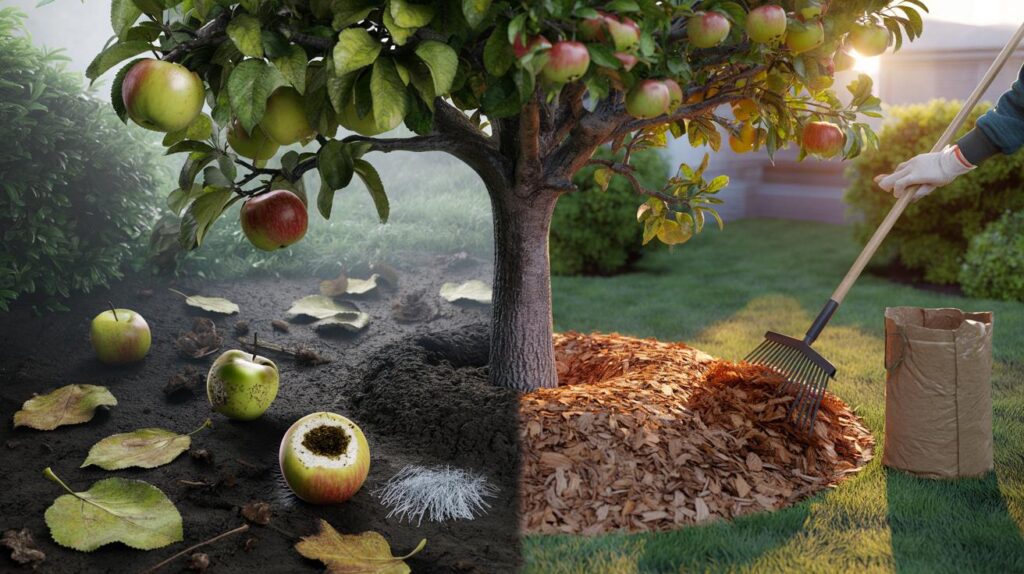
Autumn drapes gardens in gold, but that cosy leaf blanket hides a costly surprise for anyone who tends fruit trees.
Many home growers love the idea of letting nature do the tidying. It looks gentle, saves time and seems kind to soil life. Yet beneath that carpet, a quiet threat gathers strength through winter, ready to strike blossom, leaves and fruit the moment mild weather returns.
Why leaving leaf litter can hurt your orchard
Fallen leaves under apples, pears, plums and cherries do more than feed worms. They provide shelter and moisture for pathogens and pests that wait out the cold. When spring arrives, spores and larvae wake, ride the wind or climb the trunk, and attack tender growth that has no defence yet.
A winter refuge for fungi and larvae
Diseased leaves become safe houses for the culprits that ruin harvests. Apple scab (Venturia inaequalis) overwinters in fallen apple and pear leaves. Brown rot (Monilinia spp.) lurks in leaf litter and shrivelled fruit. Codling moth caterpillars pupate near the trunk and in debris, then emerge just as fruitlets form.
Leaf litter under fruit trees acts as a bridge from one season to the next, preserving disease pressure when vines and branches should get a clean break.
Under a damp, still layer, spores survive frost more easily. The more leaves you leave at the base, the more inoculum survives into spring.
The quiet disease cycle you don’t see
Fungi complete a loop while you wait for blossom. Scab spores mature in late winter inside old leaves. The first warm, wet spell sends them airborne towards swelling buds. Brown rot moves from mummified fruit and infected petals into young shoots. Codling moth time their life cycle to coincide with fruit set, ensuring a direct hit on your crop.
The common myths about leaf mulch under fruit trees
The free mulch idea that backfires
Leaf mulch looks like a bargain: free, organic and tidy. That logic works in ornamental borders and under hedges. Around fruit trees, it traps moisture and disease at the crown, keeping trouble where it can do the most harm.
Feeding the soil while seeding disease
Leaving leaves to “feed” the soil under fruit trees often introduces more pathogens than nutrients. You gain a little organic matter but you also keep last year’s infection on site. The trade-off rarely favours your harvest.
- Good idea: use finished compost or clean woodchip as mulch around fruit trees in late winter.
- Risky habit: spreading fresh, mixed autumn leaves under the canopy where scab and rot overwinter.
- Safer choice: compost healthy leaves hot, then apply away from trunks once fully broken down.
Recognise the early warning signs in March and April
What to look for on leaves, blossom and fruitlets
Early signs help you react before damage snowballs. Inspect weekly from bud-break.
- Leaves: olive to black spots with a velvety sheen (scab), distorted growth, premature yellowing.
- Blossom: browning and withering that clings to spurs (brown rot blossom blight).
- Fruitlets: tiny pinholes, frass (sawdust-like droppings) and internal tunnels (codling moth).
If you saw scab or brown rot last season, assume spores sit under the tree now. Action in autumn decides what returns in spring.
Act now: when and how to clear leaves safely
A simple autumn routine
Set aside one weekend between late October and the end of November. A tidy session of 10–15 minutes per mature tree can transform next year’s odds.
- Rake all leaves, twig debris and mummified fruit from the drip line to 50 cm beyond.
- Bag diseased material in strong sacks; send to council green waste or landfill if your compost stays cool.
- Brush or lightly hoe the soil surface to disturb hiding places for pupae.
- Finish with a 3–5 cm ring of clean mulch, keeping a hand’s width clear around the trunk.
- Record the date and any issues; repeat after windy spells that drop more leaves.
Clear the base of each fruit tree by the end of November and you can cut disease carry-over by up to 80%.
Smart recycling without spreading problems
You can still turn leaves into a resource. The method and the destination matter.
| Leaf status | Where to put it | Processing needed | Risk near fruit trees | Notes |
|---|---|---|---|---|
| Spotted, mildewed or from under fruit trees | Council green waste or hot compost bin | Hot composting above 55°C for 3+ weeks | High if returned cold | Do not mulch fruit trees with this material |
| Clean leaves from lawn or ornamentals | Leaf-mould cage or compost heap | Cold composting 9–12 months | Low if used away from trunks | Great for beds and paths, not against tree crowns |
| Mixed, uncertain origin | Separate if possible; otherwise green waste | N/A | Variable | When in doubt, remove from the orchard |
The pay-off next season: cleaner blossom, fewer sprays, steadier yields
Healthier trees with less effort
Removing leaf litter lowers the starting dose of spores and pests. That often means fewer spring interventions, cleaner blossom set and a steadier crop. You protect pollinators too, because you rely less on reactive treatments.
A clean orchard floor supports a clean canopy; better air flow and lower inoculum often make the difference between a light nibble and a lost crop.
Numbers that matter to home growers
- Time: 10–15 minutes per mature tree, 5–8 minutes for young trees.
- Frequency: 2–3 sweeps per autumn in breezy regions.
- Mulch gap: keep 10–15 cm clear around trunks to prevent collar rot.
- Compost target: above 55–60°C for at least 21 days to neutralise most pathogens.
Extra tasks that multiply the benefit
Deal with “mummies”, prune for air, trap at the right time
Pick off and bin any shrivelled, hanging fruit. These “mummies” carry brown rot into spring. Winter-prune apples and pears for an open centre to let air and light through, which dries leaves after rain and slows disease. In late spring, use pheromone lures to monitor codling moth flights, then time control methods precisely if traps spike.
Leaf-mould wisely, feed roots, and welcome allies
Leaf-mould shines in ornamental borders and around berries, not piled against fruit tree trunks. Feed roots instead with a light dressing of well-rotted compost spread in the drip zone. Encourage ground beetles and birds by avoiding debris piles in the orchard; they help clear larvae that survive your tidy-up.
If space allows, rotate poultry through the orchard for a few days in late winter. Hens scratch up pupae and add gentle manure. Keep them away during blossom and fruit swell to avoid pecking damage. Where hens are not practical, a shallow cultivation of the surface in February exposes overwintering pests to frost and predators.
For small gardens, think prevention by design. Plant scab-tolerant apple varieties, maintain grass at ankle height under trees for airflow, and water at the root zone rather than over foliage. These small habits reduce the pressure that leaf litter would otherwise amplify.



Great breakdown. I’ve always mulched under my apples with leaf mold, thinking it was free nutrition, but your scab and brown rot notes are a wake-up call. I’ll switch to finished compost and keep a mulch gap around the trunks. The 55–60°C compost target is super helpful.
Is there solid data behind the “up to 80%” claim? A citation would be great. I’m wary of over-cleaning because leaf litter also supports soil life and benefitts predators. How do we balance disease suppression with biodiversity? Maybe a threshold for removal when scab pressure was high last year?