
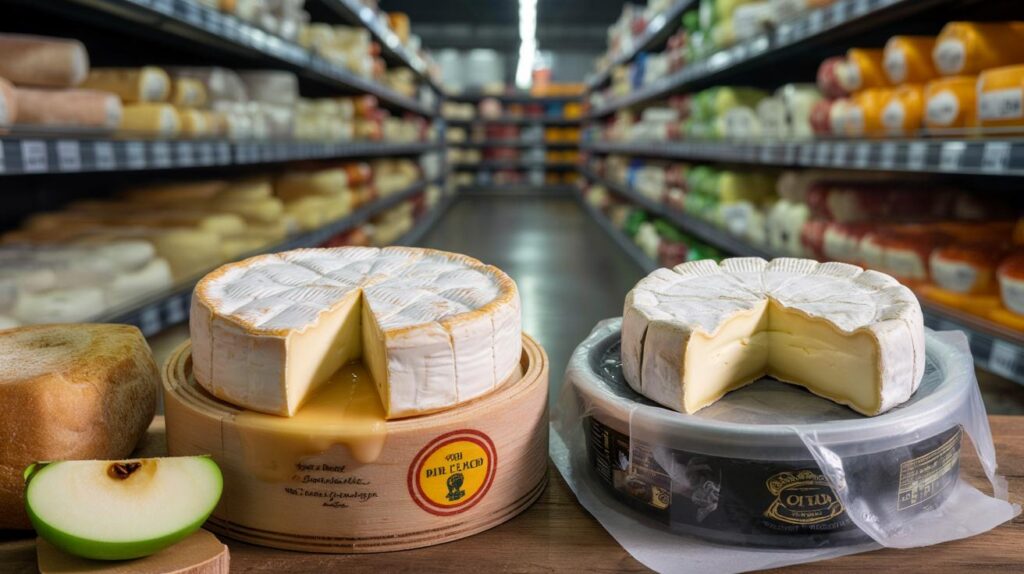
Shoppers love a creamy wheel, yet supermarket shelves hide traps that quietly empty wallets and dull the flavour you crave.
France sells hundreds of millions of camembert wheels every year, yet quality varies wildly by label, milk and ageing. A few seconds with the box can spare you a bland or rubbery let‑down and steer you to the real thing.
Why camembert confuses shoppers
Camembert enjoys cult status in France. Around 500 million wheels leave factories each year. People in France eat more than 26 kg of cheese per person annually. Cheese brings calcium that helps maintain strong bones and reduces fracture risk as we age. That popularity also feeds a crowded shelf of lookalike products that don’t taste alike.
Since 1926, the name “camembert” has not been protected on its own. Any producer can sell a product called camembert, wherever it’s made, with any milk treatment. That’s where shoppers get tripped up. One box hides a traditional, raw‑milk cheese with depth. The next holds a hastily matured wheel with muted aroma and a tough rind.
What 60 millions de consommateurs says
The French consumer magazine draws a simple line between authentic Normandy tradition and standardised copies. The label to find is “Camembert de Normandie AOP” (protected designation of origin). That badge locks in strict rules on milk, pasture, geography and craftsmanship. Anything else may still be enjoyable, but it won’t follow the same rulebook.
Look for “Camembert de Normandie AOP”. Expect about €3 to €4.50 for 250 g. A price below €2.50 is a red flag.
The label that protects you
“Camembert de Normandie AOP” guarantees that:
- The cheese uses raw milk that has not been heated above 40 °C.
- Herds include Normandy cows that graze at least six months a year.
- Milk collection, cheesemaking, maturation and packing all occur in Normandy (Calvados, Eure, Manche, Orne, Seine‑Maritime).
- Moulding happens by ladle, giving those characteristic striations on the rind.
- A poplar wood box protects the cheese for transport and storage.
- Ageing runs for at least 12 days in the cave and at least 21 days in total before packing. Some producers extend to around 30 days for deeper flavour.
The four supermarket red flags
- No protected origin on the label, or vague wording such as “made in Normandy”. If it is authentic, it will say “Camembert de Normandie AOP”.
- Suspiciously low price. Under €2.50 for 250 g usually signals short ageing and a flatter profile. Expect €3–€4.50 for AOP.
- An overly thick, dense rind. A good rind is white, fine, possibly speckled with small brown‑red dots, never bulky.
- Harsh, ammoniac smell when you lift the lid. That points to a cheese past its peak or poorly balanced in maturation.
No AOP, low price, thick rind or strong ammonia notes? Put the box back and move on.
Price: the small number that tells a big story
That €1 difference often mirrors real work at the dairy. Raw milk demands careful handling. Hand‑ladling slows production. Extra days in the cave take time, space and skill. Those steps create the supple core and layered aroma that shoppers seek. Bargain wheels tend to rely on pasteurised milk and accelerated ageing that freezes flavour at a basic level.
| Feature | Normandy origin (AOP) | Standard camembert |
|---|---|---|
| Milk | Raw, not above 40 °C | Often pasteurised |
| Breed & pasture | Normandy cows, 6+ months grazing | No specific requirement |
| Geography | Made, matured, packed in Normandy | Anywhere |
| Moulding | Ladle moulded, visible striations | Mechanical moulding |
| Ageing | 12 days in cave, 21+ days total | Often shorter |
| Typical price (250 g) | €3–€4.50 | €1.80–€2.50 |
How to check your cheese in 10 seconds
Glance at the front: is “Camembert de Normandie AOP” clearly stated? If not, consider a different wheel. Flip to the back: scan the milk type and the production area. Your nose then has the final say. Lift the lid and sniff. You want a clean dairy scent with soft mushroom notes, not a blast of ammonia. Press the sides lightly. A good camembert feels yielding at the centre, neither rigid nor fully runny, and without hard edges under the rind.
A thin white rind, a gentle farmyard scent and a supple core signal a cheese at its peak.
Serving, storage and timing
Keep the cheese in its wooden box, wrapped in the original paper, in the fridge’s vegetable drawer. Avoid cling film that traps moisture and suffocates the rind. Take the wheel out 45–60 minutes before serving so the centre relaxes and aromas bloom. If your camembert seems young, give it two or three extra days in the fridge; turn the box daily to encourage even ripening.
If the rind turns thick and smells sharp, use it quickly in hot dishes where heat softens edges: baked camembert, a tart with apples, or melted over potatoes. Heat will tame aggressive notes and rescue a purchase that isn’t ideal for a cheese board.
Health, safety and portion sense
Cheese offers calcium and protein, but it also brings fat and salt. Many dietitians suggest portions of around 40–50 g per day if you eat cheese regularly. Balance it with fibre‑rich foods and vegetables. Raw‑milk cheeses carry higher microbial risk. Pregnant people, very young children, older adults and those with weakened immunity often choose pasteurised versions as a precaution. If you’re unsure, check the milk treatment line on the label.
Why wording on the box matters
Three phrases appear in the aisle and they don’t mean the same thing. “Camembert de Normandie AOP” indicates the protected origin and the strict rulebook. “Fabriqué en Normandie” or “made in Normandy” only refers to part of the process happening in that region and doesn’t guarantee the traditional method. A plain “camembert” can be made anywhere, with any milk treatment. When price seems too good to be true, that wording often tells you why.
A quick cost check you can run
Compare price per 100 g. A €2.20 wheel costs €0.88 per 100 g. A €3.80 AOP costs €1.52 per 100 g. If you serve four people, the difference per person sits at well under €1 for a cheese that usually brings better texture, aroma and a more satisfying finish. That small uplift can transform a simple supper plate.
Pairings and practical extras
To showcase delicate mushroom notes, pair camembert with a crisp apple, a slice of country bread and a light cider. Avoid aggressive chutneys that can drown its subtleties. If you bake a wheel, score the top, tuck in a sliver of garlic and a sprig of thyme, and bake until just oozing. Overbaking squeezes out fat and turns the centre grainy.
Finally, get into the habit of a quick three‑point check in the aisle: protected origin, fair price band, and a calm, clean smell at the counter. In less than a minute you protect your budget, your palate and your cheese board from disappointment.



If it smells like a chemistry set (ammonia), I put it back. Learned the hard way with a €1.99 “camenbert” that bounced like a rubber ball. Guess I was penny‑wise, cheese foolish. Never again 🙂