
As winter cooking ramps up, the washing-up pile grows and budgets feel tighter. Small changes can stretch every bottle.
Kitchens across the country pour away tired-looking detergent the moment it stops foaming. That habit drains money and fills bins. A pantry-powered tweak can revive a flagging bottle, cut plastic, and keep pans shining even after heavy stews and Sunday roasts.
Why washing-up liquid fails faster than you think
Most households overdose on detergent. A saturated sponge can’t hold more suds, so extra squirts do little. Hard water blunts surfactants and leaves a dull film. Cold water slows grease cutting. Bottles that sit for weeks separate gently; unshaken, they feel weak. All of that feeds the urge to bin a half-used bottle and grab a new one.
The waste is not trivial. A typical 500 ml bottle weighs 25–30 g when empty. Throw two away early each season and you add roughly 100 g of avoidable plastic, plus the cost of another shop run. Multiply that across a street, a town, a month of hearty cooking, and the footprint grows fast.
Most sinks need a pea-sized blob and warmer water, not a double squeeze. Technique often beats volume.
There’s also a performance trap. Thick sauces and oven bakes leave proteins, sugars and fats welded to metal. Without pre-soak or heat, users turn to more liquid rather than smarter steps. A simple, natural upgrade changes that equation.
The 200 ml upgrade: a safe, natural way to boost cleaning
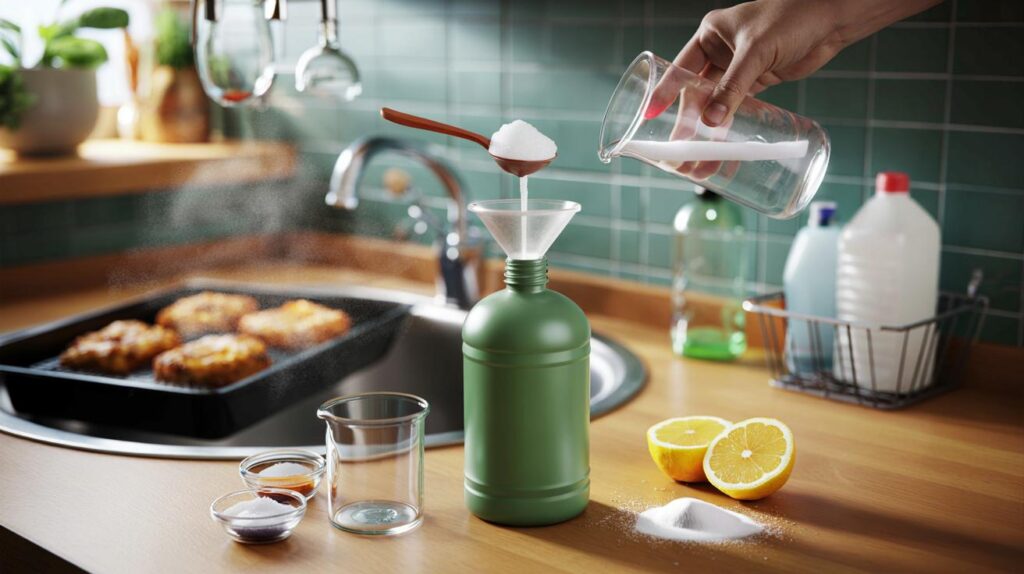
This method refreshes the cleaning power of a fading bottle using cupboard staples. It takes two minutes, avoids harsh additives, and improves degreasing on baked-on mess.
What you need from the cupboard
- 200 ml of washing-up liquid (use the end of any bottle)
- 2 tablespoons white vinegar
- 1 tablespoon bicarbonate of soda (food grade)
- 1 teaspoon fine salt
- Juice of half a lemon; for heavy grease, swap in 1 tablespoon washing soda crystals
Method, in the right order
- Pour the 200 ml of washing-up liquid into a clean bottle with spare headroom.
- Add the white vinegar and swirl gently.
- Tip in the bicarbonate slowly. Expect fizzing as carbon dioxide forms; pause if foam rises.
- Stir in the salt until dissolved.
- Finish with fresh lemon juice, or use washing soda crystals for stubborn, burnt residues.
Cap and roll the bottle rather than shaking hard. Use a smaller squeeze than usual and warm, not scalding, water. Rinse well.
Do not mix with bleach, and never decant into a drink bottle. Open the cap slowly after fizzing to release pressure.
How the chemistry helps
Vinegar loosens mineral films that make glassware look cloudy and help grease cling. Bicarbonate adds mild abrasion to lift residue and buffers acidity. The fizzing releases gas that helps dislodge grime from corners. Salt increases ionic strength so surfactants cut through fat more readily. Lemon contributes citric acid and natural oils for shine and fresh smell. Washing soda, if used, raises alkalinity for baked-on fat, so a short pre-soak works faster.
Yes, vinegar and bicarbonate react, but the end mix still carries helpful by-products plus the original detergent’s surfactants. The point is not to create a new chemical cleaner, but to tweak the conditions so each squeeze cleans more efficiently.
What you save this winter
The gain shows up in the basket and the bin. With better technique and the boosted mix, many homes cut detergent use by 25–40% on big, greasy loads. That means fewer rushed purchases and less plastic.
| Item | Quantity | Approximate cost used |
|---|---|---|
| White vinegar | 2 tbsp (30 ml) | £0.03 |
| Bicarbonate of soda | 1 tbsp (15 g) | £0.04 |
| Fine salt | 1 tsp (5 g) | £0.01 |
| Lemon juice | ½ lemon | £0.07 |
| OR washing soda crystals | 1 tbsp (15 g) | £0.03 |
Pantry inputs total pennies per batch. The bigger saving comes from using less detergent per sink. A common pattern is one 500 ml bottle every two weeks at £1.50. Cutting use by one third saves about four bottles between November and February, roughly £6 and 100–120 g of plastic. Add lower hot water use when pre-soaking with hotter, smaller volumes rather than constant hot rinsing, and energy bills drop further. Across a year, the combined effect can reach around £24 for a family that cooks most days.
Small, repeatable changes—smaller squeeze, warmer soak, smarter mix—deliver visible results and measurable savings.
Pro tips and pitfalls
- Agitate the bottle gently before each use; separation is normal with simple ingredients.
- Pre-soak burnt pans with very hot water and a teaspoon of the mix for 10 minutes; scrape with a wooden spatula, not steel wool.
- Use a measured pump or a squeezy cap with a tiny aperture to prevent heavy-handed dosing.
- Rinse glasses with warm water first to remove milk proteins that kill foam; then wash.
- In hard water areas, add a pinch more citric acid or lemon to reduce filming on glassware.
- Avoid natural stone, unsealed marble, or aluminium: acids and alkalis can etch or darken surfaces.
- Keep away from children and pets. Label homemade bottles clearly with contents and date.
What not to mix and where not to use it
Never mix this boosted liquid with bleach or chlorine-based powders. The combination can release hazardous gases and damage stainless finishes. Skip abrasive pads on non-stick coatings. For cast iron, use hot water and a brush only, then dry and oil to protect the seasoning.
For dishwashers, this is not a substitute for machine detergent. It foams too much for a closed system, and suds can leak. Reserve it for the sink, trays, oven shelves, and utensils.
A smarter routine that pays off
Set up a simple flow: scrape, pre-soak, wash with a small squeeze, and rinse hot. Keep a jug for boiling-water soaks and a separate sponge for glasses to avoid greasy transfer. When a bottle feels weak, don’t bin it. Drop in the cupboard ingredients, refresh, and carry on.
For readers who like numbers, trial your own savings. Note the date a new 500 ml bottle starts, log each top-up of the boosted mix, and record when you buy again. Track water temperature and pre-soak time as well. After four weeks, compare spend and plastic with your usual routine. Many households find both costs and effort fall, while cookware comes up cleaner with less scrubbing.
Related ideas to extend the benefit
The same principles work beyond plates. The boosted mix shifts hob splatters, de-greases extractor filters after a soak, and refreshes fridge shelves without overpowering fragrances. Always test a small spot first and avoid porous surfaces. For an odour-neutral bin clean, wash with the mix, rinse, and finish with a teaspoon of bicarbonate sprinkled under the liner.
If you batch-cook, plan a weekly “deep sink” session: collect the worst trays, kettle-boil water, apply a measured squeeze of the boosted liquid, and leave for ten minutes. The time you save on scrubbing offsets the minute spent making the mix—and keeps that next bottle lasting longer.



Isn’t vinegar + bicarbonate mostly neutralising each other? If the fizz is done, what active benefit remains beyond the detergent itself—mild abrasion and salts, I guess? Any side-by-side tests vs just warmer water and a smaller squeeze? Would love numbers, not just impressions.
Tried this tonite on a baked-on lasagne pan—10 min pre-soak, tiny squeeze, then a wooden spatula—and it came clean with far less scrubbing. Bottle feels “stronger” again. Big thanks, and the bleach warning is defintely helpful for distracted, post-dinner me.