
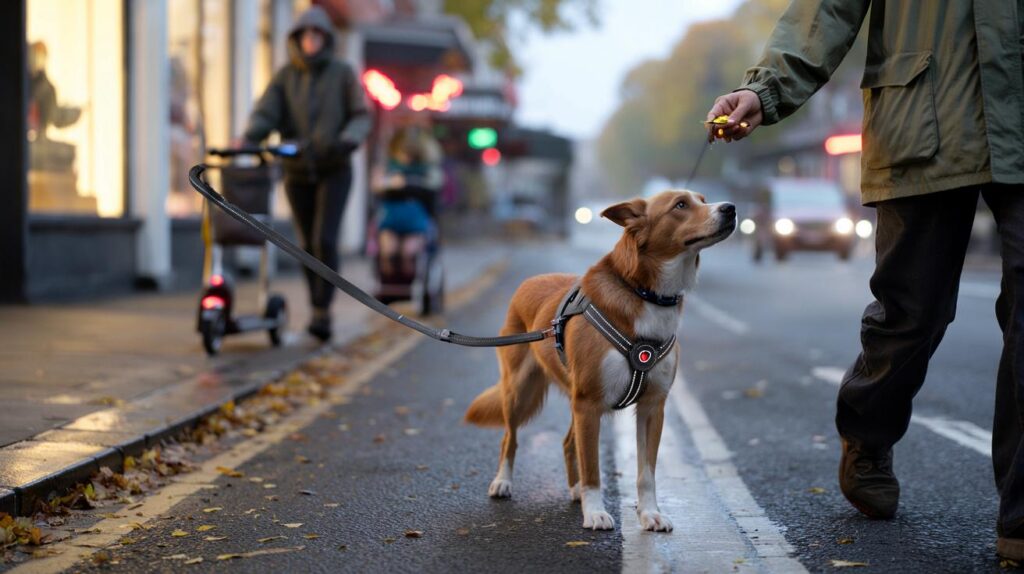
Golden leaves aside, your daily loop with the dog hides risks you can shrink with three tiny tweaks today alone.
Autumn brings crisp air, darker evenings and busier pavements. Add e-scooters, prams and reactive dogs, and tension rises quickly. Three everyday habits quietly ramp up danger and stress. Tidy them up, and your next outing feels steadier, safer and far calmer for both of you.
Long leads create sudden trouble
That carefree image of a dog on an extra-long lead looks charming until it isn’t. In towns, a retractable or overlong lead lets your dog reach kerbs, bins, joggers and other dogs before you can respond. One lunge, and you face tangled ankles, a snapped mechanism or a near miss with a car.
A shorter, fixed-length lead gives you choices. In busy areas, keep it to 1.5–2 metres. In open parks with good sightlines, extend to 3–5 metres using a long line, never a thin retractable tape. The aim is space you can manage, not a zip-wire you cannot stop.
Control isn’t about yanking. It is about setting a distance that prevents problems before they start.
Where a long line works—and where it doesn’t
| Setting | Recommended lead length | Why | Watch-outs |
|---|---|---|---|
| Busy pavement, high street | 1.5–2 m fixed lead | Quick response around people, prams, bikes | Keep the dog on your building side, away from kerb |
| Open park, clear sightlines | 3–5 m long line | Sniffing freedom, safer recall practice | Use a back-clip harness; avoid finger loops that burn |
| Woodland trails | 2–3 m | Less snagging on roots and branches | Scan ahead for off-lead dogs and horses |
| Near roads or livestock | Short, under 1.5 m | Precise control during sudden events | Keep treats ready for fast attention turns |
- Swap retractable leads for a sturdy, non-slip 2 m lead in town.
- Clip a long line to a back-clip harness, not a collar, to protect the neck.
- Practise gathering the lead smoothly so you can shorten it in two seconds.
Ill-fitting gear turns calm into chaos
Equipment failure is rarely dramatic; it is a slow drip of discomfort. A collar that tightens when the dog pulls compresses the throat and can irritate the trachea. A gaping harness rubs under the front legs, while a loose chest strap lets a frightened dog reverse out and bolt.
Choose and fit a harness that actually helps
A well-fitted Y-shaped harness spreads pressure across the chest and allows free shoulder movement. The quick test: you should slide two fingers flat under each strap. If it spins around the body, it’s too loose. If skin bunches or the dog flinches, it’s too tight.
If two fingers can’t glide under each strap, it’s too tight. If the harness twists, it’s too loose.
Adjust fit seasonally. Autumn coats thicken, and many dogs gain or lose weight as routines change. A monthly check keeps rubbing sores and surprise slip-outs at bay.
Fitting checklist you can do in five minutes
- Measure around the deepest part of the chest; use the brand’s size chart, not guesswork.
- Check that the shoulder point remains free; no strap should cross the point of the shoulder.
- Ensure the chest strap sits at the breastbone, not the soft throat area.
- Prefer two points of attachment: a front clip for steering and a back clip for power.
- Keep a flat collar for ID only; avoid relying on it for control during city walks.
Missing stress signals fuels risky reactions
Most leash drama starts with unease your dog already showed you. The signs are quiet: a quick lip lick, a sudden yawn, ears pinned back, a head turn away, a shake-off as if drying after a bath. Ignore those signals, and tension climbs towards barking, lunging or a frantic attempt to flee.
Spot the early whispers
- Lip licking without food nearby.
- Slow or frozen sniffing when another dog appears.
- Whale eye: the whites of the eyes show as the dog looks sideways.
- Bouncy, jerky movements that replace a relaxed trot.
- Tail held stiff, not wagging loosely at mid-height.
Intervene in 10 seconds
As soon as you notice a stress cue, create space. Step off the path, shorten to a comfortable arc, and feed three small treats for looking back at you. Use a calm cue like “this way”, arc around the trigger, and then let your dog sniff a verge as decompression. Those ten seconds change the whole walk.
Distance is your friend. Move first, then ask for attention. Asking for attention while the dog is overwhelmed rarely works.
Seasonal and UK street factors you might overlook
As daylight fades earlier, visibility drops. Reflective trim on the harness and a small LED on the lead help others spot your dog. Pavements get slick with leaves and rain; slow your pace to prevent slips, especially on corners.
Be mindful of rules. Local Public Spaces Protection Orders often require dogs on lead in certain parks, school zones and cemeteries. The Highway Code advises keeping your dog on a short lead on pavements and on roads, and never allowing a dog out on the road alone. Around livestock, a short, secure lead is non-negotiable.
Quick wins for your next 20-minute loop
- Pick a fixed route the first week back after summer; predictability lowers arousal.
- Carry 30 pea-sized treats; reward check-ins, not just sits.
- Use a “sniff break” cue, then a “let’s go” cue to alternate freedom and focus.
- Practise two clean lead gathers before leaving the house.
- Do one two-minute “look at that” game near, but not next to, passing dogs.
- End with a calm chew at home to lower post-walk adrenaline.
What this looks like in practice
Imagine the after-work rush. You clip a 2 m lead to a Y-harness and keep your dog on the building side. A jogger appears; you step to the verge, shorten the lead without tension, and feed three treats for a glance back. In the park, you swap to a 5 m long line, walk along a hedgerow for scenting, and practise one recall with a jackpot reward. You spot a bouncy off-lead dog at 30 metres; you arc away, talk softly, and give your dog a minute to sniff a tree line. You head home with a dog that is mentally satisfied, not wound up.
Extra pointers to widen your toolkit
Select treats by value. Kibble works in the garden. On pavements and near traffic, use soft, smelly options your dog rates highly. Rotate flavours to keep interest. For sensitive stomachs, try cooked chicken breast, low-fat cheese in tiny cubes, or commercial training treats designed to be small and soft.
If your dog already rehearses lunging, map a “distance ladder”: note how far away a trigger must be for your dog to stay under threshold. Start training beyond that distance and move in by a metre or two over days, not on a single walk. Keep sessions short—five minutes is plenty—and finish while your dog is still coping well.
Rainy evenings add noise and glare. Plan routes that avoid tight blind corners, and choose quieter side streets. On weekends, swap one long march for two shorter scent-led walks. Ten minutes of deliberate sniffing often tires a dog more than a fast, overstimulating hour.



Loved this! The long-lead vs. long-line distinction finally clicked for me. Quick Q: any brand recs for sturdy non-slip 2 m leads that won’t shred my hands in rain? Also, how do you gather a line smoothly without rope-burn?