
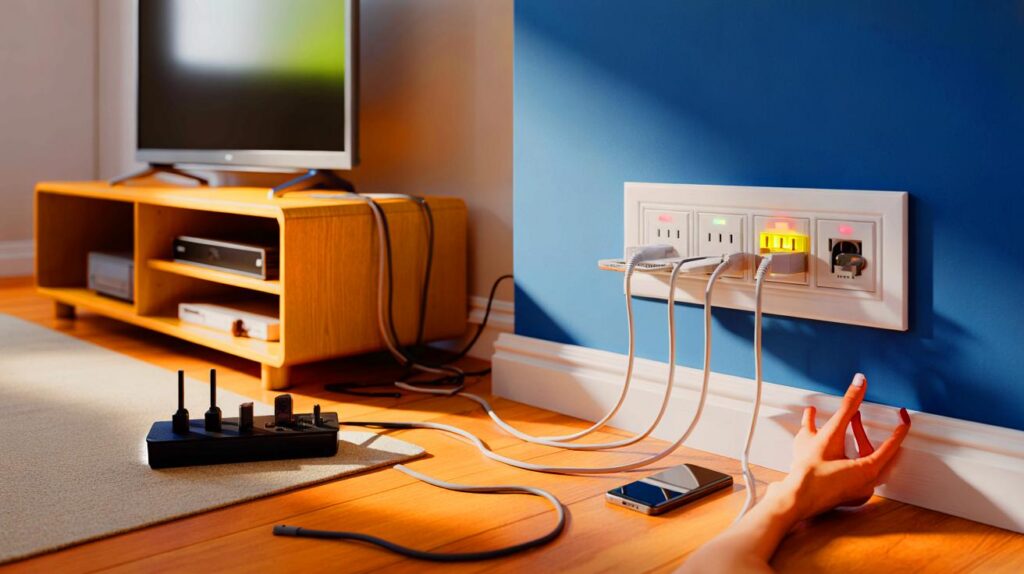
Cables underfoot, hot power strips behind the telly, and sockets never where you need them: home life quietly wastes money.
A new surface-mounted socket system promises tidy walls, safer charging, and fast installation without chasing plaster or moving furniture.
Why surface-mounted sockets are replacing power strips
Surface-mounted sockets fix directly to the wall in a neat box, with slim trunking carrying the cable on the surface. You hide the run along skirting, up a corner, or across a beam. You avoid dust, masonry damage, and days of disruption. Renters keep their deposit. Period homes keep their plaster intact.
Think of them as a deliberate, designed alternative to the dangling multiway adaptor. The outlet sits at a sensible height, wires disappear into a tidy channel, and switches remain within reach. Finishes range from matte white to brushed metal and wood-effect fronts, so they blend into most rooms.
No chasing, no rubble, and no guesswork: stick the trunking, fix the box, click in the sockets, and power up.
- Fewer trailing leads and less trip risk behind the TV or under the desk.
- Switches and neon indicators show what is live at a glance.
- Built‑in shutters on BS 1363 outlets prevent prying fingers.
- Optional surge protection shields your router, console, and TV.
How the installation works without chasing
Planning the route
Start at the nearest safe supply point. Map a straight line for trunking along skirting or ceiling. Keep at least 150 mm from corners where possible. Avoid radiators, cookers, or damp patches. Measure twice, cut once.
Fixing and wiring
Most DIY kits include self-adhesive trunking plus screws for heavy-duty surfaces. Degrease the wall. Press the trunking in place. Screw the pattress box to the wall or beam. Feed 2.5 mm² twin and earth for a ring or radial circuit, or 1.5 mm² where permitted on low-current spurs. Terminate conductors firmly and test.
Follow BS 7671 (18th Edition) and Part P rules. Use RCD protection. Maintain earth continuity. If you are unsure about spurs, ring finals, or load limits, book a qualified electrician.
| Option | Typical time | Upfront cost | Risk profile | Everyday convenience |
|---|---|---|---|---|
| Floor power strip (6‑way) | 5–10 minutes | £10–£25 | Overheating, trip hazard, daisy‑chain temptation | Low: hidden behind furniture, hard to switch |
| Surface‑mounted box + trunking | 45–90 minutes | £35–£90 | Low when wired to regs, switch per outlet | High: waist‑height access, cleaner cabling |
Safety and compliance: numbers you should know
On a UK ring final circuit (2.5 mm², 32 A), you can add outlets within limits if the ring remains intact, the loop impedance tests pass, and RCD protection exists. On a radial circuit, 2.5 mm² usually supports 20 A, and 4.0 mm² up to 32 A, subject to cable runs and installation method. Use a proper junction or fused connection unit where a spur is the only safe option.
Each BS 1363 outlet supplies up to 13 A. A 2 kW heater draws about 8.7 A at 230 V. A gaming PC and monitor may sit around 500–700 W. Keep margin for start‑up surges and avoid stacking cube adapters or daisy‑chaining strips.
One 13 A socket, one 13 A plug. Keep high‑load devices on separate outlets and check for the BSI Kitemark on accessories.
Childproof shutters are standard on UK sockets, yet placement matters. Avoid low, exposed locations in play areas. In garages or damp zones, choose weather‑resistant enclosures with gaskets and protected switches, rated to at least IP44 for splashes and higher for washdown zones.
Features that change how you use your space
USB‑C power without the brick
Many wall modules now include USB‑C PD ports rated 20 W, 30 W, or 45 W. Phones and tablets charge faster, and you lose the bulky charger. A twin USB‑C face can free two full 13 A outlets for appliances.
Smart and repositionable control
Battery‑free wireless switches pair with smart relays or connected sockets. You stick the switch anywhere, move it when the layout changes, and control lamps or desk lights without carving the wall. For renters, that flexibility feels liberating.
Rugged options for tough spots
Workshops and sheds benefit from robust, impact‑resistant boxes with sealed cable entries. Look for knock‑resistant housings and clear labelling. Add a surge protective device if your run feeds sensitive kit such as NAS drives or routers.
- Two‑gang surface box with USB‑C PD 30 W: about £28–£45.
- Four‑gang surface box with individual switches: about £20–£35.
- 20×40 mm adhesive trunking, 2 m length: about £6–£10.
- Weather‑resistant enclosure with switch, IP55: about £15–£30.
What you could save and tidy away
Replace two 6‑way strips under the TV with a four‑gang surface box mounted behind the unit, plus a short trunking run. Expect to cut 5–6 trailing leads and reclaim two metres of floor edge. You reduce heat build‑up behind furniture and gain switches you will actually use.
Switched outlets curb standby waste. If you cut 10 W of idle load for 16 hours a day, that is about 58 kWh a year. At 28p per kWh, you save roughly £16. Add in a TV bundle and a console on timers and you approach £40–£120 saved annually, depending on habits.
Most homes can install a basic kit in under an hour and remove at least six loose cables in one room.
When to call a professional
Ring continuity testing needs proper instruments. If your home lacks RCD protection, shows signs of damaged insulation, or has no earth at the point of connection, stop and call an electrician. Bathrooms, kitchens, and outdoor areas carry extra rules. In England and Wales, certain works fall under Part P and may require notification or certification.
Helpful extras before you start
Quick load check you can do on paper
Add the wattage of the devices you plan to use on the new outlet group. Divide by 230 to estimate amps. Keep well below 13 A per outlet and design for diversity. Example: TV (120 W), soundbar (60 W), console (180 W), router (15 W) equals 375 W, or about 1.6 A. That sits comfortably on one switched socket, leaving margin for peaks.
Glossary for clarity
- Ring final: a looped 2.5 mm² circuit on a 32 A breaker that returns to the consumer unit.
- Radial: a one‑way circuit that ends at the last outlet, often on a 20 A or 32 A breaker.
- Spur: a branch from a ring or radial. On a ring, use a fused spur if in doubt.
- RCD: a safety device that trips on earth leakage, protecting people from shock.
If you want a cleaner desk tomorrow, start small. Fit one surface‑mounted box where clutter hurts most, run a short, straight trunking, and test. Note what worked, then repeat the method in the bedroom or the workshop. Small changes deliver quick wins without opening a single wall.



Loved the straight, no-chasing approach. I ran 20×40 trunking along the skirting, mounted a two-gang with USB‑C, and actually cut five trailing leads behind the telly. The waist‑height switches are a game‑changer. Cheers for flagging BS 7671 and RCDs—kept me honest.
Quick Q: in England/Wales, would adding a spur from a ring in a rented flat need Part P notification or just landlord consent + a minor works cert? I don’t want to void my deposit or be non‑compliant. Bit confuzed here.