
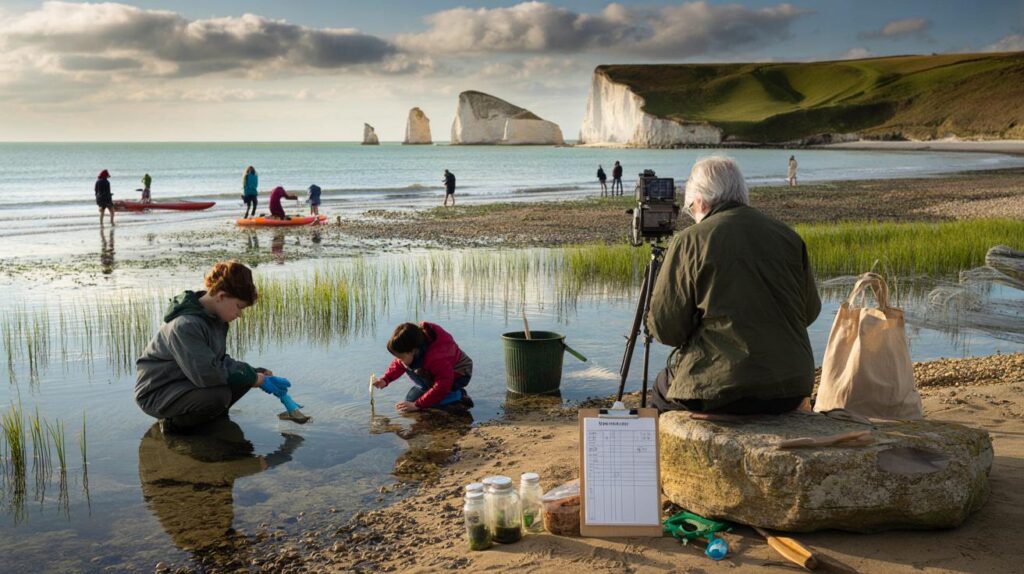
A beloved broadcaster returns to a windswept Dorset shoreline, sparking plans, questions and new faces on the Swanage calendar.
Sir David Attenborough’s final on-location scene, filmed at Studland and Old Harry Rocks, now anchors a burst of community action in Purbeck. A film night, a church gathering and a seafront festival line up to turn emotion into clear steps for the sea.
A farewell on Shell Bay that starts a local push
The Discovery Channel documentary Ocean opens and closes on Shell Bay and Old Harry Rocks, shot in 2024. Attenborough, 99 when the film reached a worldwide audience in May 2025, frames the coast as both memory and warning. The sequence is the last location shoot of his career, and it carries a simple message: the ocean decides the fate of everything on land.
Save the sea, save our world. That is the thread pulled from Studland’s shore into Swanage’s plans.
The Mowlem screens Ocean at 7.30 pm on Friday 12 September 2025. A week later, Planet Purbeck teams up with Greenpeace for a public evening at Emmanuel Baptist Church on Friday 19 September, titled Protecting Our Oceans. Organisers want people to leave with a plan, not just a feeling.
What the film shows — and why locals want action
Viewers should expect wonder and discomfort side by side. The film celebrates discoveries from a century of ocean science. It also shows warming seas, acidification and industrial-scale fishing damage that most of us never witness. Local campaigners say the screening gives a shared reference point before Swanage meets to talk solutions.
Three dates to circle: 12 September for the film, 19 September for action night, 20 September for a hands-on festival.
Inside the 19 September programme
Planet Purbeck’s chair, Doug Skinner, will be joined by Greenpeace speakers bringing new fieldwork and policy updates. Expect science, local stories and practical sign-ups rather than a lecture format.
- Antarctic science briefing from Greenpeace, focusing on warming, ice dynamics and marine life impacts.
- An update on the UN Ocean Treaty drive to lock in 30 percent of seas as protected areas, with 61 countries needed to cement progress.
- Footage from Dr Owen Exeter (University of Exeter) showing near-pristine seabeds around the Isles of Scilly.
- Planet Purbeck’s projects for young people, from seed growing to supervised rockpooling along Purbeck’s coves.
Target to watch: 30 percent protection on the high seas, unlocked when 61 nations ratify and resource enforcement.
The groups want to channel local frustration into tasks that feel achievable. That includes coastal surveys, school sessions, and contacting MPs with specific asks on bycatch, trawling and enforcement funding.
Key dates, places and times
| Date | Event | Time | Venue | Cost |
|---|---|---|---|---|
| Fri 12 Sept 2025 | Ocean screening (Attenborough) | 7.30 pm | The Mowlem, Swanage | Ticketed |
| Fri 19 Sept 2025 | Protecting Our Oceans (Planet Purbeck x Greenpeace) | Evening | Emmanuel Baptist Church | Free |
| Sat 20 Sept 2025 | Discovery Fest | 10 am–3 pm | Shore Road, Swanage | Free |
| Sat 11 Oct 2025 | Planet Purbeck fundraiser with Sir Mark Rylance and George Monbiot | Evening | TBC (local venue) | Ticketed |
A family day that takes over the seafront
On Saturday 20 September, Discovery Fest turns Shore Road into a coastal fair with a purpose. Live music runs across the day. Guided walks trace the Jurassic Coast and locate dinosaur footprints at low tide. Hands-on science tents make plankton, tides and microplastics visible for children.
More than 30 stalls line the promenade. Dorset Wildlife Trust and Amphibian and Reptile Conservation bring habitats to life. Sustainable Swanage, Sustainable Wareham and the Swanage and Purbeck Repair Cafe show how to repair, reuse and reduce waste without spending a fortune. Other groups offer low-cost outdoor adventures, wellbeing sessions and local heritage trails.
Studland’s seagrass meadows and reef life need fewer anchors and less seabed scarring — small changes add up quickly.
Rylance, Monbiot and a portrait with a story
Oscar-winner Sir Mark Rylance will join columnist George Monbiot on Saturday 11 October for a fundraising evening. The event aims to prove that a coastal community can punch above its weight on national policy. Rylance plans to auction a signed photographic portrait of himself as Thomas Cromwell from the BBC drama Wolf Hall, with proceeds supporting Planet Purbeck’s next phase.
Why 61 nations, and why now
The UN Ocean Treaty sets up a legal route to create and manage high-seas marine protected areas. The ambition is clear: safeguard 30 percent of the ocean. The catch is speed. It needs a critical mass of national ratifications and the money to monitor, patrol and prosecute. That is where groups like Greenpeace push capitals, and where local voices still count.
At home, most UK waters sit inside some form of designation, but many still allow damaging gear. Campaigners want a timetable to phase out bottom-towed fishing in sensitive zones, investment in selective gear, and bycatch rules that actually shift behaviour. They also want wastewater standards that keep bacteria off popular beaches after heavy rain.
Five things you can do this month
- Write to your MP asking for bottom-towed gear bans in designated sensitive habitats and full funding for at-sea enforcement.
- Join a beach survey. Data on nurdles, litter and stranded wildlife drives local enforcement and national standards.
- Choose lower-impact seafood. Ask sellers about gear type and stock status; reward boats that reduce bycatch.
- Cut fertiliser and pesticide run-off in gardens and allotments; urban drains run to the sea.
- Support a school trip to the shore. Early contact with nature boosts care and careers across marine science.
The local picture: where land meets sea
Studland’s sheltered waters hold seagrass beds that store carbon, shelter juvenile fish and stabilise sand. Anchor damage, poor water quality and heat stress threaten those meadows. Old Harry Rocks sits at the mouth of the Channel’s busy shipping lanes. Noise, fuel spills and invasive species risk compounding climate pressure on local wildlife.
People here already feel changes. Hotter summers push sea temperatures up and shift species ranges. Storms gnaw at soft cliffs and flood low streets. None of this is abstract to families who walk these beaches or run businesses by the harbour.
From a final scene to a first step
The power of Attenborough’s closing image is its ordinariness: a man, a beach, white cliffs in a stiff breeze. That makes the message hard to dodge. Ocean health sits under our shovels, kayaks, prams and picnic rugs. Swanage has turned that feeling into a timetable.
Film night for context. A church hall for solutions. A festival for skills. A fundraiser for scale.
If you want to act beyond one weekend, set a simple plan. Pick a seafood habit to change, a volunteer day to join and one policy ask to track. Check in after a month. Small, repeated moves beat one dramatic gesture.
Need-to-know terms that will keep you in the conversation
- Marine protected area (MPA): A sea zone with rules to limit damage and allow habitats to recover.
- Bottom trawl: A net dragged over the seabed. It catches fish but also disturbs corals, sponges and seagrass.
- Ocean acidification: Extra carbon dioxide dissolves into seawater, lowering pH and making life harder for shell-forming species.
- Bycatch: Non-target species caught and often killed. Better gear and real-time closures can reduce it.



What a send-off for Attenborough — Shell Bay to Old Harry Rocks is perfect. I really apreciate the clear three-date roadmap and the practical “what you can do.” Does the Ocean screening at The Mowlem include a Q&A with local scientists afterward?
Love the ambition, but 30% protected by relying on 61 ratifications feels… optimistic. Who’s funding actual patrols and prosecutions, not just paperwork? Also, will bottom-towed gear really be phased out or is that another promisssion with loopholes?