
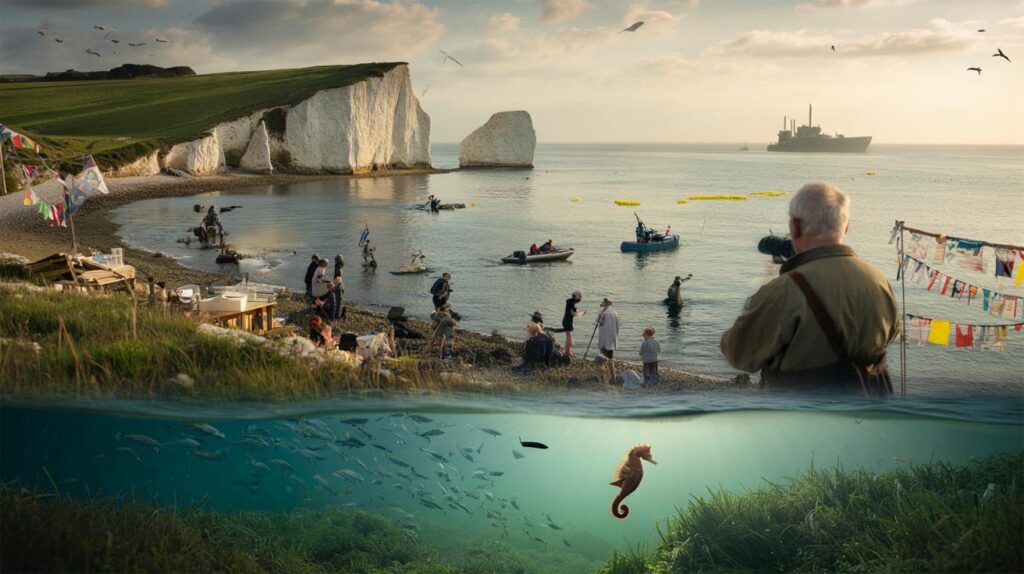
On Dorset’s edge, where chalk cliffs meet restless tides, a farewell on camera is quietly setting big plans in motion.
A film moment recorded at Shell Bay and Old Harry Rocks has become the spark for a fortnight of coastal action in Swanage, with a major screening, a community briefing, and a seafront festival all pointing towards one question: what will you do next?
Final scenes in Studland, fresh momentum in town
Ocean, the new Discovery Channel documentary presented and narrated by Sir David Attenborough, returns to Swanage on Friday 12 September 2025 for a big-screen showing at The Mowlem at 7.30pm. The film opens and closes on the Purbeck coast with sequences shot in 2024 at Shell Bay and beside Old Harry Rocks. Sir David, who marked the worldwide release on his 99th birthday in May 2025, described the trip as his last location shoot.
From Shell Bay to Old Harry Rocks, a farewell to filming has become a rallying point for Dorset’s sea.
A week later, on Friday 19 September 2025, Planet Purbeck and Greenpeace will co-host Protecting Our Oceans at Emmanuel Baptist Church, Swanage. Organisers want to turn the emotion of the film into local action, bringing residents face to face with science, policy and hands-on projects.
Two dates designed to turn awe into action
The Swanage briefing promises a brisk, practical programme that blends global science with Purbeck projects:
- Antarctica update: Greenpeace researchers outline new findings from the Southern Ocean.
- The Ocean Treaty: a push to secure 61 national ratifications and safeguard 30% of the seas.
- Near-pristine seas: Dr Owen Exeter shares footage from the Isles of Scilly to show what recovery looks like.
- Purbeck pathways: Planet Purbeck showcases local initiatives, from school planting schemes to coastal rockpooling days.
Target on the table: 30% of the ocean effectively protected, with governments pressed to sign and act.
Swanage weekend goes hands-on
The community momentum continues on Saturday 20 September 2025, when Discovery Fest takes over Shore Road from 10am to 3pm. Expect live music, guided Jurassic Coast walks with real fossil and footprint finds, and pop-up science stations testing water, wind and shore life. More than 30 organisations are due to line the seafront, including Dorset Wildlife Trust and Amphibian and Reptile Conservation, alongside local groups advising on repair, reuse and greener living.
| What | When | Where | Notes |
|---|---|---|---|
| Ocean screening | Fri 12 Sep 2025, 7.30pm | The Mowlem, Swanage | Cinema presentation of the new documentary |
| Protecting Our Oceans | Fri 19 Sep 2025, evening | Emmanuel Baptist Church | Planet Purbeck and Greenpeace briefing with Q&A |
| Discovery Fest | Sat 20 Sep 2025, 10am–3pm | Shore Road, Swanage | Free, family friendly coastal science and music |
| Community fundraiser | Sat 11 Oct 2025 | Purbeck venue TBC | With Sir Mark Rylance and George Monbiot; auction included |
Why this matters along Dorset’s shore
Residents speak of a coast under pressure. Sea temperatures rise. Sea levels creep higher. Waters turn more acidic. Industrial “supertrawlers” pass offshore with capacity that alarms small-boat fishers. The concerns are local and immediate, yet they tie into global trends seen from Antarctica to the tropics.
Purbeck also holds assets worth guarding. Studland Bay sits within a Marine Conservation Zone, home to seagrass meadows that nourish juvenile fish and lock away carbon. Old Harry Rocks forms part of the Jurassic Coast World Heritage Site. Visitors, livelihoods and wildlife all depend on keeping these places healthy.
Protecting coasts is not just scenery. It is food, jobs, flood safety and a decent future for local children.
Five actions you can take this week
- Book the film, then bring a question to the 19 September briefing.
- Head to Discovery Fest and sign up for one local project that suits your skills.
- Choose lower-impact seafood, and ask retailers where and how it was caught.
- Use seagrass-friendly moorings when boating and avoid anchoring on sensitive beds.
- Join a shore survey or citizen science scheme to track change along the bay.
Rylance and Monbiot bring national attention
On Saturday 11 October 2025, Oscar winner Sir Mark Rylance teams up with writer George Monbiot for a Planet Purbeck fundraiser that links village halls to world stages. Rylance will auction a signed photographic portrait of himself as Thomas Cromwell from the acclaimed BBC drama Wolf Hall. The evening aims to show how small coastal communities can nudge policy, budgets and behaviour at scale.
Think internationally, act locally: change one place well and it can pull the wider system towards balance.
Background: the ocean treaty and supertrawlers
The Ocean Treaty sits at the heart of this autumn’s messaging. The plan is straightforward: build a legal route to create and manage protected areas on the high seas and support the push to protect 30% of the ocean by 2030. Advocates say 61 national ratifications would secure the next steps and unlock robust enforcement. The UK government has backed the 30×30 ambition; the test lies in delivery and resourcing.
Supertrawlers are very large freezer-fitted vessels, often over 100 metres long, able to fish for extended periods with vast nets. Operators point to quotas and monitoring. Campaigners highlight bycatch risks, pressure on forage fish and the awkward reality of industrial gear operating near marine protected areas. Strong licensing rules, transparent data and clear exclusion zones can cut conflict and reduce harm.
Local glossary, quick and useful
- Old Harry Rocks: chalk stacks marking the start of the Jurassic Coast’s limestone drama.
- Shell Bay, Studland: sand and dune systems opposite Sandbanks with views to Poole Harbour.
- Marine Conservation Zone (MCZ): a legal tool in English waters to safeguard habitats and species.
- Seagrass meadow: underwater flowering plants that shelter young fish and store carbon in sediments.
- Rockpooling: careful exploration of tidepools at low water; ideal for children with supervision.
Going further: from curiosity to commitment
Turn a film night into a season of action. Try a family shore survey once a month, log what you see, and compare across the year. If you kayak or paddleboard, carry a small litter bag and set a five-minute collection rule every launch. If you fish, share basic catch details with community science groups to build a better local picture.
Think risk and reward. Warmer seas invite new species but also disease and jellyfish swells. Seagrass restoration locks carbon and calms waves, yet needs careful boating habits to survive. A repaired item keeps cash in town. A protected nursery ground supports next year’s fish. Small acts add up when a whole town joins in.



Thrilled to see Ocean back at The Mowlem — Attenborough’s last Studland shoot feels historic. How do we book advanced tickets, and is there step-free accesibility at the venue? Also, will there be a post-screening Q&A or just the film?
61 ratifications by 2030 sounds great on paper, but realisticly, how do we enforce “30% protected” while supertrawlers still work near MPAs? Is this about actual exclusion zones and patrol budgets, or more bureaucraccy and press releases?