
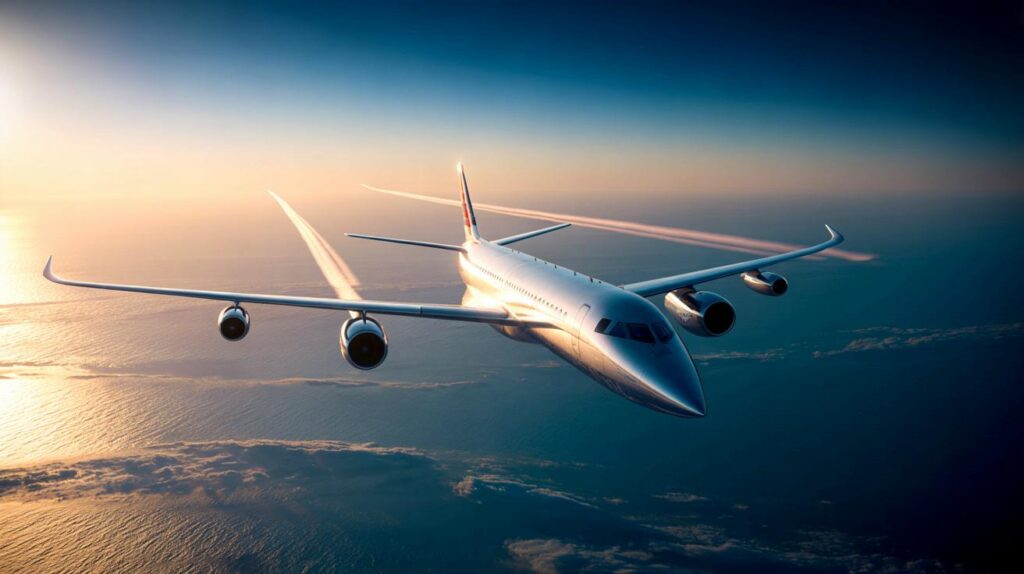
Aviation’s fastest dreams refuse to fade, with sleek new prototypes raising hopes, doubts and questions for travellers eyeing quicker crossings.
Two decades after Concorde bowed out, a new generation of supersonic aircraft is edging from pitch deck to production line, promising shorter flight times on busy routes and a renewed race for speed at altitude.
A new supersonic pitch gathers speed
Denver-based Boom is developing Overture, a supersonic airliner designed for around 60 to 80 passengers and cruising near 60,000 feet. The company promotes a target cruise around Mach 1.7 over water and a transatlantic schedule with London–New York in approximately 3 hours 40 minutes. Major carriers, including United Airlines, American Airlines and Japan Airlines, have placed orders or pre‑orders, signalling interest in premium, time-sensitive operations rather than mass-market services.
By 2029, industry timelines suggest a first wave of supersonic passenger services could return, led by a 60–80 seat jet targeting sub‑four‑hour London–New York trips.
United has announced plans for 15 aircraft, aiming to reintroduce supersonic speeds on selected long-haul routes. Boom, for its part, touts a potential network breadth reaching hundreds of city pairs, with transoceanic corridors the early focus to comply with current noise rules.
How the aircraft would cut hours off key routes
Over water, higher permitted speeds allow the biggest gains. The north Atlantic corridor is the headline, but developers also point to coastal and near‑coastal city pairs where aircraft could accelerate away from land, then slow before descent. The result is significant reductions in gate‑to‑gate times on certain missions.
| Route | Typical current time | Projected supersonic time | Time saved |
|---|---|---|---|
| London – New York | 6–7 hours | ~3h40 | ~2h20–3h20 |
| Los Angeles – Washington DC | 5–6 hours | ~2 hours (with over‑water segments) | ~3–4 hours |
Speed is only part of the story. Operators plan business‑style cabin densities, quick turnarounds and priority ground handling, which together sharpen the door‑to‑door advantage for travellers who count minutes, not miles.
On select routes, a same‑day return across the Atlantic moves from punishing outlier to practical option for well‑heeled travellers and tight schedules.
Who will actually use it first
Expect early adoption to concentrate on premium passengers whose schedules and budgets support higher fares. Corporate travellers, government delegations and high‑value leisure trips are the core target, especially where time saved offsets hotel nights and lost productivity. Airlines with pre‑orders are positioning the aircraft as a prestige tool that complements, rather than replaces, large long‑haul twins.
- Capacity: 60–80 seats, arranged for comfort and rapid service.
- Altitude: near 60,000 ft, above most weather and subsonic traffic.
- Speed: planned around Mach 1.7 over water, where regulations allow.
- Network: hundreds of potential city pairs, with transoceanic routes first.
- Airlines: interest signalled by United, American and Japan Airlines.
Industry voices expect mainstream air travel to keep favouring larger, highly efficient aircraft for the masses. Supersonic, by contrast, looks more like a specialised layer aimed at time-critical journeys. That balance could make services highly visible yet relatively scarce day to day.
The regulatory headwinds
Noise remains the pivotal hurdle. Current US rules still restrict supersonic flight over land, and similar constraints exist in other major markets. Regulators on both sides of the Atlantic continue to evaluate noise standards and certification pathways for a new class of civil supersonic aircraft. Much rides on how testing informs those rules and whether corridors emerge that allow higher speeds without disturbing communities.
Certification is another mountain. New structures, engines, materials and operations must clear safety gates, from environmental review to type certification and airport compatibility. While test programmes are under way, service entry dates depend on how quickly those programmes close risk and how regulators respond to evidence from flight trials.
Noise and fuel questions, answered plainly
Concorde’s sonic crack defined the debate for decades. This time, engineers are shaping airframes to manage shockwaves, tuning take‑off and landing profiles, and promising cabin comfort without nuisance on the ground. Airports will ask tough questions about departure noise and night‑time quotas before opening slots for supersonic movements.
Fuel strategy matters, too. Developers frame Overture around sustainable aviation fuel to cut lifecycle emissions, while acknowledging that higher speeds increase fuel burn per seat. Airlines will look for credible pathways to SAF supply and transparent accounting on carbon intensity to justify programmes to investors and regulators.
The promise: big time savings for a small cabin. The trade‑off: tight noise limits, rigorous certification and a credible plan for cleaner fuel.
What this means for British travellers
For UK–US flyers, the north Atlantic could become the test bed. London–New York stands out thanks to strong premium demand and favourable over‑water routing. Airports with robust premium traffic and ground handling capacity would be prime candidates for early stations. If schedules materialise, travellers could leave late morning, arrive before lunch local time, and still make an afternoon meeting—then return the same evening if needed.
Door‑to‑door timing still matters. Faster cruise helps only if security, boarding and transfers stay tight. Expect operators to bundle chauffeured transfers, fast‑track security and lounge‑to‑kerb services to protect the time advantage across the entire journey.
Risks to watch, beyond the marketing slides
Programme timelines slip when test data surprises designers. Supply chains for high‑temperature composites and specialised engines can pinch. Noise rule changes may take longer than hoped, particularly for overland operations. Financing cycles shift with interest rates. Any of these could push inaugural services beyond target years, or constrain the first network to a handful of flagship routes.
Practical scenarios for early users
If you travel frequently on transatlantic business, think in use‑cases rather than headlines. A banker based in the City could attend a two‑hour client session in Midtown and be back home before midnight, avoiding a hotel stay. A production team might shuttle between London and the eastern seaboard to compress a multi‑day shoot into a single ultra‑long day. For leisure, a milestone trip—an anniversary in New York, a once‑in‑a‑lifetime theatre weekend—might justify paying for time saved at both ends.
There are trade‑offs. Smaller cabins mean fewer award seats and less flexibility if a flight cancels. Weather at high latitudes can still force speed or routing changes. For many travellers, modern subsonic wide‑bodies remain better value, especially with flat beds, reliable Wi‑Fi and competitive fares. Supersonic aims to sit above that, offering minutes where minutes matter most.
Think of it as a razor‑sharp tool: not for every job, but transformative when cutting time is the priority.
What to track next
Watch for three signposts: successful high‑speed flight testing on a full‑scale prototype; firmed delivery schedules from airlines with deposits; and clear regulatory milestones on noise and certification. When those align, the countdown to commercial tickets begins in earnest.
Until then, treat the 3‑hours‑and‑40‑minutes promise as a live scenario rather than a guarantee. The technology is closer than it’s been in 20 years, the demand case is clearer, and the obstacles are better understood. If the pieces fall into place, British travellers could once again measure the Atlantic in hours you can count on one hand.



3h40 LON–NYC is wild. Same‑day out‑and‑back actually sounds doable—late morning departure, lunch in Midtown, home by midnight. If priority ground handling + fast‑track security are real, this could be a game‑changer. Take my money! 😊
Bold promise, but how do you clear US over‑land supersonic bans and night‑time quotas? Even with tuned profiles, airports guard noise Qs hard. 2029 feels… optimistic. Regualtors don’t move at Mach 1.7.