
Autumn brings shorter days, steamy windows and clothes that seem to stay clammy forever. Your radiators stay off, yet the laundry pile never does.
Plenty of households now avoid switching on the heating until deep winter. That choice saves pounds, but it also slows drying and raises the risk of musty smells. One simple, zero-cost item already in your cupboard can speed things up dramatically and keep your rooms fresher.
The £0 towel roll trick
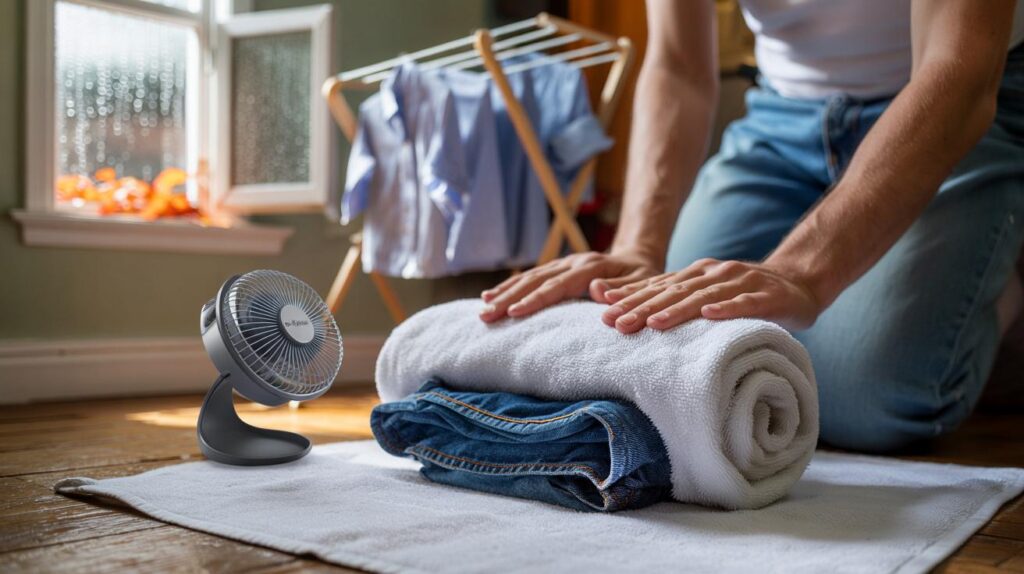
You don’t need a heated airer or a tumble dryer to shave hours off drying times. Use a clean, dry bath towel as a moisture sponge before you hang items on a rack or rail.
- Lay a dry towel flat and place a wet garment on top, smoothed out.
- Roll the towel tightly with the garment inside, like a Swiss roll.
- Press or kneel along the roll to force water into the towel fibres.
- Unroll, replace with a fresh towel if the first feels saturated.
- For very wet items, add a layer of kitchen roll inside the fold to catch extra moisture, then discard it.
- Hang the garment immediately with good airflow around it.
Wrap, roll, press, hang: this four-step routine removes trapped water fast, so air can do the rest without any heating.
This method works especially well for dense cottons, denim, hoodies and children’s school uniforms that usually sit damp for ages. It also helps when rain caught you out and the spin cycle didn’t quite finish the job.
Why it works
Air drying slows down when fabric holds water deep in its weave. The towel’s thicker pile drags liquid out by contact and pressure. That reduces the amount of evaporation needed, so circulation alone can finish the job. The roll also squeezes seams and cuffs that often drip longest.
Boost the effect by running a high spin before you start. Most UK machines offer 1200–1400rpm. A second spin can cut retained water by a third, which then makes the towel stage even quicker.
Get sheets and heavy items dry quicker
Bed linen turns sluggish indoors because the fabric folds back on itself. Treat big items in sections. Work one end of a sheet inside a towel, press firmly, then move along the length. Give each sheet a sharp shake before hanging to separate the fibres. Peg duvet covers from two corners to create a tent shape that air can pass through.
Big, flat items need space to breathe: shake, spread and create gaps for airflow rather than layering them up.
Airflow beats heat
You don’t need hot air; you need moving air. A small desk fan on low speed aimed across the rack will carry moisture away for pennies. Crack a window for cross-ventilation or run an extractor fan. If your home feels humid, a compact dehumidifier can help the whole room dry faster and reduce condensation on windows.
| Method | Typical time | Estimated energy cost per load | Best use |
|---|---|---|---|
| Towel roll + airer | 3–8 hours | £0 (fan optional ~£0.02–£0.05) | Daily laundry without heating |
| Heated airer (200–300W) | 3–6 hours | ~£0.25–£0.50 | Small spaces, cool rooms |
| Dehumidifier + airer | 3–6 hours | ~£0.25–£0.60 | Condensation-prone homes |
| Vented or heat-pump dryer | 1–2 hours | ~£0.50–£1.20 | Rainy emergencies, thick loads |
Figures depend on machine efficiency, room temperature and the current unit rate on your tariff, but the pattern holds: airflow and water removal matter more than raw heat.
A simple setup that works in a British home
- Place the airer in a room with a door you can shut and a window you can crack open.
- Run a fan across the rack, not into it, to sweep moist air away.
- Leave 5–10cm gaps between garments; don’t double up bars.
- Flip and rotate thicker pieces after 90 minutes to present a dry surface to the air.
- Use slim hangers for shirts and drape trousers over two bars to widen the contact area.
Keep the drying zone contained and ventilated: door shut, window ajar, air moving across the rails.
Condensation and health
Indoor drying raises humidity. Target 40–60 percent relative humidity to keep mould at bay. If windows mist up, open the trickle vent or the window a finger’s width until the glass clears. Wipe frames in the morning to remove any droplets. Avoid drying in bedrooms if anyone has asthma or allergies.
Quick checklist before you hang
- Run an extra spin for heavy cottons and towels.
- Smooth cuffs, collars and pocket linings so they don’t trap moisture.
- Shake each item firmly to separate fibres and reduce creases.
- Use the towel roll for jeans, hoodies, sheets and school trousers.
- Space items by fabric weight: light synthetics up high, dense cottons lower down.
- Check after two hours and rotate anything still cool to the touch.
How much time could you save
As a guide, a cotton T-shirt that takes 8–10 hours on a crowded rack may drop to 4–6 hours after a towel roll and fan. A pair of jeans can move from an overnight wait to a same-evening finish. A double sheet often reaches touch-dry in the afternoon when rolled first and hung with a fan running.
Care notes and small wins
Use colourfast, lint-free towels so fibres don’t shed onto dark clothes. Skip the roll for delicate knitwear and press water out between two towels instead. Don’t wring garments by twisting them alone, as that can stretch seams. If fabric feels board-stiff, scrunch it gently once dry to soften it, or give it a six-minute tumble with two dry towels to loosen fibres at low cost.
If you line-dry when the weather allows, an early morning wash helps you catch any mild sunshine and breeze. When rain blocks that plan, the towel trick becomes a handy fallback. Pair it with a fan and a cracked window and you keep bills down, condensation in check and laundry turning over on the same day.
For households juggling school uniforms and sports kits, set a weekly routine: wash at night, second spin at dawn, towel roll key items, then hang with a small fan. This rhythm keeps wardrobes topped up, avoids last-minute panic and saves you from reaching for the radiator dial.



Tried this today with my kids’ uniforms—dry in hours, not days. The fan-across-the-rack tip was a game changer 🙂