
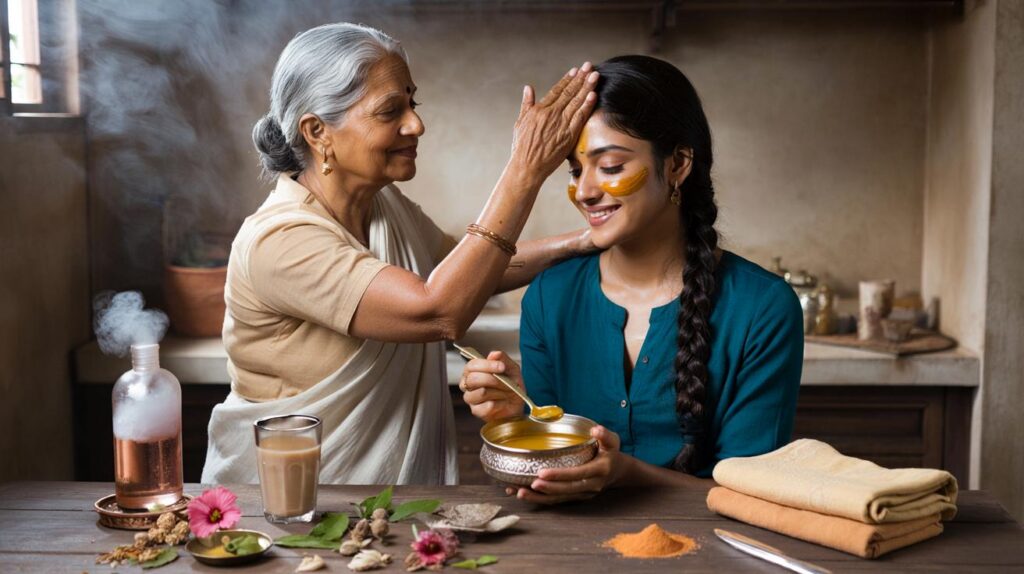
Grandmothers don’t scroll for skincare. They stir it. Across India, beauty has long been something you pass by hand, not through an algorithm — the scent of coconut oil on a Sunday, a pinch of turmeric in a chipped bowl, a soft thumb tracing a brow. These are not trends. They are memories that glow.
I’m standing in a warm kitchen in Pune, watching a brass spoon sink into ghee as my friend’s nani grinds turmeric with a stone. The room smells like cardamom tea and wet earth after rain. She asks for a splash of rose water, then flicks her wrist, turning powder to paste with a speed you only get from years of doing, not Googling.
Outside, a pressure cooker hisses and a child drums the window with a plastic cricket bat. Inside, we sit at the table and the yellow paste finds our cheeks like sun finding a garden wall. The bowl is dented, the recipe isn’t written, and nothing about this feels accidental.
The glow spreads, quietly.
Kitchen wisdom, courtyard mirrors
Beauty in India often starts where meals do: in the kitchen. You see it in a mother pinching gram flour into a quick ubtan after lunch, or a cousin twisting hibiscus leaves into a slick green pulp for hair. These gestures look simple, but they carry a pulse — a way of caring that’s both everyday and ceremonial.
On a balcony in Jaipur, I watched an auntie rub a slice of tomato over her elbows while the neighbour’s radio played old film songs. She laughed at the tang, washed, then dabbed on cold rose water with the authority of a head nurse. The glow wasn’t instant, but the mood was. A small act transformed the air, and the terrace felt like a salon for two.
There’s logic beneath the tenderness. A humid climate nudges light layers and plant oils, so coconut, sesame, and mustard oils show up in scalp rituals. Cooling powders — sandalwood, fuller’s earth — calm heat flushes. Trust sits with ingredients you can pronounce, and with the person showing you how to use them. The science is not a lab coat here; it’s years of observing skin under monsoon and summer sun.
Rituals that travel: from champi to kajal
The classic head massage, or champi, is half method, half music. Warm a small bowl of coconut oil with a few drops of amla or neem; test the heat with the back of your wrist. Part the hair into sections and tap the scalp with your fingertips, then press in circular motions from crown to temple. Work the oil down the lengths, braid loosely, and sit. Thirty minutes if you can. A towel warmed on a radiator turns the room into a tiny spa.
Errors creep in when speed wins. Don’t pour hot oil straight onto the scalp; skin is skin. Go easy on turmeric in face masks or your T‑shirt will carry the memory. Smudge kajal only after it sets or you’ll chase it all day. We’ve all had that moment when a well-meaning DIY turns your sink yellow and your patience thin. Let’s be honest: nobody really does that every day.
Listen to the elders and you hear a tempo, not a rulebook. They know which ingredients stain, which heal, which ones stain then heal and are worth it anyway.
“Start with what the house already loves,” my friend’s mother told me, smoothing haldi over her knuckles. “If it nourishes your kitchen, it won’t insult your skin.”
- Rose water: splash post‑cleanse, keep in the fridge for late‑afternoon skin slumps.
- Gram flour + turmeric: weekly ubtan for brightness; mix with yoghurt for dry days.
- Shikakai/reetha: a gentle cleanse for hair when shampoos feel too loud.
Beyond glow: what elders pass on
These rituals carry more than beauty; they carry time. A Sunday champi slows a household that’s been sprinting all week. An engagement haldi is laughter pinned to skin, each smear a future story. Packaging changes, city rents rise, routines get squeezed by commutes and screens, but the hand that oils your hair is still the hand that tucks your tag in. There’s a kind of intimacy here that doesn’t age. And it asks a simple question: what do you want your face to remember when the day is done?
| Point clé | Détail | Intérêt pour le lecteur |
|---|---|---|
| Ubtan at home | Gram flour, a pinch of turmeric, yoghurt or milk, gentle massage | Low-cost brightening without long INCI lists |
| Champi method | Warm oil, slow scalp circles, braid, rest, rinse | Shinier hair, calmer mind, a ritual that fits a Sunday |
| Rose water habit | Keep chilled; spritz after sun or screens | Instant refresh, travel-friendly, softens hard water feel |
FAQ :
- Does turmeric stain the skin?It can, especially on lighter complexions. Use a tiny pinch in face mixes and balance with yoghurt or milk. Any tint fades after a cleanse or two.
- Is homemade kajal safe?Traditional soot-and-ghee methods vary. Modern ophthalmologist‑tested kohl is a safer daily option, with a similar soft look.
- How often should I oil my hair?Once or twice a week suits most. Fine hair may prefer lighter oils and shorter rest times. Rinse with a gentle shampoo to avoid residue.
- What if my skin is sensitive?Patch‑test on the inner arm and keep mixes simple: rose water, oat flour, plain yoghurt. Skip strong lemon, clove, or undiluted essential oils.
- What’s a five‑minute Indian‑inspired routine?Rinse, chilled rose water spritz, light sesame or coconut on damp skin, a dot of lip tint, and a quick brow brush. You’re out the door.



Merçi pour ce texte — on sent la cuisine chaude de Pune à travers les mots. Ma nani jurait par l’eau de rose au frigo et le champi du dimanche. Ça m’a donné envie de reprendre ces rituels.
Question pratique: pour un ubtan visage sur peau claire, vous mettez combien de curcuma exactement? Une pincée c’est vague; 1/8 de cuillere à café? Et combien de temps avant de rincer pour éviter la tache jaune?