
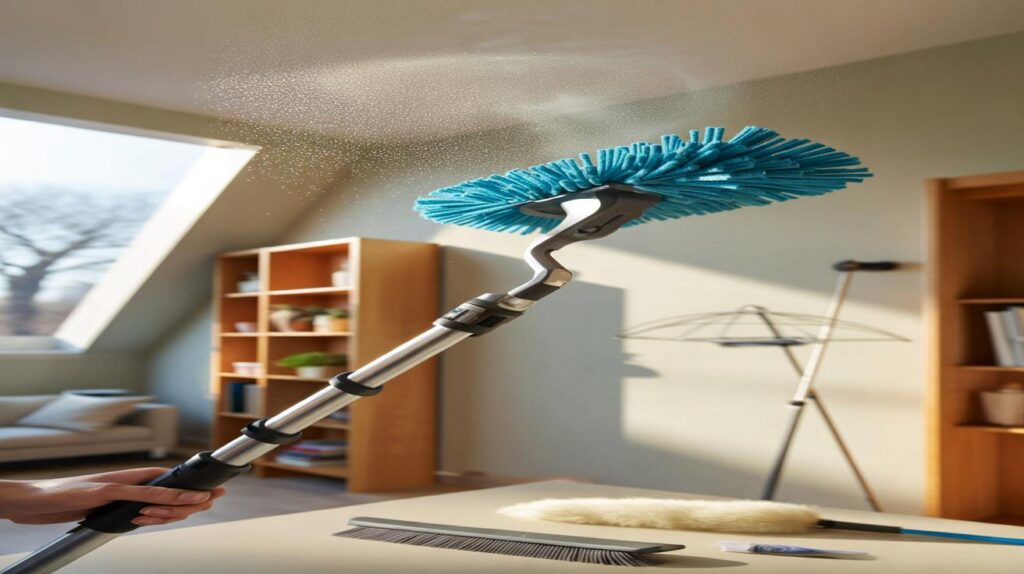
High shelves hoard dust like secrets, especially the ones you only notice when sunlight hits at the wrong angle. Corners grow little grey beards. You reach, you wobble, the dust swirls, and somehow your jumper wears it all. Which duster actually solves that?
It started on a cold Saturday morning with the kind of slanting winter light that exposes everything. I was staring up at the top of a wardrobe that’s taller than me by a good half-metre, a fine line of fluff tucked against the ceiling like it paid rent. The step stool felt shaky, my shoulders already tired just imagining the reach. On the table: a fan of options — microfibre head on a telescopic pole, lambswool wand, a bendy chenille brush, a flat microfibre blade for blinds, and a crinkly disposable number everyone swears by. I took a breath, poked the first corner, and watched the air bloom with motes. The room went quiet in that way only dust can manage. Something had to change.
The best dusters we actually tested for heights and tricky corners
Here’s what surprised me first: not all “fluffy” equals effective. The microfibre head with a pivoting joint felt modest, yet grabbed more than it looked like it should. The lambswool looked gorgeous, like an old film usher’s plume, but dropped little bits. **The right pole beats the wrong head.** If the handle flexes, your aim dies in the last ten centimetres, and that’s where corners win.
In a one-bed with 3 m ceilings, I ran six dusters through the same route: top bookshelves, picture rails, ceiling corners, and the canyon above kitchen cabinets. I timed the loop, weighed what the heads collected, and watched how much fell back down. The extendable microfibre with an angle joint captured the most with the least sneezing, while a cobweb brush on a stiff pole cleared spiders’ silk in one gentle twist.
Why did microfibre win? It’s the split-fibre structure that pulls particles in by static charge as well as surface grip. Lambswool glides beautifully over big fluff but struggles with fine grit and pollen. Feather-style heads whisk dust off a surface, then let gravity do the rest. A flat blade with a washable sleeve shines where space is tight, especially between the top of a wardrobe and the ceiling. Corners need a cone or dome head that hugs edges, not a round puff that bounces off. **Microfibre captured more and dropped less.**
How to reach higher, safer, cleaner
Pick a telescopic pole that locks at each stage, not just at the end. Extend it only as far as you actually need; the shorter it stays, the steadier it feels. Set the head to a slight angle, then approach the corner from the side and “hook” the dust out with a slow J-shaped sweep. One calm pass beats five frantic jabs.
Two tiny changes make a big difference. Very lightly mist the microfibre with water — not wet, just a whisper — and it holds on like Velcro. Work high-to-low through the room so you’re not re-disturbing clean areas. Let’s be honest: nobody does this every day. Rotate heads outside or over a bin before you move to the next spot, so you’re not redepositing your victory in the next room.
Many people press too hard or rush, which flicks dust into the air and into your lungs. Others never wash the heads, so they glide on a layer of old fluff that defeats the point. Store the pole upright, head covered in a bag, so it’s clean when you need it in a hurry. My shoulders thanked me.
“Angle beats force. If you can see the back of the head in the reflection of the ceiling, you’re probably holding it right,” said Marta, a London cleaner who carries two poles and swaps heads like a pit crew.
- Best overall reach-and-grab: Microfibre duster with telescopic pole and pivoting head (washable sleeve).
- Best for cobweb corners: Dome-shaped cobweb brush on a rigid, lightweight aluminium pole.
- Best for narrow gaps: Flat microfibre blade with removable, washable cover.
- Best quick fix: Disposable microfibre refills on an extender arm for picture rails.
- Best delicate touch: Soft lambswool wand for pendant lights and plants.
So, which duster wins for your home?
If your place has high shelves and awkward corners, a washable microfibre head on a solid telescopic pole is the workhorse that pays rent. Pair it with a cobweb brush for the ceiling edges and you’ve covered 90% of what truly annoys. The disposable extender comes out when you’ve got guests in an hour and a sunbeam exposing your sins. **Your ceiling height decides more than brand names.**
We’ve all had that moment when the dust cloud catches a shaft of light and you see how much you’ve been ignoring. A single, reliable tool you can reach for without fetching a ladder changes how often you’ll actually do it. Start with reach, add an angled joint, then choose the head: soft for ornaments, split-fibre for grit, dome for webs. Share what’s worked in your house; there’s always a trick you haven’t tried yet. The corners have been waiting.
| Key points | Details | Interest for reader |
|---|---|---|
| Reach and control matter most | Stiff telescopic pole with reliable locks, plus a head that pivots 90–135° | Hits high shelves safely without wobble or ladder drama |
| Microfibre beats fluff for fine dust | Split fibres grab particles and hold them; light misting boosts capture | Less fallout, fewer sneezes, faster clean |
| Match head to job | Dome for corners, flat blade for gaps, lambswool for delicate surfaces | Cleaner results in fewer passes, fewer scratched finishes |
FAQ :
- What length pole do I need for standard UK ceilings?For 2.4–2.7 m rooms, a pole that extends to 3 m gives comfortable reach without full extension. Taller Victorian spaces do well with a 3.5–4 m pole that still feels rigid.
- Are disposable dusters worth it for high shelves?They’re handy for quick picture rails and the top of frames. For big, dusty runs above cabinets, a washable microfibre head is cheaper long-term and holds more per pass.
- How do I stop dust from falling everywhere as I sweep?Mist the head lightly, slow your strokes, and approach corners from the side with a hooked motion. Work high-to-low through the room so anything that drops gets caught later.
- Do lambswool dusters actually clean or just move fluff?Lambswool glides over delicate items and lifts loose fluff nicely, but it struggles with gritty dust. Use it for pendants, plants, and uneven surfaces, then follow with microfibre for the fine stuff.
- How often should I wash microfibre duster heads?Every 2–4 sessions, depending on how dusty your home is. Hand wash or gentle cycle with mild detergent, no fabric softener, and air dry. Shake out between rooms if you’re mid-session.



For a 3 m ceiling in an old flat, would you prioritize a 3.5 m pole even if it’s heavier, or a lighter 3 m that feels steadier? Any lock mechanisms you’ve found don’t slip after a few months? Brand recs welcome, especially non-wobbly joints.