
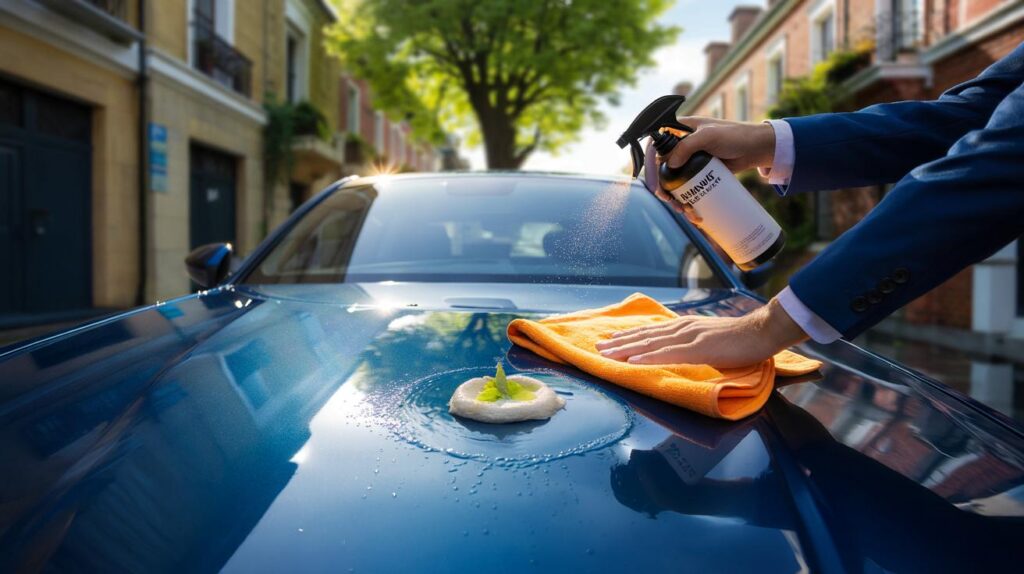
Bird droppings don’t just look bad on your car — they can bite into the clearcoat in a matter of hours, especially under sun. Most days you don’t have a hose, a bucket, or time. You’ve got a meeting, a nursery drop‑off, a tight parking bay, and a splat drying by the minute. This is the real-world guide to acting fast, and getting it off even when there’s no water around.
I watched a man in a navy suit freeze in a street of terraced houses in Islington. He’d parked under a lime tree, grabbed his coffee, then saw it: a messy white-and-brown badge smeared right on the bonnet. The morning sun was already warming the metal. He glanced at his watch, then at the bird-signed splat, then at the only thing he had — a loyalty card and a crumpled napkin.
We’ve all had that moment where time and mess arm-wrestle on the paint. He reached for the card, hesitated, and then did something better. He placed the napkin over the splat, let his coffee’s condensation dampen the paper, waited, and lifted slowly. He left a faint ghost in the light. He drove away, frowning. The mark would likely fade with a polish. Or not. One tiny choice can save a panel.
The clock was the villain.
Why bird splats demand speed
Bird droppings aren’t like mud. They’re a cocktail of uric acid, digested seeds, grit and, on city diets, road dust. On a warm bonnet, moisture evaporates, crystals harden, and the mess binds to clearcoat. That’s when the trouble starts — the clear layer swells and etches around the splat’s edges. **Left in the sun, a fresh splat can mar clearcoat in a single afternoon.** On dark paint, you notice a chalky ring; on light paint, a dull patch under angled light. Either way, it isn’t just “dirty”. It’s chemistry plus heat.
On a slow Saturday at a hand wash in Hackney, a valet pointed out five cars in a row with the same telltale halo: a soft crater that caught the light differently. None were old. One was a year-old crossover with a ceramic coating. Another was a company saloon that lived on motorways. Spring and summer bring more of these jobs, he said, after nesting season fills the sky and the sun bakes everything it can. People think rain will rinse it. Rain often bakes the edges harder.
There’s a myth that it’s just acidity alone that scars paint. The fuller picture is nastier and more physical. Droppings dry unevenly, concentrating salts on the outer edges where drying is fastest; heat pushes the clearcoat to swell and then contract around that ring. That’s why you see a circular “witness mark”. Parking near glass or chrome makes it look worse because they reflect the blemish back at you. *Time is paint.* Quick neutralisation and gentle lift beat any heroic scrubbing later. Waxes and coatings buy you time — they don’t grant invincibility.
How to remove them on the go (even with no water)
Think softening, then lifting. No hoses? No problem. Take a folded microfibre, spray it with a waterless wash or quick detailer, and lay it over the splat like a poultice. Let it sit for 60–120 seconds, adding a touch more product if the towel goes dry. Slide the towel off in one direction to carry away the softened mess. If a crust remains, repeat the “soak and lift”. Use a clean edge each pass. For stubborn bits, use a plastic loyalty card wrapped in microfibre to nudge, not scrape. Finish with a fresh spritz and a gentle pat-dry, not pressure. **Soak first, lift second, wipe last.**
No products to hand? You still have options. Sensitive, alcohol-free baby wipes can work in a pinch — place, dwell, lift — then go over with a dry microfibre to avoid streaks. A sealed can of sparkling water is handy too; the fizz helps break up the crust. Don’t pour it straight onto hot paint — wet the cloth, not the car. Screenwash in a spray bottle can help if it’s ammonia-free; spray onto the towel rather than the panel. If all you’ve got is tissue, double it up, press gently with the flat of your hand, and remove in one motion. Let’s be honest: nobody actually does a full wash in the middle of a commute.
There are mistakes that turn a five-minute fix into a Saturday repair. Don’t scrub a dry, sun-baked splat with a dry towel — that’s sandpaper in friendly clothing. Don’t reach for kitchen scourers. Avoid glass cleaner with ammonia on paint. Work in shade, or create it with a sunshade to slow the bake. If you polish to reduce a ghost ring later, use a fine finishing polish and a soft pad, and stop as soon as the mark blends.
“Treat bird mess like an ice cube on your wrist,” a London detailer told me. “You move it quickly or you’ll feel the burn later. Pause. Soften. Lift.”
- Glovebox kit: 2 microfibres, 100 ml waterless wash/detailer, 2 sensitive baby wipes in a zip bag, a plastic card, nitrile gloves, small bin bag.
- Park smart: if you must park under trees, crack the bonnet open a touch after driving to let heat escape.
- Shield: a cheap magnetic bonnet protector saves grief if you park in the same spot daily.
What fast action buys you — and how to keep winning
Speed isn’t just about cleanliness. It’s about keeping the clearcoat thick for the long haul so future polishing doesn’t bite too deep. A quick glovebox routine means you’re rarely playing catch-up with etching. Waxes and sealants add a slippery sacrificial layer that slows bonding and buys you those extra minutes in sunshine. Ceramic coatings go further, reducing how hard droppings stick and how quickly edges etch. They won’t stop everything. They change the game from urgent panic to manageable nip. **Speed beats scrubbing, every time.**
| Key points | Details | Interest for reader |
|---|---|---|
| Act within hours | Heat and salts create etched rings as splats dry; shade and fast softening prevent this | Avoid costly paint correction and keep your car looking newer |
| Soften, don’t scrape | Lay a damp microfibre or wipe to loosen, then lift in one direction with light pressure | Reduces micro-scratches you’ll see under sunlight |
| Carry a mini kit | Two microfibres, waterless wash, sensitive wipes, plastic card, gloves, bin bag | Real-world, no-hose solution for commutes and car parks |
FAQ :
- Will bird droppings really damage paint?Yes. Uric acid, salts and grit can etch clearcoat as they dry, especially on hot panels in direct sun.
- How fast do I need to act?Same day is best; in summer sun, aim for within a few hours. Shade buys you time by slowing the bake.
- Can I use household cleaners?Avoid ammonia on paint and anything abrasive. If stuck, use sensitive baby wipes and follow with a gentle detailer.
- What if a ring is already visible?Try a mild finishing polish by hand with a soft applicator. If it’s still visible, a detailer can spot-correct it safely.
- Do coatings make me immune?No. They make removal easier and slow etching, but you still need to remove droppings promptly for best results.



Isn’t this overblown? I’ve left bird poo for days with no marks — are modern clearcoats not tougher? Maybe the “halo” is just residu that washes off? Genuinely asking.
Great tip about using condensation to dampen a napkin. Did that this morning on a hot bonnet and it lifted clean. I was about to scrape with a loyalty card like an idot. Saved me, thanks!