
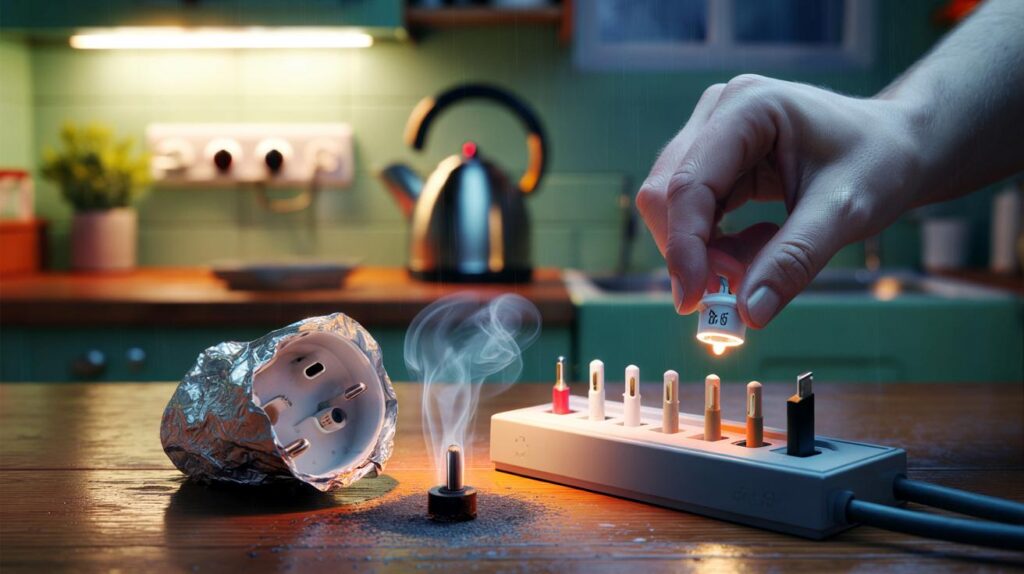
The lights blink, the kettle dies mid-boil, and the house exhales into silence. You’re left squinting at labels and rummaging a drawer where bent nails, old batteries and a crumpled strip of kitchen foil seem to promise an easy fix. Picking the right fuse isn’t guesswork — and that foil trick can turn a hiccup into a full-blown emergency.
Rain on the window, dinner half-made, a trivial pop that lands like a verdict. I watched the hallway go dim as the kettle clicked off and the fridge joined a moment of collective sulk. Upstairs, a teenager shouted that the Wi‑Fi was “broken”, which made the torch on my phone suddenly feel like a lighthouse. Somewhere behind a cupboard door, a tray of spare fuses sat like a box of aspirin from another era, promising relief if only I chose wisely. A neighbour once swore by “wrapping a bit of foil around it to get you through the night”. The smell of warm plastic says why that’s a terrible idea better than any manual ever could. The right fuse fails safe so your home doesn’t. The wrong workaround bites.
What a blown fuse is really saying
A fuse is not a nuisance; it’s a messenger that gives up its life to protect the wiring you can’t see. That thin strip of metal isn’t being awkward when it melts — it’s telling you the current got higher than the circuit, the cable or the appliance could cope with. When it blows, the safest response isn’t to bully the current back through a bigger door, it’s to listen to the message.
Picture a chilly evening, a fan heater and a kettle share a multiway adaptor behind the sofa, and a 13A plug fuse dies with a soft snap that you notice only when your tea still looks like water. I’ve seen a car dash go dark the same way: a cheap phone charger, a short in the lead, and a mini blade fuse that saved the loom. UK Home Office data reports tens of thousands of domestic fires each year involving electricity, with a grim share linked to overloading or damaged gear. Those numbers aren’t abstract; they’re living rooms like yours and mine.
Every fuse rating is a promise written in amps. It’s chosen to safeguard the thinnest, weakest link in that run — often the flex or a delicate part inside the device — not to “hold out” against your bad habits. A BS 1362 plug fuse in the UK is designed to open fast under serious overload, and a circuit breaker in your consumer unit does a different job on a bigger scale. Swap a 3A for a 13A and you’ve changed the rules of protection; wrap it in foil and you’ve removed the rulebook altogether. **If a fuse opens, something asked for more than it should.**
Finding the right fuse without guesswork
The neatest trick is hiding in plain sight: the rating plate. Look at the label on the appliance — the watts are your clue — then use the mains voltage (around 230V in the UK) to land on a sensible fuse. *It’s just simple maths: amps = watts ÷ volts.* A lamp at 40 W sits comfortably on a 3A plug fuse; a 2 kW kettle lives on 13A; a router or radio usually wants the smallest fuse that keeps it alive without complaint.
Common traps are sneaky because they feel like shortcuts. Swapping a 3A fuse for a 13A “so it stops blowing” is like taking the batteries out of a smoke alarm because it beeps — quiet, but not safer. Slow-blow (T) and fast-blow (F) glass fuses look similar, yet act differently, and car blade fuses have a colour code that means something beyond decoration. We’ve all had that moment when something trips and we tell ourselves we’ll “sort it properly tomorrow”. Let’s be honest: nobody checks their plug fuses every day.
When nerves and noise meet, a little clarity helps, so here’s the rule of thumb from the people who see the aftermath.
“A fuse is there to fail before the cable catches fire,” says a London fire officer. “Defeating it is gambling with minutes you won’t get back.”
- Match the fuse to the smallest link: light loads often use 3A, heat-makers like kettles and irons use 13A, and anything in doubt deserves the smaller value.
- For cars, match the colour and the number exactly; the rating protects the loom, not just the gadget.
- Repeated blowing means stop. Unplug, rethink the load, and get a qualified electrician if it keeps happening.
**Use the smallest fuse that safely runs the device.**
Foil myths, real risks, and better habits
Kitchen foil feels like a hack from another century because it is — a relic of a time when speed beat safety and homes had fewer hidden circuits to torch. Foil doesn’t just “get you through the night”; it bypasses the one component designed to quit before your cable becomes a heating element behind the plaster. A fuse-free path lets fault current arc, surge and build heat where you can’t see it, which is why fire investigators still find melted foil in sockets like calling cards from a near miss.
There’s a braver habit that takes less time than rummaging a junk drawer. Keep a tiny pack of the right plug fuses in the kitchen, note the ratings of your most-used appliances on a sticky label, and never mix car fuses in a glovebox potluck. The moment a fuse opens twice, treat it as a story worth hearing, not a glitch to bulldoze, because faults rarely heal themselves and heat never negotiates. **Never bridge a fuse with foil.**
We wire our rooms for comfort, then forget the secret arrangements that keep comfort civilised. A blown fuse is a whisper, not a shout, and choosing the right one is less about luck than respect for physics and the quiet heroism of small, sacrificial parts. Share this with someone who still swears by silver paper, ask what’s on that overworked extension lead, and listen to the soft warnings your house offers before it clears its throat. The safest fixes are the boring ones; they’re also the ones that let you finish your cup of tea in peace.
| Key points | Details | Interest for reader |
|---|---|---|
| Why fuses blow | A fuse melts when current exceeds what the circuit or cable can safely carry, turning a dangerous overload into a controlled outage. | Transforms irritation into understanding, reducing panic and guesswork when the lights dip. |
| How to pick the right fuse | Check the appliance wattage, divide by 230V, and choose the nearest standard rating that protects the smallest link, usually 3A or 13A for UK plugs. | Gives a quick, confident method that avoids mismatches and repeat failures. |
| Why foil is deadly | Foil defeats protection, lets fault current run unchecked, and can start hidden fires in cables, sockets and looms. | Replaces a risky “hack” with a vivid reason to keep proper spares and safer habits. |
FAQ :
- How do I tell if a fuse has blown?Some glass fuses show a broken element or darkening, but many plug fuses don’t. The simplest check is to try a fresh, correct-rated fuse; if it blows again, there’s a fault to address.
- Can I replace a 3A fuse with a 13A to stop it blowing?No. That removes protection from the cable and the device. Use the smallest rating that runs the appliance without nuisance blowing.
- What’s the difference between a fuse and a circuit breaker?A fuse is single-use and opens fast under overload; a breaker is resettable and protects whole circuits. They work together, not in competition.
- Is aluminium foil ever safe as a temporary fix?It isn’t. Foil bypasses safety and can turn a minor fault into a fire. Keep spare fuses instead; they cost pennies and save grief.
- When should I call a professional?If a fuse or breaker trips repeatedly, you smell burning, sockets feel warm, lights flicker on one circuit, or you’re unsure what’s causing the overload, bring in a qualified electrician.



Brilliant piece—turned my irritation into understanding. The ‘amps = watts ÷ volts’ reminder is gold. I’d add that many UK plugs only need a 3A fuse unless it’s a heater or kettle. Cheers for the clear, calm advice.
Quick q: If my 3A keeps blowing on a 90 W lamp with a dimmer, should I try a slow‑blow (T) 3.15A, or is that still a bad ideaa? Want to stay safe, not clever.