
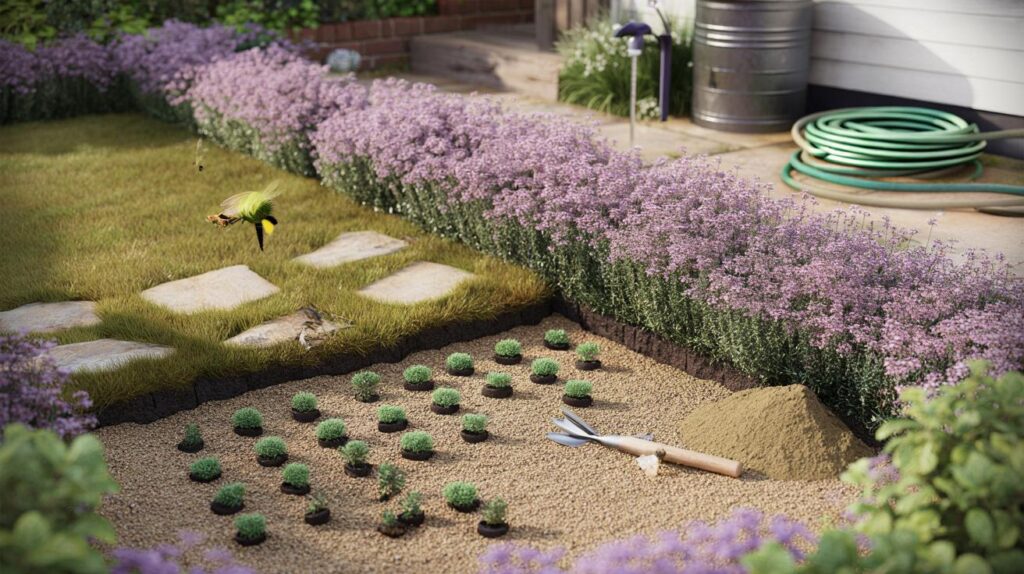
Gardeners are rethinking their plots as weather and wallets tighten, seeking greener looks with fewer chores and sweeter scents outside.
A quiet shift is creeping across Britain’s front gardens and back patches. Thymus serpyllum — better known as creeping thyme — is edging out thirsty turf, promising fragrance, bees and fewer chores. With hosepipe restrictions becoming familiar and energy bills gnawing at weekends, people want surfaces that behave. Thyme is stepping up.
What is creeping thyme, really
Creeping thyme is a low, mat-forming herb that hugs the soil at roughly 3–8 cm. It thrives in full sun, sends out tiny pink or purple blooms in early to midsummer, and releases a clean, herby scent when brushed. Unlike many groundcovers, it stays neat without constant clipping and shrugs off dry spells once settled.
Think of it as a living rug: scented, evergreen-ish, drought-leaning and humming with pollinators in June and July.
What’s driving the switch
The British dream of a billiard-table lawn has met modern reality. Frequent hosepipe bans, rising water costs, and the time drain of mowing have pushed homeowners towards lower-maintenance groundcovers. There’s also a biodiversity angle: lawns do little for insects, while thyme’s nectar-rich flowers feed bees and hoverflies for weeks.
Numbers that matter
- Sun: aims for 6+ hours a day; light shade reduces flowering and density.
- Soil: free-draining; sandy or stony is fine; pH around neutral to slightly alkaline suits it.
- Height and spread: 3–8 cm tall; spreads slowly, weaving into a continuous mat.
- Planting density: 9–12 plugs per m² for quick coverage; 6 per m² if you can wait longer.
- Timeline: expect 18–30 months to knit fully, depending on spacing and rainfall.
- Traffic: light, occasional footfall only; protect main desire lines with stepping stones.
| Feature | Conventional lawn | Creeping thyme |
|---|---|---|
| Water use after establishment | Needs irrigation in dry spells | Rare watering; copes with drought |
| Mowing | 20–30 cuts a year | No mowing; occasional light trim |
| Height | 5–10 cm with regular cuts | 3–8 cm naturally |
| Foot traffic | Moderate to heavy | Light; stepping stones recommended |
| Pollinator value | Low when mown short | High during bloom |
| Fertiliser | Often used for colour | None; rich feed weakens scent |
If you usually water a 50 m² lawn with 20 litres per m² weekly for 20 summer weeks, switching to thyme could avoid roughly 20,000 litres a year.
When and where to plant
Plant in spring or late summer when soil holds warmth but isn’t parched. Choose an open, sunny site. Drainage matters more than fertility. Sandy, gravelly and even slightly chalky ground suits thyme. Heavy clay needs help: mix in sharp sand and fine gravel to improve percolation, and raise the surface by a few centimetres if puddles linger.
Thyme excels between paving, on banks, over low walls and in gravel gardens. It sits well with alpines, sedums and low ornamental grasses. In small spaces, it thrives in broad containers where its scent and texture sit at nose level.
How to plant for a living carpet
Clear existing weeds right down to roots. Rake to a fine, open tilth. If you’re ripping out tired turf, remove the top sward, loosen the subsoil, and blend in grit to keep things airy. Mark out a rough 30–40 cm grid for plugs or 20–30 cm for small pots if you want faster coverage. Water plants in, then water weekly through the first dry spells until they put on new growth.
For faster fill, plant 9–12 thyme plugs per square metre and drop stepping stones into high-traffic routes on day one.
Care without faff
- Year one: water during dry runs to establish roots; after that, leave it unless drought bites.
- Feeding: skip fertiliser; lean soil keeps growth tight and fragrance strong.
- Trimming: shear lightly after flowering or before autumn to keep it level and encourage sideways spread.
- Weeds: hand-weed early. A dense mat will suppress most interlopers by year two.
- Winter: fully hardy in most of Britain; avoid winter-wet. Good drainage prevents crown rot.
Where thyme struggles
Shade is the main deal-breaker. Under heavy shade, mats thin, and gaps invite weeds. Consistently wet sites encourage rot. Football-mad families and dogs that pace the fence will test it to destruction. For shade, try sweet woodruff or ajuga. For tougher use, consider a mixed tapestry of dwarf clovers and yarrow, or stick with a small, reinforced turf zone and flank it with thyme either side.
Costs, time and what to expect
Planting a 20 m² patch at 9 plugs per m² means about 180 plants. Retail prices vary widely by region and supplier, but plugs often sit in the low single pounds each, with 9 cm pots costing more. That puts a weekend conversion within reach for many households, especially if you phase it: start with the sunniest third, add stepping stones, then extend the mat as budget and time allow.
The payback is measured in hours not pushing a mower, lower water bills, more quiet evenings, and a garden that smells subtly of summer whenever you step outside. Your bees will notice before your neighbours do.
Frequently asked questions growers keep asking
Will it handle children and pets
Light play is fine; regular sprints are not. Protect common routes with stone slabs set level with the soil. Dogs usually respect stones and gravel edges, which keeps paws off soft patches.
Can I sow seed instead of buying plants
Seed is cheaper, but germination is uneven and seedlings are slow. Use seed for small gaps and pots. For larger areas, plugs or small pots compress the timeline by a full season.
Does it stay green all year
Leaves stay present through winter, though colour softens in the cold. Spring warmth restores the brighter green, followed by flowers.
A quick weekend plan you can copy
- Friday: lift scruffy turf and barrow in two bags of sharp sand per m² for heavy soils.
- Saturday morning: lay a stepping-stone path along the busiest line; set stones flush to the surface.
- Saturday afternoon: plant 9–12 plugs per m², water in, and mulch very lightly with fine gravel.
- Sunday: fit a simple soaker hose for year-one dry spells, then put it away once plants take.
Two extra details worth knowing. First, the term “plug” means a small, young plant grown in a compact cell — it settles faster than seed and cheaper than larger pots. Second, “crown rot” describes dieback at the plant’s centre from standing water; drainage fixes it, not feeding. Run a quick test: after rain, if water sits for more than an hour, add grit and raise the bed before planting.
If you want the effect without committing the whole garden, trial a 3 m² patch by the path at 10 plugs per m². You’ll gauge traffic tolerance, your soil’s drainage, and how quickly it knits on your site. If it passes the test, extend in spring with the same spacing and keep the stones where feet fall most.



Finally, something that smells good and frees me from the fortnightly mow—count me in! The bee-friendly blooms and low watering sound perfect for my tiny terrace. Going to try 9 plugs per m² with a stepping-stone path. Thanks for the clear, no-faff guide 🙂
20,000 litres saved sounds huge—are you assuming zero rainfall and consistent bans? Could you show the calcualtions for a typical wet summer vs. dry summer in, say, Manchester? Also, thyme’s ‘light traffic only’ feels like a deal‑breaker for families.