
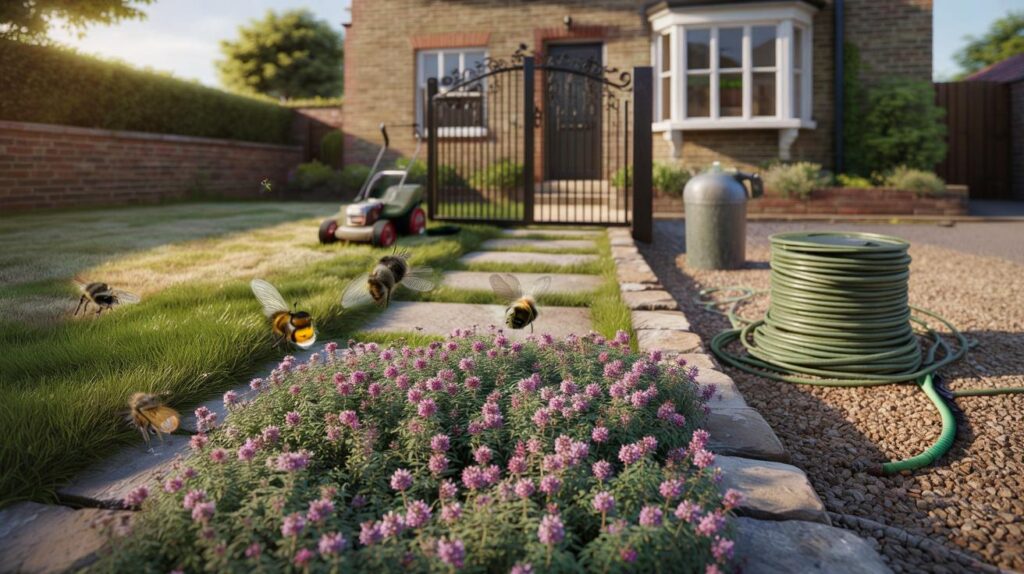
Across Britain, gardeners face parched summers, bald patches and rising bills. A low, scented cover spreads quietly, promising relief and charm.
Water limits, soaring maintenance and a hunger for wildlife-friendly spaces are reshaping front gardens and back yards. The new favourite is not grass at all, but a hardy herb that turns stress into scent.
Why creeping thyme is replacing grass
Grass asks for mowing, feeding and regular watering, then sulks in a heatwave. Creeping thyme, also known as Thymus serpyllum, flips that script. It hugs the soil, drinks sparingly and keeps its colour. Brush it with your hand or your shoes and it releases a warm, herbal aroma. Bees find it fast in summer, and the tiny pink or purple flowers turn a path or patio edge into a soft, humming border.
Swap a 20 m² patch to creeping thyme and you cut routine mowing to almost nothing while boosting nectar for pollinators.
The trend is not just about ease. Hosepipe bans bite, water rates climb, and many households want spaces that look good with less effort. Thyme suits modern life. You can walk on it now and then. You can tuck it between pavers. You can trim it lightly once a year and leave it alone.
What shifts in Britain are driving the change
- Longer dry spells make grass brown and brittle, while thyme tolerates drought once established.
- Small gardens need plants that do more than one job: cover ground, feed insects, scent the air.
- Families want safer surfaces than gravel yet lighter maintenance than turf.
- Designers favour patchwork planting with stepping stones to manage footfall without bare earth.
How creeping thyme performs in a real garden
Think of creeping thyme as a living carpet with limits. It forms a dense mat that smothers many weeds. It stays low, often under 8 cm, so it never demands a mower. It tolerates sandy, gravelly or slightly chalky soil. It prefers full sun and free drainage. It rewards patience: the first year shows slow spread, then it knits together in years two and three.
Use stepping stones where feet fall often. Thyme copes with occasional traffic, not five-a-side football.
In summer, flower clusters open for weeks and pull in bees and hoverflies. Leaves carry flavour, so you can snip a sprig for the pan. In winter, the foliage stays neat and holds its shape, giving a tidy look when most borders are bare.
Water, time and cost: the numbers
Here is a simple comparison for a typical 20 m² front patch in southern England.
| Measure | Conventional lawn | Creeping thyme |
|---|---|---|
| Water use, May–Aug | 8,000–12,000 litres if irrigated weekly | 0–2,000 litres after year one, only in extreme drought |
| Mowing time per season | 18–25 hours | 0 hours, plus one 30‑minute tidy trim |
| Fertiliser and feed | Spring feed common | Not required; rich soil can reduce scent |
| Upfront cost | £3–£6/m² (seed or basic turf) | £5–£12/m² (plugs or small pots), falling if you divide plants |
| Biodiversity value | Low nectar in summer | High nectar during bloom, strong insect draw |
Planting and care
Plant in spring or late summer when soil holds warmth but is not baked. Choose a sunny site with good drainage. Add coarse grit if your soil sits wet in winter. Space plugs 20–30 cm apart for a standard fill, or 15–20 cm if you want a faster knit.
Water new plants in well for the first few weeks. Then ease off. Let roots chase moisture. Skip fertiliser. Trim spent flowers with shears in late summer to keep the mat even. Pull any tall weeds early, before they root through.
Thyme thrives on neglect once roots are down. Less water, less feed, less fuss.
Where it works, where it doesn’t
- Best: full sun, light soils, slopes, between paving, gravelly front gardens, roof terraces with shallow substrates.
- OK: light shade for part of the day, provided drainage is sharp.
- Poor: heavy clay that puddles, deep shade, spots with constant footfall such as football goals or busy play routes.
Varieties worth a look
Different creeping thymes give different textures and colours. Mixing two or three can add depth without raising maintenance.
- Thymus serpyllum: classic low mat, soft pink flowers, strong scent.
- Thymus praecox ‘coccineus’: vivid magenta bloom, good spreader for sunny slopes.
- Thymus ‘elfin’: tiny leaves, very low habit, neat between paving stones.
- Thymus ‘doone valley’: variegated gold-green leaves, lemony scent, showy in pots.
How to start this weekend
Mark the area you want to convert. Lift weak turf with a spade. Rake out roots. Add 3–5 cm of sharp sand or gravel if your soil holds water. Rake level. Set plants on a grid, tuck them in, then water once. Lay stepping stones where feet will land. Mulch lightly with fine gravel to suppress weeds while the canopy closes.
A quick plan for a 20 m² front patch
- Buy 80–120 plug plants depending on spacing and budget.
- Position 40 cm stepping stones along the path from gate to door.
- Edge with low bricks or steel to stop spill onto pavements.
- Trim once after the first main flush of flowers.
What you gain, what you trade
You gain scent, colour and less work. You lose a flat kickabout lawn. You keep a stable winter look. You cut watering, cut noise, and give bees a clear nectar source. You accept occasional gaps in year one and two while plants knit, and you accept delicate patches where heels hit hard. Stepping stones fix most of that.
Extra notes for keen gardeners
Try a mixed groundcover matrix if you want more texture. Combine creeping thyme with sedum, chamomile and low fescue in distinct drifts. The thyme fills gaps and scents the walk, sedum handles heat on the driest edges, and chamomile softens the look with daisy-like heads. Keep each patch in sun and let them meet at stone joints.
Run a simple water-saving check. Note your meter before and after a hot week when you would normally irrigate a lawn. Replace that routine with a single 10‑minute soak on new thyme only. The number you see at the meter gives you a personal saving to aim for. If you live on heavy clay, start with a raised strip or a sunken path inlaid with grit to prove the concept before converting a full lawn.



Brilliant guide—my hosepipe ban panic just eased. Quick q: on heavy clay in Northants, would adding 5 cm of sharp sand truely be enough, or should I start with a raised strip first?