
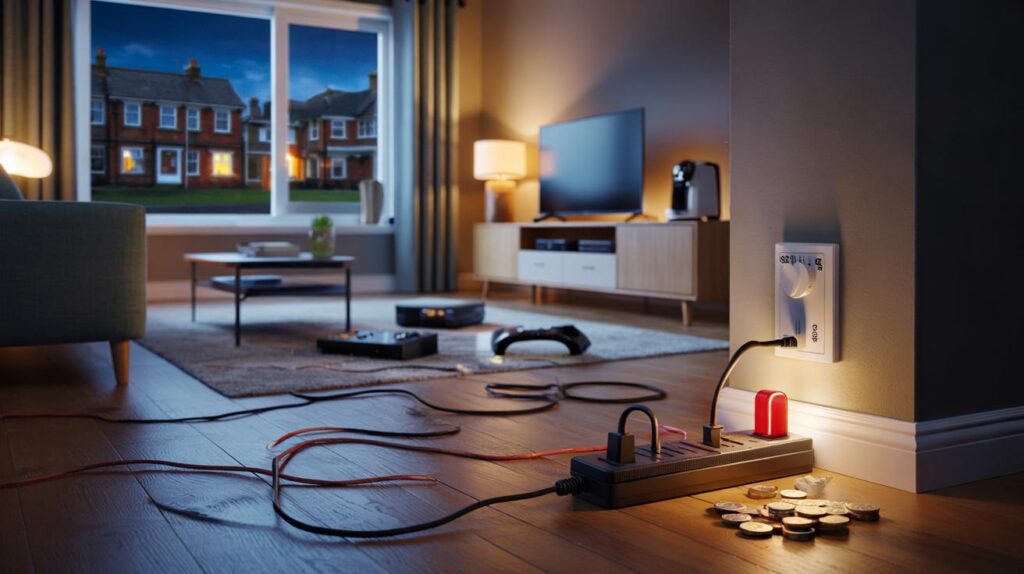
Energy bills creep up while your routines barely change. A quiet fix hiding by the skirting board can shift the numbers.
Across the country, households report a steady trickle of “phantom” electricity use while everyone sleeps. A low‑tech pairing — a switched power strip and a simple timer — revives a pre-digital habit and trims costs without denting comfort. People using it for a few weeks talk about double‑digit percentage reductions on the part of the bill linked to idle electronics.
The old habit behind a new saving
Your grandparents cut power to idle appliances because every kilowatt-hour mattered. That reflex slipped as modern gadgets arrived with glow-in-the-dark LEDs and ever-ready chargers. Those tiny lights and warm power bricks mark energy drawn around the clock. Engineers call it standby load, or vampire power. It adds up across televisions, set-top boxes, soundbars, printers, coffee machines, consoles and chargers.
Cutting supply at the wall removes that trickle. Do it on a schedule and you do not need to remember. A mechanical, programmable timer turns a switched power strip off while the house sleeps, then brings it all back before breakfast. No apps. No passwords. No cloud account. You set it once and get on with your life.
Households report up to about 15% off the slice of their bill tied to idle electronics, with some seeing roughly £18 a month shaved off during colder months.
How the £15 timer + power strip setup works
You group the right devices, plug them into a power strip with an illuminated switch, and connect that strip to a cheap mechanical timer. The timer cuts power between set hours, typically overnight. In the morning, your kit wakes normally.
What to include — and what to leave out
- Include: TV, set-top box, games console in rest mode, soundbar or amp, printer, coffee machine, spare chargers, decorative lighting.
- Exclude: fridge and freezer, internet router if you rely on overnight connectivity, alarm systems, medical devices, anything that needs updates at night for safety.
Suggested schedule for most homes
A common window is 23:00 to 06:00. That gives seven hours of automatic savings every day. Shift by an hour in winter if you relax later. Shorten the window during holidays if you binge-watch late. The goal is simple. Power down when no one needs those sockets. Power up before the first kettle boils.
A seven-hour nightly cut on a 40–100 W cluster removes roughly 102–256 kWh a year, worth about £30–£77 at 30p per kWh.
What you need and how to set it up
- One switched power strip with at least six sockets.
- One mechanical programmable timer, roughly £10–£15.
- Sticky labels to name each plug, so guests and teenagers know what is what.
- A note of your typical usage times for TV, coffee and gaming.
Place the strip within 1–1.5 metres of your devices. Label each plug. Watch your household’s routine for a week. Program the timer for the overnight window that matches your life. Keep the strip accessible, so anyone can override it with the big switch for a late film or an early brew.
What households report saving
Families who grouped entertainment gear and chargers on one timed strip reported quick wins. Some saw about £18 trimmed from a monthly statement after three weeks, helped by higher winter tariffs and energy-hungry set-top boxes. Others measured more modest gains with newer, efficient televisions. The pattern remains clear. Every watt you stop drawing for hours adds up across a year.
Results vary with the number of devices, their standby draw, and your unit rate. Old DVR boxes and AV amplifiers often sip 10–20 W each while resting. A modern TV might use under a watt. A console in rest mode can pull 5–10 W if it keeps downloads running. Test your setup and adjust.
The quick maths you can use
Savings (£) = total standby watts × hours off per day × 365 ÷ 1000 × unit price (p/kWh ÷ 100)
If your cluster totals 60 W, and you cut power for seven hours each night at 30p/kWh, the yearly saving is 0.06 × 7 × 365 × 0.30 ≈ £46. nThat outstrips the cost of the kit within weeks.
Typical standby costs at current prices
The figures below use 30p per kWh as an illustration. Your supplier may charge more or less.
| Device or group | Typical standby watts | Annual cost if left on 24/7 | Saving if off 23:00–06:00 |
|---|---|---|---|
| TV + set-top box (older DVR) | 12–18 W | £31–£47 | £9–£14 |
| Games console in rest mode | 5–10 W | £13–£26 | £4–£8 |
| Soundbar or AV amp | 8–12 W | £21–£32 | £6–£9 |
| Printer | 3–5 W | £8–£13 | £2–£4 |
| Chargers (3× idle) | 3 W | £8 | £2–£3 |
| Grouped strip total | 40–100 W | £105–£263 | £30–£77 |
Comfort intact, risk managed
The timer returns power before you wake. The TV remote works. The console boots. The coffee machine heats in minutes. You keep the evening routine you like. You lose the glowing LEDs at midnight and the silent drain that went with them.
Safety matters with extensions and strips. Keep them off carpets and away from moisture. Avoid daisy-chaining strips. Check the total load rating and use surge protection if your gear is expensive. Do not include heat sources such as heaters or irons on a timed strip. Keep ventilation clear for power bricks and AV units.
Low-cost alternatives and upgrades
- No timer to hand? Set phone alarms for a manual off/on routine using the strip’s switch.
- Smart plugs can schedule per-device cuts and show exact kWh, often at £10–£30 each. One or two on greedy devices can rival the strip-and-timer method.
- A cheap plug-in power meter lets you measure standby watts and prioritise the worst offenders.
Small extras that lift the savings
Electronics can draw more in damp rooms. Aim for indoor humidity around 40–60%. A dehumidifier run in short, targeted bursts can lower latent loads on other kit. Many consoles and boxes have deep-sleep modes that cut standby below one watt. Switch those on in settings. Disable “instant on” features that keep chipsets warm for a faster wake.
Use your in-home display or smart meter data to check progress. Note a baseline week. Install the timer and strip. Compare the next week at similar temperatures. You want a visible step down overnight. If you use overnight charging for bikes or laptops, move those chargers to a second, always-on socket to avoid clashes. Keep the entertainment strip on the schedule.
Who gains the most from this trick
People with older DVR boxes, big AV receivers, always-warm coffee machines and multiple chargers stand to gain most. Renters who cannot alter wiring still get control with a portable setup. Parents get a tidy off-switch for late-night gaming without arguments. Remote workers who shut down at six can push the off window earlier and widen the saving.
Run your own quick simulation
List your devices and their standby watts from manuals or a plug-in meter. Add the watts. Pick your nightly off hours. Multiply by your tariff. If the bundle totals 70 W and you cut eight hours at 28p/kWh, you bank about 0.07 × 8 × 365 × 0.28 ≈ £57 a year. Two strips in different rooms double the reach. A one‑off £15–£25 outlay pays back fast and keeps paying through future price cycles.



Does cutting power 23:00–06:00 interefere with console updates or DVR recordings? If the timer flips mid-download, any risk of corruption, or do most devices fail safely and retry? Tips for handling routers when night backups run?