
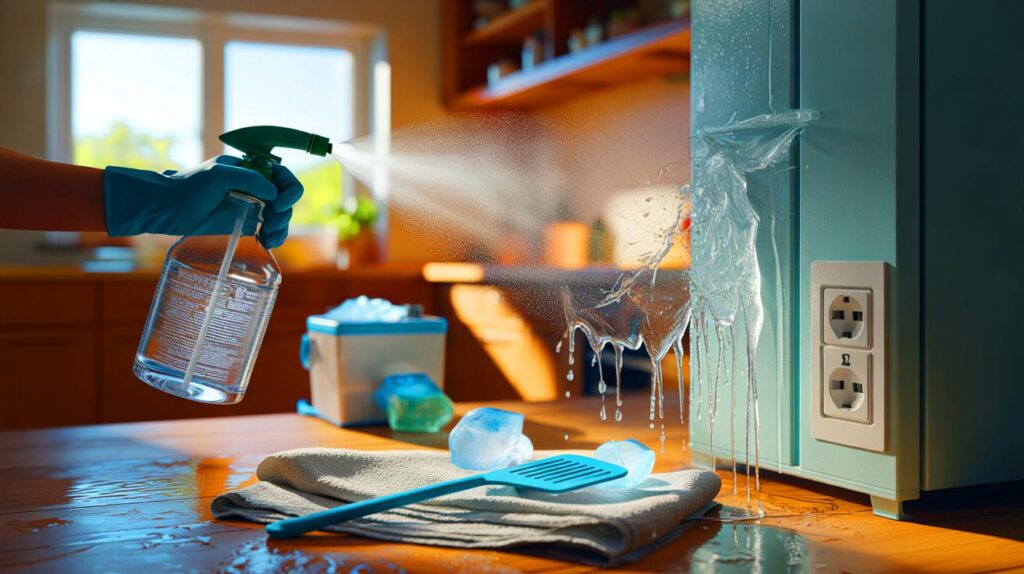
Energy bills keep biting and kitchen routines feel heavier as temperatures drop. A quiet shift at home could trim costs.
Across the country, families report stubborn frost on fridge and freezer walls, sticking drawers and sluggish cooling. Left alone, that frost eats energy and strains the motor. A small layer grows into a big bill. A plain, low-cost mix from the cleaning cupboard is now doing the rounds, and it works in minutes.
Why frost is costing you 30 to 40% more
Frost insulates the cold from your food. The compressor runs longer and harder. Space for storage shrinks. Experts flag a sharp jump in electricity use once deposits thicken.
As little as 3 mm of frost can raise consumption by 30 to 40%, while shortening the life of the appliance.
Act before ice builds. You protect food quality and reduce wear. You also reclaim capacity inside the cabinet. Start with simple preparation and a safe set-up.
Set-up before you start
- Unplug the appliance. Turn off the power at the wall.
- Empty shelves and drawers. Use cool boxes with ice packs or frozen bottles to hold food.
- Protect the floor with towels. Place more towels inside to catch meltwater.
- Keep a plastic spatula to ease loose chunks. Do not use knives or anything sharp.
- Keep children and pets away. Work with good ventilation.
The three-ingredient spray households swear by
Mix equal parts household alcohol, clean water and white vinegar. Many homes use isopropyl alcohol or surgical spirit. Pour the thirds into a spray bottle, screw on the top, and shake once. Mist the frost generously. Wait a few moments. Ice loosens and falls away. Wipe as you go. Lift off the larger pieces with your plastic spatula. Spray again on any patches that cling. The vinegar helps deodorise. Alcohol speeds melting and evaporation.
Formula for speed: 1/3 alcohol + 1/3 water + 1/3 white vinegar, sprayed directly on the frost.
Proportions and safety
- Stick to equal thirds. More alcohol speeds action but increases fumes.
- Use alcohol around 70% strength. Keep flames and sparks far away.
- Open a window. Wear gloves if your skin is sensitive.
- Keep the spray off food. Remove any items before you start.
- Test a small area of a door seal if your appliance is old. Wipe dry after use.
No spray fast alternatives that still work
If you lack a spray bottle, other home methods can cut the job to minutes. Each option has a time window and basic precautions. Choose what suits your layout and the amount of ice.
| Method | Typical time | Key notes |
|---|---|---|
| Pan of boiling water inside, door closed | 10 to 15 minutes | Steam softens frost fast. Replace water when it cools. Keep electrics dry. |
| Fan facing the open cavity | 10 to 20 minutes | Blowing room air speeds thaw. Works best in a warm kitchen. |
| Hairdryer held 30 cm from walls | 15 to 30 minutes | Watch the cord and puddles. Do not focus heat on plastic trims. |
| Fine layer of table salt on thin frost | 5 to 15 minutes | Salt lowers the melt point. Wipe residue thoroughly afterwards. |
| Commercial de-icer spray | 15 to 30 minutes | Follow label guidance. Keep off food. Ventilate well. |
| Unplug and wait (“patience” route) | Up to 24 hours | Low effort. Needs plenty of towels. Best if you can empty the cabinet. |
| Basin of very hot water inside | Around 60 minutes | Shut the door to trap heat. Mop meltwater regularly. |
Clean and reset to slow the return
Once the last sheet of ice drops, clean the cavity. Mix white vinegar with warm water. Wipe shelves, walls and door seals. Rinse with clear water. Dry with a cloth. For odours, use warm water with bicarbonate of soda. Dry again. Refit drawers. Load the food back in. Plug in and switch on.
- Keep doors open only as long as needed. Moist air rushes in and condenses into frost.
- Avoid overfilling. Cold air must circulate around packages.
- Check door seals. Replace if they split, warp or fail the “paper strip” test.
- Set the thermostat correctly. Aim for -18°C in the freezer and 0 to 5°C in the fridge.
- Defrost every three months, or whenever frost reaches 3 mm.
- If ice returns fast, suspect a leaky seal, a clogged drain or a faulty thermostat.
Plan a light defrost every three months or at the 3 mm mark to prevent a 30 to 40% energy spike.
How much could you save, realistically
Consider a compact freezer rated at 200 kWh per year under normal use. A 35% uplift from persistent frost pushes that to 270 kWh. At a unit rate of 28 pence per kWh, that extra 70 kWh costs about £19.60 a year. Larger chest freezers draw more, so the gap grows. Add wear on the compressor and you risk an earlier breakdown. A ten-minute spray twice a season cuts that risk and trims the bill.
Food safety and timing while you work
Keep chilled goods in an insulated bag or cool box with frozen gel packs. Separate frozen and fresh items. In a typical kitchen, well-packed frozen food holds for two to four hours if you limit lid opening. Use a fridge thermometer to track the rebound. Do not refreeze food that has thawed significantly. Cook it instead. Raw meat should remain below 5°C. Freezer storage should return to -18°C before you reload ice cream or delicate items.
What to avoid
- No knives, chisels or screwdrivers. One slip can pierce a coolant line and write off the unit.
- Do not pour boiling water directly on shelves or drawers. Rapid shock can crack plastic or glass.
- Keep electrical tools away from puddles. Dry surfaces as you go.
- Do not spray near a gas hob or open flame. Alcohol vapour ignites.
Frequently asked questions
Can I use table salt on thick ice
Salt helps on a light glaze. On heavy buildup it works slowly and leaves residue. Use heat or the three-ingredient spray first, then a light shake of salt on stubborn rims.
Does a frost-free freezer need this
Frost-free models use a heater and fan to clear ice on a cycle. Doors opened often, damaged seals or a packed cabinet can still produce frost. You can still clean and check seals. If ice persists on a frost-free unit, book a service check.
Which alcohol is best
Isopropyl alcohol or surgical spirit suits most jobs. Ethanol-based household alcohol also works. Avoid perfumed products that leave odours. Keep concentration near 70%. Store the bottle out of reach of children.
Will vinegar smell linger
The scent fades as it dries. Rinse with a clean damp cloth and dry with a towel. Place a small open pot of bicarbonate inside for a day if odour remains.
Extra guidance to stretch the benefit
Pack food in flat layers to speed cooling and reduce frost. Let leftovers cool before you store them, as steam turns to ice inside. Label and date bags to reduce door-open time. Wipe spills quickly; sugars and sauces trap moisture and freeze into crusts.
If you keep a second freezer in a shed or garage, pick a model rated for low ambient temperatures. Some units struggle in unheated spaces and build frost faster. A simple plug-in energy meter can show the real draw before and after a defrost. The reading helps you time your next session and quantify savings.



Brit here—energy bills still sting. Just tried the three-ingredient spray on a frosty drawer track—worked in under 5 minutes. Towels soaked, but job done. Thanks for the no-knives warning.