
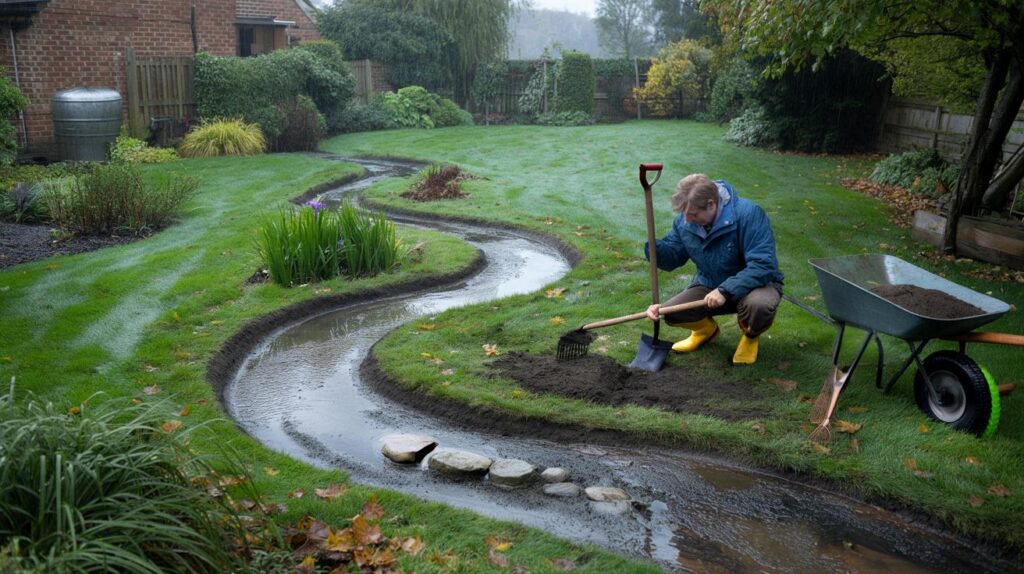
Autumn rain is swelling ditches, filling water butts, and turning neat lawns into sponges. Your garden could be next.
Across the country, heavy showers are colliding with compacted turf and clogged borders. Many households will watch puddles linger for days. A simple, almost cost-free move can change that picture before winter bites.
Why soaking gardens return every autumn
Rainfall is not the only culprit. Soil that cannot breathe, rigid edging that pins water in place, and slight dips in the wrong spots all combine to trap moisture. Clay-heavy plots struggle most when downpours arrive in quick bursts.
Hidden culprits in your soil and layout
Footfall compacts turf. Robotic mowers and wheelbarrows press surfaces flat. Fences and straight raised beds interrupt the natural path of water. Even a gentle gradient can fail if borders act like dams. The result is surface pooling instead of steady seepage into deeper layers.
Different soils drink at different speeds. Clay accepts water reluctantly. Sandy loam drinks fast but can let it race away before plants benefit. Matching your drainage approach to your soil pays off within weeks.
| Soil type | Typical infiltration rate (mm/hour) | Tip for autumn |
|---|---|---|
| Clay or clay loam | 2–10 | Create a shallow sinuous swale to spread and soak, plus regular aeration |
| Silty loam | 10–20 | Use curves to slow flow and add organic mulch to build soil structure |
| Sandy loam | 20–50 | Capture quick runoff with micro-basins and plant thirsty perennials |
What waterlogging does to roots, turf and microbes
Standing water quickly strips oxygen from soil pores. Roots suffocate. Beneficial microbes stall. Turf yellows. Fungal diseases exploit stress, and moss spreads where grass thins. Flower borders lose vigour and biodiversity drops.
As little as 24–48 hours of pooled water can starve roots of oxygen and trigger fungal flare-ups.
The overlooked expert move: install a sinuous shallow swale
Many assume drainage means trenches, pipes and big bills. Instead, shape a gentle, wavy depression that guides water through the lawn and along borders. Landscapers call it a swale. You can form one with a spade and a rake in an afternoon.
Shape, depth and slope that make water behave
Aim for 20–30 cm deep and 40–80 cm wide. Let the line weave, not run arrow-straight. Curves slow water, spread it, and invite infiltration. Follow the natural fall of the land with a faint 1–2% gradient so water moves without scouring soil.
Curves slow, straight lines rush. Slower water sinks in; faster water floods out.
Place the swale where puddles form or along the foot of a slope. Keep it at least 2–3 m away from house foundations and never channel water towards a neighbour. If utilities may cross the lawn, check before you dig.
- Mark a wavy route with string or a hose.
- Slice turf and skim out 20–30 cm of soil along the line.
- Feather edges, leaving a gentle shoulder rather than sharp sides.
- Add a 5–7 cm layer of leaf mould or compost in the base to encourage soaking.
- Set a subtle overflow towards a bed or wildlife corner, not a hard path.
- Bed a few fist-sized stones in the base to break flow and shelter helpful insects.
A 10 m swale, 30 cm deep and 60 cm wide holds about 1,800 litres — enough to catch a sharp burst.
Planting that drinks, filters and holds the banks
Choose species that enjoy damp feet yet cope with dry spells between showers. Mix heights and textures for year-round structure.
- Carex species for fine evergreen texture and root mats that grip soil.
- Mentha aquatica for scent and pollinator-rich summer flowers; use root barriers to tame spread.
- Iris pseudacorus for bold spring flowers and strong rhizomes that pin the bank.
- Hosta near shadier sections; broad leaves slow splash and shield soil.
- Filipendula, juncus and primula for moisture-loving variety and winter bones.
Plant carex on the shoulders, iris in the midline, and mint where water lingers longest. This zoning balances looks with function. Dense roots stabilise earth, filter fine sediment, and store moisture that plants release slowly back to the bed.
Quick wins you can do today
Mulch, aerate, and work with garden wildlife
Spread 5–7 cm of organic mulch in the swale and around thirsty perennials. It reduces surface sealing and feeds soil structure. Spike compacted turf with a garden fork to 8–10 cm depth every 10–15 cm. Repeat after major storms. Earthworms will take it from there, building channels that carry water down.
Leave a few stones or a log pile near the lowest curve. Hedgehogs and ground beetles feed on slugs and leatherjackets that thrive in damp lawns. That natural patrol keeps turf damage down while the ground rebalances.
Low-cost kit and time needed
- Tools: spade, rake, fork, wheelbarrow.
- Materials: home-made compost or leaf mould, a bucket of stones, optional plugs of moisture lovers.
- Cost: £0–£50 if you already have tools; a landscaper may charge £150–£400 for half a day.
- Time: 2–4 hours for a small garden; a weekend for larger plots.
How fast you’ll see change, and what to adjust
Signs the fix is working
- Puddles vanish within 2–4 hours after steady rain, not days.
- Turf feels firm underfoot and footprints spring back.
- Moss recedes and blades green up across weak patches.
- Fewer fungal blotches on leaves and fewer bare rings in beds.
Most gardens show clear gains within 2–6 weeks of regular autumn rainfall and light maintenance.
Fine-tuning after the first storms
If a low spot still collects water, extend the swale by 2–3 m or add a shallow side pocket. In heavy downpours, a scattering of 20–40 mm gravel in the base of the wettest metre slows flow and protects soil. If water races out too fast, soften the gradient with an extra curve or raise one shoulder by 2–3 cm using mulch.
Keep the overflow safe. Direct it into a planted bed, not onto paving. In very wet districts, create a small rain garden basin where the swale ends. A round dip 2 m wide and 20 cm deep, filled with coarse mulch and planted thickly, soaks surprise cloudbursts.
Numbers that help you plan
Use rainfall volume to size your swale. A 50 m² lawn under a 20 mm shower receives 1,000 litres. A single curved channel 10 m long, 60 cm wide and 30 cm deep handles that comfortably if the soil is willing to drink. In clay, split capacity between two shorter curves so water spreads instead of lingering.
Leave a buffer from buildings and boundaries. Keep swales at least 2 m from walls, sheds and hard standings. Do not direct water onto a neighbour’s land. Check for buried cables and pipes before digging, especially near drives and service runs.
Extra gains you can bank for spring and summer
That shallow depression pays off when weather swings the other way. Moisture stored along the curve reduces hose use in dry spells. Plants dug into the swale line often need fewer summer waterings. Birds and pollinators use the lush strip as a corridor, lifting garden resilience without extra work.
Pair the swale with light seasonal tasks. In spring, plug gaps along the curve with drought-tolerant yet moisture-friendly perennials such as geum or astrantia, which bridge wet and dry cycles. In early summer, trim mint and remove spent iris stalks to keep flow channels clear. In early autumn, top up mulch before the first big storm line rolls through.



Brilliant explainer — dug a 30 cm wavy swale this afternoon and the first shower already soaked in. Cost me £0 and two blisters 🙂 Cheers for the overflow tip away from the house.
Are you sure a 30 cm dip won’t undermine nearby paths? Our estate has strict rules about run‑off onto a neighbour’s plot. Any UK guidance/regs to check before I start diging, or is this more of a common‑sense thing?