
Hosepipe bans, cracked soil and rising bills are back. Residents across Britain are scrambling for a cheaper, drought-proof plan.
As summers stretch hotter and drier, gardeners are turning to low-tech fixes that build resilience. One quietly resurging approach draws on the roof above your head. It stores rain during wet spells and rations it to crops when taps run dear or restrictions bite.
The forgotten fix: from gutter to lifeline
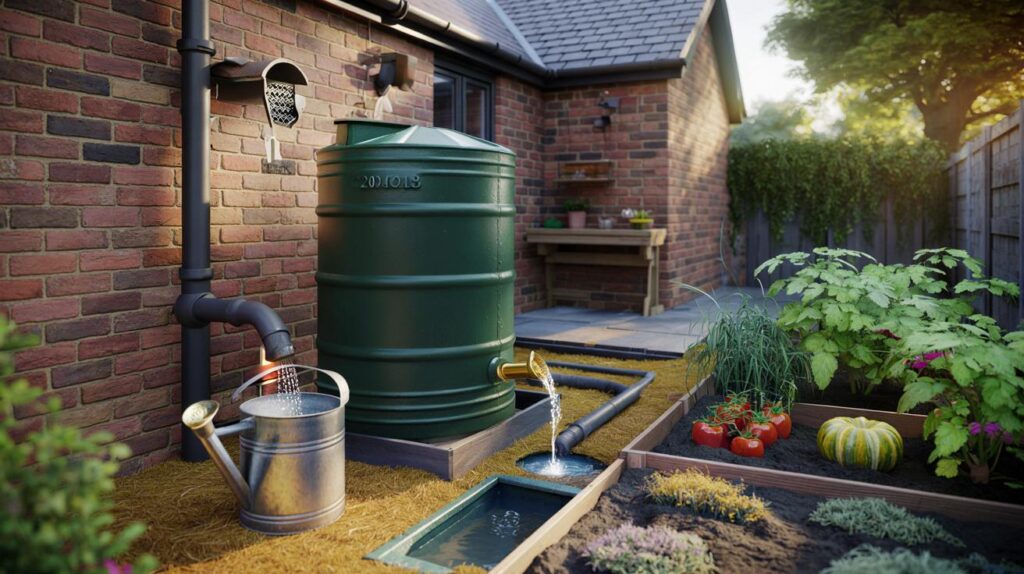
Decades ago, many homes kept a barrel beneath the downpipe. Today that habit is returning, from terraces in Leeds to smallholdings in Devon. A simple diverter clips into the guttering, channels rainfall into a sealed tank, and gives you a pressurised outlet for a hose or watering can.
It is basic by design, and that is the point. No electronics. Few moving parts. When councils warn of hosepipe bans, a full barrel turns anxiety into a plan.
Every millimetre of rain on 1 square metre yields close to 1 litre of water. A 50 m² roof in a 12 mm shower can capture about 510 litres.
Why autumn set-up pays back by spring
Autumn brings regular rain and cooler temperatures. That combination fills tanks quickly and limits algae growth. Fit the kit now, and you carry stored water into late winter. Come April, you will have a buffer for seedlings, transplants and thirsty roots during dry spells.
Shaded placement matters. A barrel in sun loses litres to evaporation and warms the water, which can stress delicate crops. Keep lids tight to block debris and pests.
How the system works, in plain steps
- Measure roof area that feeds the chosen downpipe.
- Fit a downpipe diverter with a leaf and grit screen.
- Stand a 200–500 litre barrel on a sturdy, level base for gravity pressure.
- Add a tap near the base, an overflow to drain away from foundations, and a fine mesh under the lid.
- Link a second barrel when storage runs short; modular sets make this easy.
Most households start with a 200 litre barrel. Keen growers often double up. A pair of 200s provides a week or two of targeted watering for a family veg patch during a dry run.
Position tanks in shade, use a first‑flush diverter after long dry spells, and keep overflows well away from walls.
What you can collect: quick figures
The rough maths uses a runoff factor of 0.85 for pitched roofs. Use it to size storage and predict scarcity.
| Roof area (m²) | Rain in one event (mm) | Water captured (L) | 200 L barrels filled | Weeks of watering for 20 m² bed at 5 L/m²/week |
|---|---|---|---|---|
| 50 | 10 | 425 | 2.1 | 4.3 |
| 50 | 30 | 1,275 | 6.4 | 12.8 |
| 80 | 10 | 680 | 3.4 | 6.8 |
| 80 | 30 | 2,040 | 10.2 | 20.4 |
Your actual yield varies with roof material, wind, and downpipe losses. Even so, the rule of thumb helps you decide whether to add another barrel or step up to an IBC tank.
From barrel to bed: making every drop count
Stored water pays back when you deliver it precisely. That means slow and close to the soil. Splashy overhead sprays waste water and invite disease in cool weather.
Targeted watering that stretches storage
- Drip lines or soaker hoses powered by gravity feed root zones without run-off.
- Bury perforated bottles or clay pots beside tomatoes and squash to push water deep.
- Cut furrows along rows so water sits and infiltrates rather than flowing away.
- Mulch 7–10 cm with straw, leaves or chipped wood to curb evaporation and regulate soil temperature.
- Water early morning. Cooler air reduces loss, and plants start the day hydrated.
With two 200 litre barrels, drippers and a thick mulch, many gardens ride out 6–8 rainless weeks without opening the tap.
Soil life, pollinators and less chlorine
Rainwater lacks chlorine and treatment residues. That benefits earthworms, mycorrhizae and the micro-life that keeps soil crumbly. Healthier soil holds moisture longer and feeds plants steadily.
Wildlife wins too. A covered trough with a ramp offers safe drinking water for birds and hedgehogs. In return, they pick off slugs and pests. Keep any open water shallow and refreshed to prevent mosquitoes.
Costs, savings and practical risks
Entry costs stay modest. A 200 litre barrel runs roughly £35–£70. Diverter kits sit around £12–£25. Stands cost £20 or you can build one with blocks. A basic in-line filter adds a few pounds. A small 12 V pump for gentle pressure ranges from £40–£90, but most gardeners manage with gravity.
How much do you save? That depends on lawn size, veg area and rainfall. Households who switch garden watering to rain typically cut metered bills by £40–£120 a year, with peak savings in dry summers. In unmetered homes the benefit shows up as resilience rather than cash, but it still reduces demand on stressed supplies.
Aim to store four weeks of summer demand. If your beds need 150 litres a week, target 600–800 litres of storage.
Keep water use safe. Do not drink stored rainwater. Do not connect any rain system directly to the mains. Direct overflows away from foundations. Avoid spraying water onto edible leaves close to harvest; water the soil instead. In frost-prone areas, drain or lag exposed parts to prevent cracks.
Maintenance through the year
- Clear gutters each autumn and late spring to stop blockages.
- Rinse filters and meshes monthly during leaf fall.
- Flush the first-flush chamber after long dry spells.
- Check taps and seals for drips; a slow leak wastes precious litres.
- Scrub green film from inside surfaces in early spring to slow algae growth.
Why autumn prep changes next season’s harvest
Autumn projects run smoother. Hardware is in stock. Rain refills as you test, tweak and seal. By March you have muscle memory, a full tank and no surprises. Seedlings move outdoors into beds that already hold moisture beneath a mulch, and irrigation lines sit primed.
That head start shows up in survival rates. Young plants establish deeper roots, which reduces wilting on hot afternoons. Less stress means fewer blossom drops in tomatoes and peppers, and steadier yields.
Quick sizing and a simple plan you can copy
Try this two-minute calculation for a small British garden. Add your roof area in square metres that feeds the chosen downpipe. Multiply by an average autumn shower of 12 mm. Multiply by 0.85. That number is your likely capture for one event. If you tend 20 m² of beds needing 100 litres weekly in summer, four events at that size cover a month of watering. If storage cannot hold that total, add a second barrel or step up to a 500–1,000 litre IBC.
Combine storage with demand reduction. Replace a leaky spray gun with a watering can at the root. Shift thirsty crops like courgettes to the lowest part of a gentle slope so furrows pool water there. Group pots together and use saucers to cut waste.
Going further without overcomplicating it
Gardeners who want to push the idea often integrate a small roof section on a shed or greenhouse exclusively for edibles. The short run reduces contamination and simplifies cleaning. Others add a cheap soil moisture meter to avoid guesswork. Some capture one or two laundry rinse cycles separately for non-edible ornamentals, keeping a strict divide between greywater and food crops.
The risks stay manageable when you keep the system simple, covered and disconnected from drinking supplies. The gains accumulate: lower bills on a meter, fewer drought panics, healthier soil, and a garden that carries on when the tap must stop.



60 dry days in the UK? Bold claim—convince me.