
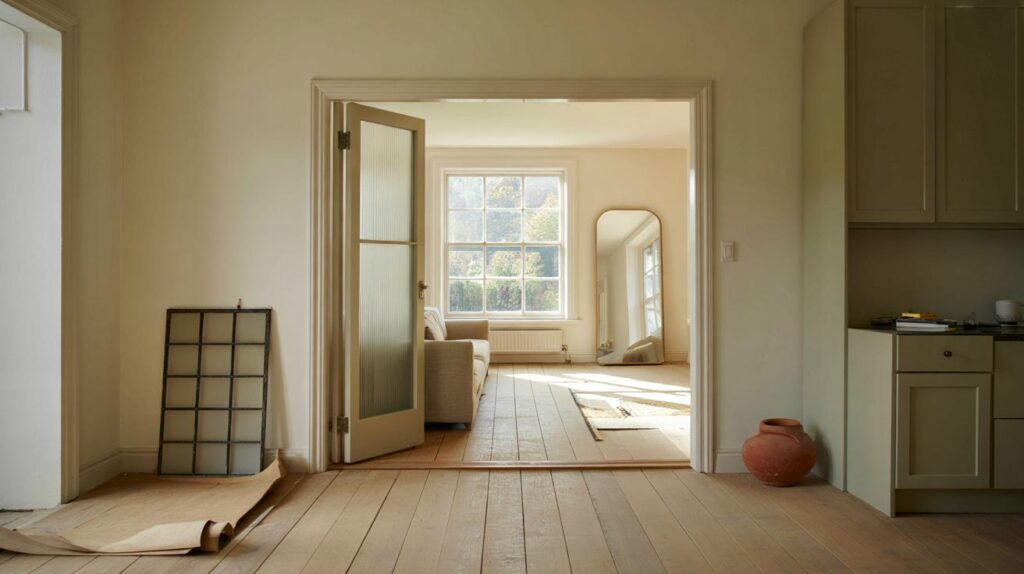
As the days shorten, homes crave calmer rooms, warmer textures and smarter routes for daylight to travel indoors.
Designers across Europe are quietly moving away from black-framed internal glazing and the catalogue “atelier” vibe. The new brief is simple: maximise real daylight, soften contrasts and keep rooms flowing. The result feels brighter, warmer and easier to live with from October through spring.
Why the factory look is fading
Saturation and sameness
Industrial-style partitions once felt daring. Now they’re everywhere. When a visual device dominates, the eye stops noticing it and the room loses personality. Repetition breeds fatigue. Many households want spaces that feel tailored to their routines rather than a set piece lifted from social media.
Light blocked where it matters
Internal glazing can underperform when frames are thick, panes are tinted or the opening sits off-axis from windows. Segments and muntins chop light into weaker shafts. Rooms end up bright near the glass and gloomy beyond it. In short, more glass does not always mean more luminance.
A chill in autumn and winter
Dark metal grids introduce visual cold. They break sightlines and puncture the softness people seek when the weather turns. Without careful styling, the look can feel noisy and busy, especially under low northern light. Families now ask for spaces that soothe, not spaces that shout.
More daylight comes from fewer barriers, gentler surfaces and wider, cleaner openings—not from extra panes and heavy frames.
The style bringing more clarity
Bigger openings and thinner frames
Designers are widening structural apertures, specifying pocket doors and using slim-profile joinery. The goal is to share daylight across rooms without adding visual clutter. Where privacy matters, light fabrics or timber screens offer a soft veil rather than a hard line.
- Pocket doors with clear or reeded glass slide away to free wall space and spread light.
- Full-height openings align with window heads to push daylight deeper into the plan.
- Minimalist tracks and slim jambs reduce shadows at transitions.
Materials that warm the light
Natural surfaces lift mood under grey skies. Pale oak, ash and beech bounce light without glare. Linen and cotton voiles diffuse the sun, removing harsh contrast across floors and worktops. Terracotta, chalky creams and sage greens sit well with autumn light and reduce the need for daytime lamps.
Matt finishes matter. Shiny lacquers can dazzle and show hotspots. A matt or eggshell sheen gives a gentle, usable glow that flatters skin tones and soft furnishings alike.
Choose matt finishes, pale woods and gauzy textiles to turn thin winter sun into an even, comfortable brightness.
How designers now plan a room
- Mirror placement is strategic: opposite or adjacent to windows, not random. Large panes amplify daylight and widen perspective.
- Furniture height stays low near windows to avoid blocking luminance paths across the floor.
- Electrical circuits layer warmth: dimmable wall washers, portable lamps near glass, and under-cabinet strips for evenings.
What to swap—and what you might gain
| Swap this | For this | Typical budget (UK) | Daylight effect |
|---|---|---|---|
| Internal metal-grid partition | Wider opening with pocket door (clear or reeded) | £900–£2,500 per doorway | Cleaner sightlines, fewer shadows across floors |
| Opaque hallway door | Slim-frame glazed door, full height | £600–£1,400 | Light pulled from front to back of plan |
| Heavy curtains | Linen sheers with thermal lining on a second track | £250–£800 per window | Softer daylight, maintained privacy |
| Gloss cabinetry and dark worktops | Matt fronts, pale mineral or timber surfaces | £1,200–£4,000 (partial refresh) | Reduced glare, more even reflection |
Ideas you can use this weekend
- Move the sofa so the back runs perpendicular to the window, not across it. You’ll send light deeper into the room.
- Add a 120–160 cm mirror beside, not opposite, a window to extend the window visually and avoid back-glare.
- Swap heavy shades for off-white linen or pleated paper to brighten lamp output without changing bulbs.
- Place a low console below a window and keep decor under sill height to stop cutting the light cone.
- Use reeded film on a doorway instead of a solid panel to borrow light while maintaining discretion.
Pitfalls before you remove glass partitions
Structure and rules
Check whether the partition sits in a load-bearing opening. Pocket doors and wider spans may require lintels and sign-off. In flats, consult building rules and the freeholder before altering internal layouts.
Acoustics, heat and privacy
Openings share sound as well as light. Add soft rugs, lined curtains and upholstered chairs to keep rooms calm. If you rely on zoning for heat, consider a dual-track curtain or a glazed pocket door to retain warmth at night without sacrificing daytime brightness.
Moisture and safety
Kitchens and bathrooms need ventilation when openings widen. Choose moisture-suitable paints and seal timber near wet zones. For households with children, specify soft-close tracks and safety glass where needed.
Open the plan with care: balance daylight gains with acoustic comfort, heat control and the privacy you actually use.
How to plan light like a pro
Map the sun path and reflectance
Note orientation. South- and west-facing rooms handle deeper, warmer tones. North-facing rooms prefer pale, warm neutrals and matt finishes. Look for paint with high light reflectance value (LRV). LRV indicates how much visible light a colour reflects on a scale of 0–100.
- Main walls: target an LRV of 70–85 for a bright, calm envelope.
- Joinery and doors: LRV 50–65 to anchor the room without darkening it.
- Ceilings: LRV 85–95 to lift perceived height and spread light evenly.
Aim for LRV 70+ on principal walls, then add texture—not grey—to create depth without stealing light.
Layer natural with artificial light
Daylight changes by the hour. Complement it with adjustable LEDs around the perimeter rather than a single ceiling point. Wall washers raise vertical brightness, which the eye reads as daylight. Portable battery lamps near windows extend the evening and keep sockets free.
A real-world example
In a modest terrace with a gloomy middle room, a team removed a small internal grid, raised the opening to full height, and added a reeded-glass pocket door. They switched high-gloss units to matt off-white, laid a pale wool rug, and hung linen sheers on a dual track. A tall mirror sat at 90 degrees to the back window. The space reads wider, the floor stays bright to the fireplace, and evening lighting feels gentler at lower wattage.
Extra angles that boost clarity without demolition
Smart colour zoning
Use a slightly deeper tone on lower wall thirds to ground the room and a lighter shade above. The eye travels up, and the upper wall reflects light further. This trick adds intimacy without robbing the plan of brightness.
Greenery and reflective decor
Glazed pots, clear vases and leafy plants near windows modulate sun patches and scatter light attractively. Keep plant heights below the sill in small rooms to avoid blocking the beam.
Maintenance that matters
Clean windows, wash sheers and dust lampshades seasonally. A film of grime costs noticeable lux. Replace dim, cool bulbs with warm 2700–3000K LEDs to blend with autumn light and reduce stark contrasts at dusk.



Swapping heavy curtains for linen sheers made a massive difference in our north-facing lounge. I didn’t expect the LRV tip to matter, but wow—lighter ceilings really lifted the space. Any thoughts on matt vs eggshell on trims to keep glare down on winter afternoons?
Isn’t this just another trend cycle? We spent £2k on internal glazing last year; now it’s ‘out’. Show me before/after lux readings and not just vibes, otherwise I’m not knocking thru a wall because Instagram got bored.