
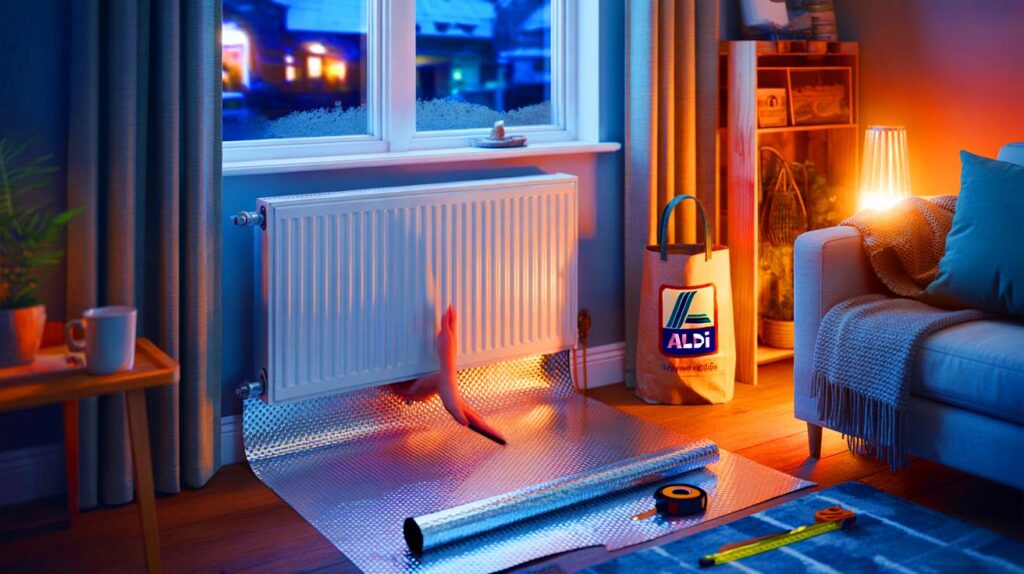
As temperatures dip and direct debits rise, families hunt for cheap, quick fixes to keep living rooms cosy without cranking boilers.
This week, a £9.99 sheet heading for Aldi’s Specialbuys aisles is stirring interest, with bold claims on heat loss and bills.
What’s arriving and when
Aldi’s latest Warm Home push lands in Specialbuys from 23 October, with a radiator reflector roll pitched at households trying to rein in energy spend. The roll has a bubble-core structure, measures 0.6m by 3m, and comes with adhesive strips pre-fitted. You cut it to size, place it behind a radiator on an external wall, and it reflects heat back into the room instead of letting warmth soak into the masonry.
On sale 23 October for £9.99, Aldi says its reflector can cut heat lost through the wall behind a radiator by up to 86%.
The promise is simple: redirect heat you already pay for, warm rooms faster, and trim running costs. The chain is also stocking a 3‑in‑1 multi-layer foil wrap, also £9.99, aimed at lofts, garages and basements, with claims of reducing heat loss in those settings by as much as 65%.
How a radiator reflector really works
Radiators shed heat three ways: radiation, convection and a little conduction. On an external wall, a chunk of that energy heads straight into the brickwork. A reflective foil creates a low-emissivity barrier. It bounces infrared back into the room and adds a thin pocket of still air that slows heat transfer to the wall. The net effect: more warmth stays where you feel it.
Where it helps most
- Rooms with radiators on external or poorly insulated walls.
- Older homes with solid walls or thin insulation.
- Spaces you heat regularly but that cool quickly between cycles.
It’s not a cure-all. Behind an internal wall, heat remains inside the home, so a reflector gives little gain. And if your walls are already well insulated, the benefit shrinks.
What you can realistically save
The headline “up to 86%” applies to heat escaping through the wall behind the radiator, not to the whole heating bill. Real-world savings depend on your home, your boiler, run-times and how many radiators sit on external walls.
A quick, cautious calculation
Take a typical two-bed terrace spending £900 a year on space heating. Suppose half the radiators sit on external walls and, for those units, 15% of their output is lost into the wall. If the reflector recovers most of that wall loss, you might claw back 2–5% of annual heating energy. That’s roughly £18–£45 a year—enough to pay for the £9.99 roll in a few weeks, even on modest gains.
Payback can be fast. Recover a sliver of wasted heat across a winter, and a sub-£10 outlay often returns multiple times its cost.
Consumer finance voices, including Martin Lewis in previous broadcasts, have long said reflective panels can make sense on external walls. The usual caveat applies: your results will vary.
How to fit it in ten minutes
Most people won’t need to remove the radiator. Slide the cut sheet behind from above or the side. If you rent, test a small patch first, as adhesives can lift flaking paint. Avoid trapping existing damp behind a vapour-tight layer; address moisture issues before fitting.
What else is in Aldi’s Warm Home bundle
| Item | Price | Claimed effect | Where to use | Size/notes |
|---|---|---|---|---|
| Radiator reflector roll | £9.99 | Up to 86% cut in heat lost through the wall behind a radiator | Behind radiators on external or poorly insulated walls | 0.6m x 3m; bubble core; adhesive strips included |
| 3‑in‑1 multi-layer foil wrap | £9.99 | Up to 65% reduction in heat loss in targeted applications | Lofts, garages, basements; wind, dust and moisture barrier | Multi-purpose wrap; cut to fit; not a substitute for full insulation |
Who benefits most
Households in drafty period properties, flats with single-skin walls, and anyone who can’t undertake major insulation work this winter stand to gain the most. Landlords looking for low-disruption improvements before peak season may also find the product attractive, provided adhesives are agreed with tenants and surfaces are sound.
Make every kilowatt count
- Lower the thermostat by 1°C to trim roughly 5–10% from heating use, depending on your home.
- Bleed and balance radiators to push heat to cooler rooms and prevent boiler overrun.
- Shut doors and use draught excluders; heated air escapes quickest through gaps.
- Fit reflective foil plus thick, lined curtains on external walls for a double effect.
- Set thermostatic radiator valves so little-used rooms run cooler.
Common pitfalls and how to avoid them
Don’t drape foil over the radiator itself; you’ll block convection and risk hot spots. Keep panels flat and secure to stop rattling. Around sockets or cables, leave clearances as you would with any covering. If you have underfloor heating beneath the same wall, ensure the wall routing doesn’t require heat dissipation you’d be hindering—rare, but worth checking on newer systems.
If you want to go further
Think of reflectors as a gateway fix. A thermal imaging survey on a cold morning can reveal where heat really escapes. From there, targeted measures—loft top-ups to 270mm, cavity wall fills, pipe lagging, and letterbox brushes—tend to offer the best payback. If you’re weighing an upgrade, compare the reflector’s quick win with the longer-term gains of insulation grants or boiler servicing.
A quick scenario to test the maths
Scenario A: a one-bed flat with two external-wall radiators, gas heating costing £600 a year. Recover 3% and you save £18 a year; payback in the first month of regular use. Scenario B: a family home at £1,400 a year; even a 4% saving delivers £56 back. Include a 1°C thermostat trim, and the combined effect can push savings well into three figures while comfort holds steady.



At a tenner, if it shaves even 3% off the gas, that’s my Sunday job sorted. Fitted panels in my old flat and the chill by the sofa vanished. Thanks for the step‑by‑step—ten minutes I can handle! 🙂
That “up to 86%” line is only about the wall losses, not your whole heating—bit cheeky. Any links to independent measurements or a BRE/EST test? Otherwise it’s just shiny bubble wrap.