
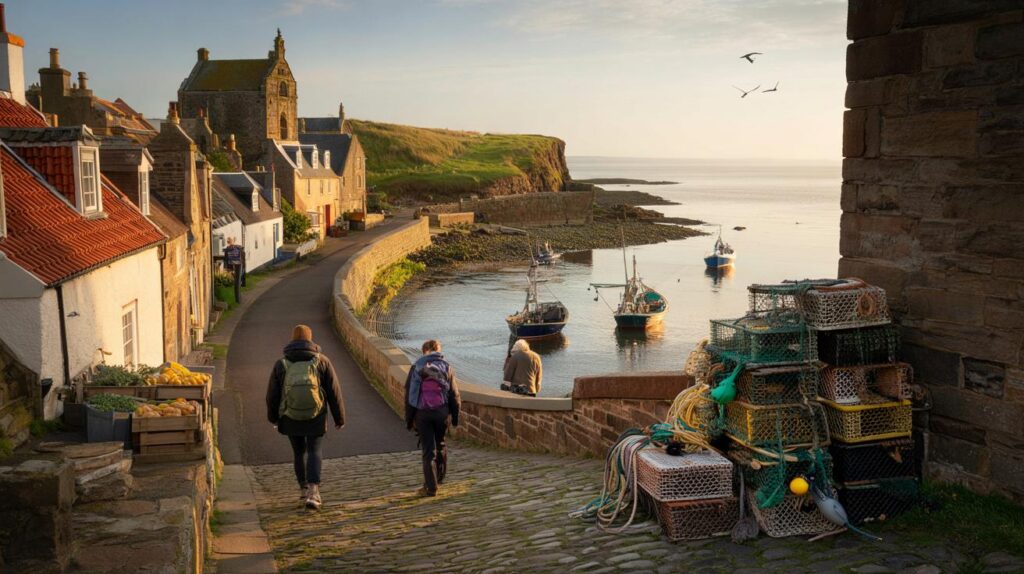
Low roofs, cobbled lanes and the rattle of lobster pots set the scene on a quiet Scottish shore. Then the high street surprises you.
This isn’t a museum piece. It’s a working coastal community where visitors mingle with locals, and heritage sits shoulder to shoulder with everyday life.
Where the coast meets history
On the East Neuk of Fife, about 10 miles south of St Andrews and roughly 90 minutes by car from Edinburgh, Crail has grown from medieval port to modern draw without losing its scale. The village sits on the Fife Coastal Route and is a highlight of the 117‑mile Fife Coastal Path, which threads beaches, skerries and fishing towns into one long shore-side journey.
Its core is compact. Narrow streets tumble towards a tiny harbour cupped by old stone walls. Boats nose the water. Stacks of lobster creels form bright, utilitarian sculptures. Honey‑coloured cottages reflect the light, red tile roofs tilting to the breeze. It feels cinematic yet unmistakably lived‑in.
Crail’s harbour and cobbled wynds deliver postcard looks, but the village works as a place first and a destination second.
A high street that still hums
Many coastal towns now host gift shops and little else. Crail’s main drag still trades in essentials as well as treats. A butcher, an artisan bakery, a grocer and cafés anchor daily life. Independent galleries and a pottery add texture. In summer, the Crail Food Festival brings producers and chefs, and footfall spills down to the pier for paper-wrapped fish and chips with a view.
There’s heritage on the fairways, too. The Crail Golfing Society is among the oldest clubs on the planet. Every hole opens to the sea, the coastline acting as both backdrop and hazard when the wind turns.
Real shops, regular events and a storied golf club keep Crail’s centre busy when many high streets struggle.
A timeline etched in stone
Crail’s story stretches back more than a millennium. It became a royal burgh in 1310 under Robert the Bruce, a status that supercharged trade and self‑governance. Parts of the parish church date to the 12th century, with weathered stone telling its own version of events. Marketgate, the wide central green, was once the largest market square in Europe, a scale that still surprises first‑time visitors.
Royal burgh (1310). Parish church with 12th‑century fabric. A market square that once dwarfed rivals across Europe.
Getting there and getting around
The drive from Edinburgh is straightforward and scenic, with views opening as the road meets the coast. The last drop to the harbour is steep, and parking is limited near the pier. Good shoes help on cobbles and steps, and the weather changes quickly beside the North Sea. Walkers tackling the Fife Coastal Path will find waymarks through the village and benches at intervals for sea‑gazing and sandwiches.
- Distance context: around 90 minutes by car from Edinburgh; about 10 miles from St Andrews.
- Path facts: the Fife Coastal Path runs 117 miles, with Crail a notable staging post.
- Access tips: harbour lanes are narrow and steep; consider leaving cars higher up.
- Peak times: late mornings and sunny weekends bring crowds to the pier and cafés.
- Festival note: the Crail Food Festival adds queues but also buzz and extra choice.
What to do in a day
Start early with coffee on the high street, then drift towards the quay as the village wakes. Watch the boats, photograph the curve of the harbour wall and the tight cluster of cottages, then climb back for a simple lunch. In the afternoon, browse a gallery, pick up a loaf warm from the oven and grab a bench to people‑watch. Golden hour can be glorious; roofs glow, and the sea flattens to pewter. If golf calls, a pre‑booked tee time brings cliff‑edge panoramas and a stiff test in the breeze.
Low tide reveals rock pools and slick weed. Children love the search for crabs. Take care on wet stone, and keep an eye on the sea’s return. Dogs should stay on leads near the harbour; fishermen and gear need space.
| Highlight | Why it matters | Best time |
|---|---|---|
| The harbour | Historic setting with working boats and classic North Sea views | Early morning or late afternoon |
| The high street | Independent shops meet daily needs and visitors’ appetites | Weekdays for shorter queues |
| Marketgate | Remnant of a market square once vast by European standards | Midday for context and local bustle |
| Golf with sea views | Heritage club with cliff‑top holes and wind‑shaped strategy | Book ahead; mornings are calmer |
Why this place is winning hearts
Many visitors talk about a “magical” feel. Strip away the romance and you find clear reasons. The scale is human. History sits in the open air without barriers. You can buy tonight’s supper, meet the baker, and still photograph a harbour that looks lifted from an oil painting. The coastal path brings steady custom, while events put local producers in front of city day‑trippers. It’s a recipe that supports livelihoods and keeps shutters up.
Small scale, deep heritage and everyday shops combine to create a village that feels real and welcoming.
Practical notes for visitors
Respect the rhythms of a working port. Keep clear of nets and creels. Take litter away if bins are full. Photograph cottages from public paths rather than doorsteps. If you plan to walk sections of the coastal path, pack layers, a hat and something windproof, even in July. The shore can be bright and biting on the same day.
Heritage fans should look for carved stone at the church and information boards near Marketgate. Food lovers can time a trip for festival dates, when local produce takes centre stage. Early birds win with parking and light. Night owls find quiet lanes and a sky that, on clear evenings, delivers a spray of stars you rarely catch in cities.
Context that adds depth
“East Neuk” refers to the corner of Fife where old fishing settlements dotted the scalloped coastline. Crail shows how such places can adapt. The royal burgh charter of 1310 set a foundation for trade. Today’s lifeblood includes weekenders and walkers as well as residents who rely on the butcher and baker. That mix keeps the high street from becoming a stage set.
If you want to stretch the day, plan a circular walk using parts of the coastal path and inland lanes. Check tide times before committing to any shoreline shortcuts. Carry a paper map or download an offline route, as signal dips can happen. Those with mobility concerns may prefer the level ground around Marketgate and the upper streets, saving the harbour descent for a quick look rather than a long linger.



Just added Crail to my weekend list—90 minutes from Edinburgh and paper-wrapped fish & chips on the pier? Yes please. Does the Crail Food Festival run in early June this year, and is parking chaos or manageable if you arrive before 9am? Definately keen.