
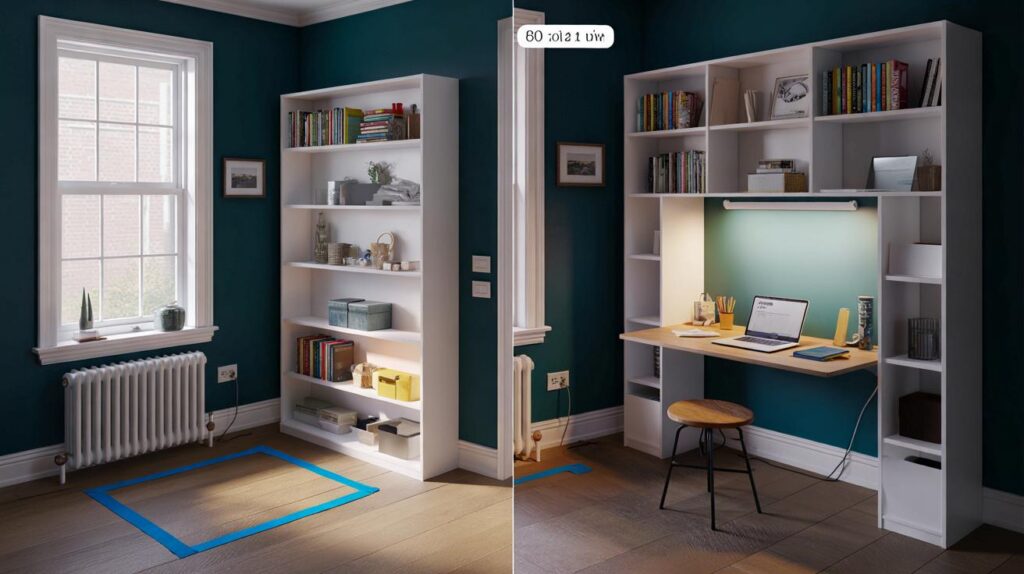
Space keeps shrinking while to-do lists grow. Families need furniture that bends with the day instead of hogging floors.
IKEA has reworked its best-known bookcase into a storage-plus-workstation hybrid, answering the squeeze of remote work and homework in one neat move.
A bookshelf that moonlights as a desk
The classic Billy bookcase now comes with a concealed, pull-out work surface that slides from the lower section. By day it is a slim, wall-hugging bookcase. When tasks call, it extends into a sturdy workstation without swallowing the room. For flats, shared kids’ rooms or a spare corner beside the sofa, it turns one square metre of wall into a reading shelf, craft bench and laptop desk.
From just 33 cm deep in storage mode to a 112 cm-deep workstation when extended, Billy now works double shifts without stealing your floor.
How the mechanism works
The lower shelf rolls out on guides and locks into place, creating a stable table area. The motion is smooth, so older children can set it up for homework, yet the construction feels robust enough for daily family use. Shelves above stay accessible, so books, storage cubes and devices live right where the work happens.
- Slide out the lower section, lock it, and you have a proper surface for a laptop or crafts.
- Finish the task, release the lock, and the table glides back in to clear the floor.
- No need to rearrange chairs or stash a spare desk against a wall.
The numbers that matter in tight rooms
Dimensions make or break compact furniture. Here are the figures that shape whether this model fits your space.
| Width | 80 cm |
|---|---|
| Height | 106 cm |
| Depth (bookcase mode) | 33 cm |
| Depth (work mode) | 112 cm |
| Shelf load capacity | Up to 18 kg per shelf |
Each shelf supports up to 18 kg, so textbooks, storage boxes and craft gear sit safely above a table that rolls out when needed.
Who it suits and where it shines
In a studio flat, it replaces a freestanding desk and keeps sightlines clean. In a child’s bedroom, it becomes a homework hub that tucks away for play. In a living room, it doubles as a craft or sewing station that vanishes before guests arrive. It also suits hybrid workers who only need a desk for a few hours each evening but refuse to dedicate permanent floor space to it.
Setup, safety and care
Assembly follows IKEA’s familiar approach, with hardware and step-by-step drawings in the box. Confident DIYers will manage it, though a second pair of hands helps when aligning the sliding section. As with any tall storage, wall anchoring is non-negotiable in homes with children or pets. Fixing to solid brick, block or to studs in plasterboard improves stability and reduces tip risk during table use.
- Measure a clear walkway of at least 75–90 cm when the table is extended.
- Check for skirting boards or radiators that could affect the unit sitting flush to the wall.
- Note nearby sockets for chargers and lamps to avoid cable trip hazards.
- Use felt pads under a chair to protect floors as seating slides in and out.
Make it ergonomic
For adults, aim to pair the table with a seat around 45 cm high and keep forearms level when typing. A compact footrest helps shorter users plant their feet. A task lamp mounted under an upper shelf illuminates the work surface without glare. If your work involves a larger keyboard and mouse, add a slim desk mat to boost traction and reduce wrist strain.
Why people may ditch a separate desk
A standard desk measuring 120 × 60 cm occupies 0.72 m² permanently, and you still need space to pull a chair back. The Billy with table folds to roughly 0.80 × 0.33 m, or 0.264 m². In daily life that means you gain back about 0.46 m² compared with a typical desk, and once you factor in chair clearance, the breathing room feels bigger. During work, the extended depth of 112 cm offers elbow space; afterwards, you return the room to its normal flow in seconds.
Use mode: about 0.896 m². Stowed mode: about 0.264 m². That’s roughly two thirds of a square metre back when the job’s done.
Limits to keep in mind
This isn’t built for heavy machinery or sprawling multi-monitor rigs. Keep loads within the listed shelf capacity and avoid leaning hard on the outer edge of the extended table. If you need dual displays, consider a clamp arm fixed to the shelving section, ensuring the wall fixings can handle the extra torque. For very tall users, legroom may feel tighter than at a conventional desk; a backless stool that tucks completely away can help.
Smart add-ons to make it work harder
Shallow storage boxes corral stationery on the upper shelves so the tabletop stays clear. A magnetic strip fixed to the side panel holds scissors and small tools. LED strip lighting under a shelf boosts visibility for crafts. Cable clips guide chargers to the front, and a slim surge protector can mount along the side to keep plugs off the floor. Stick with light accessories to preserve the smooth slide of the pull-out section.
What this means for family homes
Small-space living asks furniture to carry more than one job. This Billy variant blends reading, learning and working into a single footprint you can tidy away. Children can start homework at the table then slide it in to open floor for play. Parents can open it for a late shift on the laptop and reclaim the lounge before bedtime. The rhythm of the day drives the setup, not the furniture.
Planning your switch from a desk
Map your room on paper and sketch both modes: bookcase closed and workstation open. Mark door swings, window sills and radiators. If the extended depth nudges into a walkway, rotate the unit or shift it to a wall that doesn’t serve as a route. Trial your chair with the full extension to confirm knee clearance. If you live in a rental, pick wall anchors suited to hollow walls and check the agreement for fixings; many landlords accept neat, repairable holes.
For families, think in zones. Keep schoolbooks and pencil cases on the shelf directly above the pull-out. Store craft paints and glue in sealed boxes to prevent drips on the mechanism. Set a two-minute tidy timer before closing the table so nothing gets pinched in the slide. With these small habits, the Billy-with-table behaves like a tidy desk that never overstays its welcome.



Exatly what my tiny flat needed: a bookcase by day, a desk on demand. If the slide stays smooth, I’m sold.