
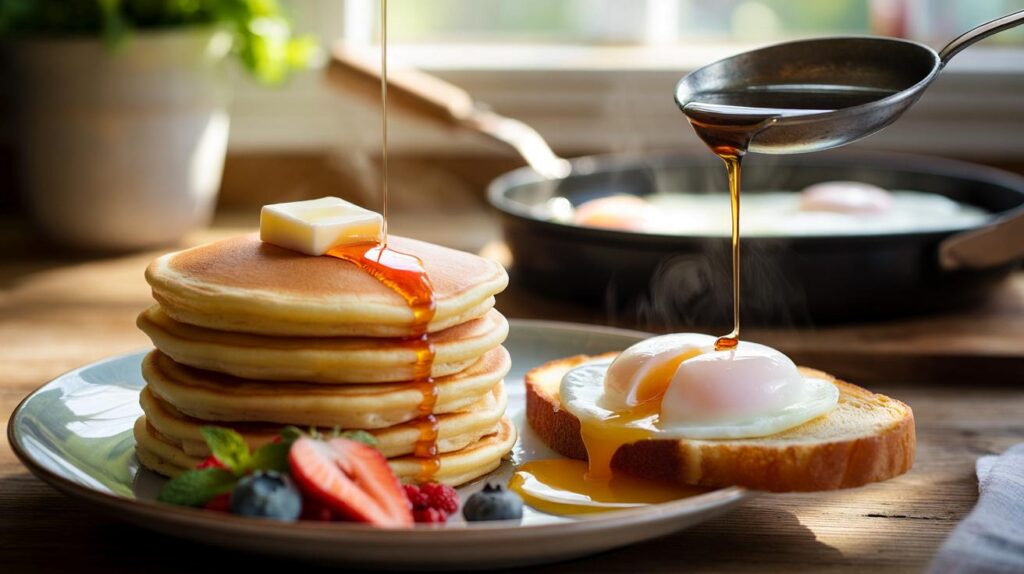
You want a brunch that actually feels like weekend magic, not a stack of flat regrets and rubbery eggs. Pancakes that puff like pillows. Poached yolks that spill in slow gold. The catch: one wrong stir, one feisty bubble, and the whole thing tips from dreamy to “maybe cereal instead”. This is the fix — practical, forgiving, and made for a small kitchen with a big appetite.
The light in my kitchen at 9:43 a.m. does something kind to batter. It skims across the mixing bowl, catches the dusting of flour on the rim, and turns a quiet Saturday into something a bit cinematic. The kettle is humming, a pan sits on the hob warming its own small weather, and I’m watching a spoon trail through a lumpy batter that looks wrong, then right, depending on the angle. The trick, I’ve learned, is to stop chasing perfect lines and start trusting tiny cues. There’s a calm that comes when you realise the fluff happens before the pan, not after. The eggs are waiting in a cold bowl, still in their shells like little promises. One thing is about to change everything.
The brunch problem we secretly love solving
Home brunch has a unique pressure to it: you want restaurant texture from a domestic mess, and you’re racing hunger while pretending not to care. Pancakes should be cloud-soft and barely sweet, and poached eggs should land like velvet, not like a boiled moon. We’ve all had that moment when you flip too soon, the pancake rims tear, and you blame the pan rather than the quiet science you just bulldozed. **Heat is the real ingredient.** Not the fancy vanilla, not the “cheffy” swirl — just calm, consistent heat.
I watched a friend in Bristol make pancakes in near silence, the way someone parks a car in a tight spot. She whisked until the flour stripes just disappeared, set the bowl aside for ten minutes, then walked away like it was none of her business. When she came back, a gentle lift of the ladle, a steady pour, and the batter set into neat, dimply circles that rose like a held breath. Google Trends tells us pancake searches spike every Shrove Tuesday, but the real spike is when timing kicks in on any given weekend. If you’ve got a decent non-stick and five steady minutes, you’re in play.
The logic is disarmingly simple: pancakes get height from trapped gas and restrained gluten, poached eggs get silk from low turbulence and fresh whites. Acid in buttermilk nudges bicarb into releasing bubbles; overmixing pops those bubbles and tightens gluten into chew. For poaching, fresher eggs hold their shape because thick albumen doesn’t fray — the pan should whisper, not boil, because big bubbles shred delicate edges. **Stir less than you think.** Wait more than you want. The best bites are mostly patience disguised as technique.
From bowl to plate: the moves that make it sing
For cloud-level pancakes: use 150g plain flour, 1 tbsp sugar, 1 tsp baking powder, a scant 1/4 tsp bicarb, and a pinch of salt. In another bowl, whisk 230ml buttermilk, 1 egg, and 2 tbsp melted butter until just smooth, then tip wet into dry and fold with a spatula 10–12 lazy strokes. Lumps are good. Let the batter sit 10–15 minutes so starch hydrates and bubbles bloom. Heat a non-stick pan over medium-low; brush with butter; drop 1/4-cup scoops; cook until edges matte and bubbles hold, then flip once. **No pressing, no fidgeting.** Serve as they are or with a thin ribbon of warm maple.
For poached eggs that feel like satin: start with the freshest eggs you can find — day-old from the shop is great, farmers’ market same morning is dreamy. Bring a wide pan of water to a lazy shimmer, not a boil; think small-cat purr, not a steam train. Add a teaspoon of vinegar if your eggs aren’t very fresh, crack each egg into a ramekin, and gently lower it in. Skip the vortex unless you enjoy drama; a quiet drop is enough. Cook 2:45–3:30 depending on size, spoon off any wisps, then lift to drain on kitchen paper. Let’s be honest: nobody really does this every day.
Here’s why these small decisions stack up: resting batter lets the flour saturate without you having to fight it later, so the pan does the lifting while you simply turn and smile. For eggs, low heat keeps proteins from tightening into squeaky rubber, and a ramekin drop gives you control in a busy pan. When a chef in London told me their “secret” was nothing but patience and fresh eggs, I believed them straight away.
“If the water looks calm and the batter looks a bit lumpy, you’re 90% of the way there.”
- Pan heat sweet spot: a drop of water should dance, not explode.
- Rest the batter: 10–15 minutes changes everything.
- Crack into a ramekin, not straight into the water.
- Use fresh eggs; strain watery whites if needed.
- Flip pancakes once; lift poached eggs gently with a slotted spoon.
Why this brunch sticks with you
The reason fluffy pancakes and perfect poached eggs feel like a win isn’t just the bite. It’s the small domestic theatre: the wait, the hiss, the sway of a yolk under a spoon, the first forkful that tells you the morning is going your way. I find it quietly heroic that a stack can be both forgiving and fussy, that it asks for presence but rewards every measured pause. Share the plate, pass the coffee, let the conversation sit in the steam and the citrus scent of fruit on the table.
| Point clé | Détail | Intérêt pour le lecteur |
|---|---|---|
| Gentle mixing | 10–12 folds; leave visible lumps | Prevents tough batter and preserves lift |
| Low-turbulence poach | Shimmering water; 2:45–3:30 cook | Silky whites, runny yolks, no ragged edges |
| Timed resting | Let batter sit 10–15 minutes | Hydrates flour and boosts fluff without effort |
FAQ :
- Should I separate eggs and whip the whites for extra fluff?It works, especially for soufflé-style pancakes, but it’s not essential here; the buttermilk–bicarb combo and a short rest give you lift with less faff.
- Can I use milk instead of buttermilk?Yes, stir 1 tbsp lemon juice into 230ml milk and rest 5 minutes; you’ll get a similar acidity to drive bubbles without a shop run.
- Why do my poached eggs look feathery?That’s usually very fresh water but not-so-fresh eggs or a rolling boil; strain the watery white and keep the water at a shy simmer.
- Do I need vinegar in the poaching water?It helps less-fresh eggs set a bit faster, though truly fresh eggs hold on their own; use a teaspoon and keep the flavour neutral.
- How do I keep pancakes warm while I poach?Stack them on a wire rack in a low oven (90°C) for 10 minutes; they’ll stay fluffy rather than sweating into a soggy pile.



Resting the batter 10–15 minutes finally gave me lift without whipping whites. My pancakes puffed and didn’t deflate. The “water should dance, not explode” line fixed my poached-egg shred fest. This is defintely the most useful brunch guide I’ve read—clear, calm, and doable.
Do we really need buttermilk? I used whole milk + lemon and got a weird tang and less lift. Maybe my bicarb was old? Anyone test soured milk vs true buttermilk, gram-for-gram, with fresh baking powder?