
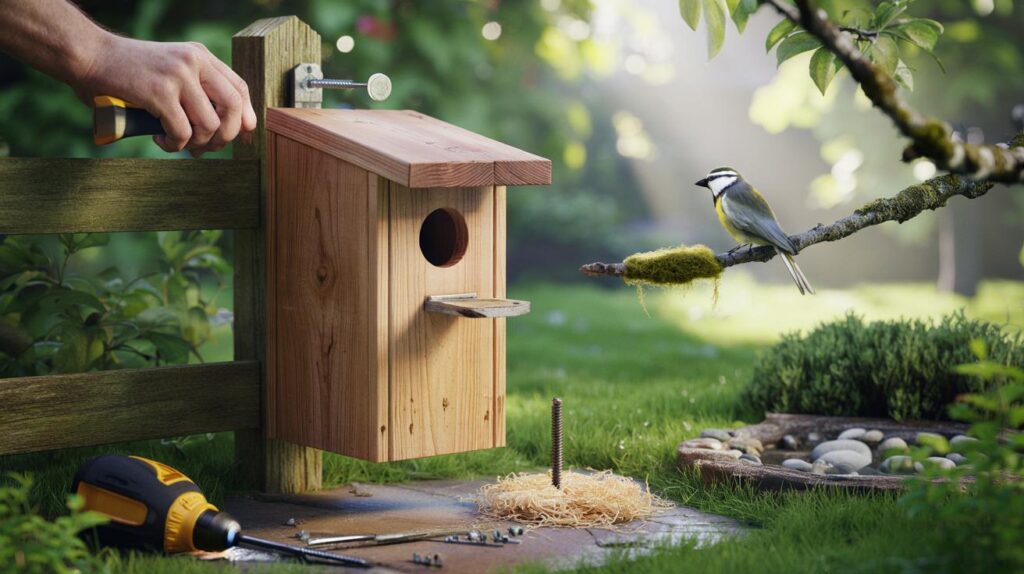
You can feel it in the garden right now: birdsong thinning, hedges a little too tidy, the patio quiet at dawn. We want nature close, but we also want things neat and easy. That tension sits on every fence post and windowsill.
I was standing with a mug of tea, eyeing a scrap of timber left from a shelf we never built. The garden was damp, the kind of mild Sunday that smells of soil and sawdust. A robin watched from the apple tree as if waiting for me to do something vaguely useful. I sketched a box on the back of an envelope, the lines wobbly, the plan in my head already looser than any tutorial would allow. The drill slipped once. The hole looked slightly off-centre. It felt, unexpectedly, like a story starting. We screwed the sides together on the lawn, hands cold, wood warm from the friction of the bit. We hung it on the fence and stepped back like we’d hung a painting. And then we waited.
Why a simple birdhouse changes your garden
There’s a moment when your garden stops being décor and becomes habitat. A birdhouse is tiny, yes, but it signals welcome in a way feeders never quite do. It says: you can live here, not just visit for crumbs. In a week, the sounds shift. The hush at midday pops with contact calls, then soft tapping as a beak tests the entrance. It’s subtle, almost private. But you feel it.
We’ve all had that moment when a small wild thing chooses our space and, for a second, our hearts get bigger. Our first box was made from an old fence paling, the saw marks still visible. A blue tit came first, peering in like a polite neighbour. Then a pair turned up with strands of moss. I timed nothing. Birds don’t love a stopwatch. Across the UK, reports show millions fewer breeding birds than in the 1970s. A box won’t fix that, yet it offers a real cavity in a world of sealed eaves and perfect fencing. It’s a doorway back.
Here’s the quiet logic. Cavity nesters once found rotten limbs, gaps in old barns, holes in hedgerow trees. We seal, trim, and replace. Nest boxes mimic those lost pockets, matching entrance size to species: about 25 mm suits blue tits and coal tits, 28 mm brings in tree sparrows, 32 mm opens the invite to great tits and house sparrows. Height and direction matter too. In most UK gardens, a north-east facing box avoids midday scorch and the worst of the rain. The physics of shade meets the patience of birds. It’s simple, not simplistic.
Build it right: a quick, forgiving method
Think one-plank method. Grab an untreated, rough-sawn board, roughly 150 mm wide and about 15–20 mm thick. Cut six pieces: back (45 cm), front (25 cm), sides (two at 25 cm with a slight slope), bottom (12–14 cm), roof (20–22 cm). Drill a 25–32 mm entrance in the front, 12–15 cm from the top, then two small drainage holes in the bottom. Screw, don’t nail. Hinge the roof on one side with a strip of rubber or an old bike inner tube for cleaning later. Sand just the entrance edge so it’s safe, leave the wood rough inside for grip. Mount 1.8–3 metres up, facing between north and east. That’s the backbone.
People trip over the last 10%. They paint the inside (don’t), add a perch (predators love them), or place the box in full midday sun. Shade is comfort. Distance from busy feeders cuts stress. A slight forward tilt helps rain run off the entrance. If you’re fixing to a tree, use a strap or an aluminium nail to keep the tree healthy. Let climbers grow around the box to soften its outline. Let’s be honest: nobody really does that every day. You’ll do it once, well, then enjoy the ripple for years.
The most effective trick is patience. Put the box up by late winter, then walk away. A quiet corner outperforms a high-traffic view from the kitchen window. Small, steady kindness builds a habitat. A drop of raw linseed oil on the exterior helps shed rain without sealing the wood. If you can, add a 10 mm predator guard around the hole with a metal plate. It’s a tiny shield against determined beaks.
“The best nest boxes are the ones you forget you built,” said an old birder I met on a canal towpath. “They blend in, then one morning the garden sounds different.”
- No perch — it helps magpies and cats more than tits and sparrows.
- North-east facing — cool mornings, fewer drenching winds.
- Rough interior — fledglings climb out easier.
- Clean in autumn — gloves on, one minute, done.
- Space from feeders — 3–5 metres reduces squabbles.
Make space for the rest of the wild
A birdhouse is a door. Open one, then think like a neighbour not a landlord. Plant a clump of native shrubs so nestlings have cover on their first clumsy flights. Leave a shallow water dish and smooth stones for perching. Cut a “hedgehog highway” at the base of the fence and let a small patch go a bit shaggy in summer. The best wildlife gardens aren’t manicured, they’re gently edited. You don’t need to rip up your decking or plant a mini-forest. Start where you stand. Add one box, one water source, one messy corner. **Soon your garden starts writing its own weather.** The birds will show you what they need next, and you’ll learn to read those signs. Share that with a neighbour, and watch the street change.
| Key points | Details | Interest for reader |
|---|---|---|
| Right box, right place | 25–32 mm hole, north-east facing, 1.8–3 m high, slight tilt | Higher chance of occupancy and fledglings |
| Build simply | One-plank method, screws not nails, rough interior, hinged roof | Quick win, durable, easy to clean |
| Think habitat | Water, cover, fewer chemicals, space from feeders | Turns a nice garden into a living one |
FAQ :
- When should I put up a birdhouse in the UK?Late winter is ideal so birds can scope it out before spring, though boxes added in spring or even summer may still be used for roosting.
- What entrance size should I drill?About 25 mm for blue and coal tits, 28 mm for tree sparrows, 32 mm for great tits and house sparrows. Larger open-front boxes suit robins and wrens.
- Do I need to clean the box?Yes, once a year in autumn. Remove old nesting material, brush out, and let it dry. A minute’s care keeps parasites down and boxes attractive.
- How do I keep predators away?Skip perches, fit a metal hole plate, place the box away from leap points, and consider a baffle on poles. Dense planting nearby gives fledglings a fast refuge.
- Will a birdhouse attract wasps?Occasionally. If wasps move in before birds, block the hole at night and relocate the box for the season. Next year, reposition to a shadier, quieter spot.



Loved this! I slapped together the one-plank box this weekend and a blue tit is already casing the place. The NE-facing tip and slight forward tilt were gold. Any thoghts on using cedar versus pine for longevity?
Not convinced a single box does much when local councils keep trimming hedges to nubs. Feels like a band-aid. Do you have data on occupancy rates in small urban gardens?