
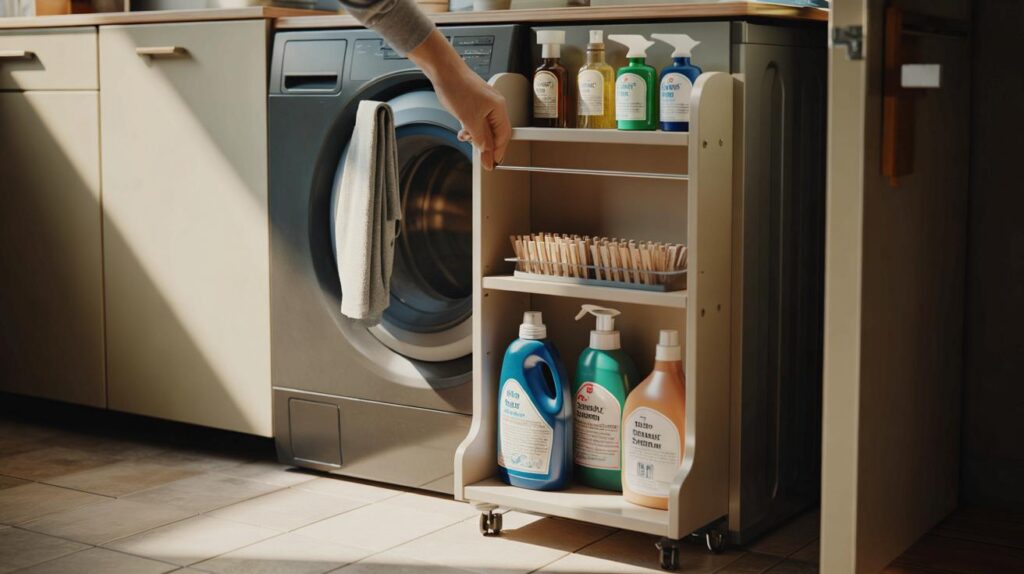
Small utility rooms swallow space in the strangest places. Bottles colonise every corner, a mop leans like an unwanted guest, and that narrow gap beside the washer gathers dust and guilt. Here’s a gentle fix that turns dead air into daily ease.
Morning light slid across the tiled floor, catching the echo of the spin cycle. I watched my neighbour squeeze sideways to fetch a softener bottle buried behind a laundry basket, muttering as two lids clinked to the ground. Then she grasped a slim handle, and a whole shelf slipped out from the gap between machine and wall like a secret drawer: rows of detergents upright, pegs for cloths, a shallow tray with clothespins lined up like sweets. The room looked calmer by half, and she moved easier. The secret sits in the sliver.
Why a slim laundry shelf changes everything in a small utility room
Most utility rooms aren’t big, they’re busy. Movement is the currency that matters: in, out, bend, reach, leave. A slim pull-out shelf swaps hunting for gliding. Instead of stashing bottles wherever they’ll fit, you park them in one vertical lane beside the washer or dryer, and they come to you.
In a narrow London terrace, I measured a cupboard off the kitchen: 650 mm wide, boiler on the left, washer centred. A nib of wall left a 140 mm gap on the right, too tight for a cupboard, too wide to waste. We built a 1,600 mm-tall pull-out on soft casters. It swallowed eight big bottles, pegs, stain sticks, and a roll of bin bags. Weeks later, the owner texted: “I stopped knocking things over.” That’s a tiny sentence with real square footage behind it.
Vertical storage works because it respects how you move. Your hands travel forward and back, not deep into a dark shelf. A slim unit keeps all labels facing out at eye and hip height, so you decide quickly and move on. Stability comes from proportion: taller sides, shallow shelves, a low centre of gravity. Add a lip to hold bottles, and you’ve nudged chaos into a narrow, predictable groove.
How to build a slim rolling shelf for detergents
Start with the gap. Measure the clear space from skirting to cabinet, and from floor to any sill or tumble-dryer vent. **Measure the gap twice**. Subtract the thickness of your material and the wheel height to confirm the overall height. Cut a simple carcass: two tall sides in 18 mm ply or MDF, narrow shelves in 12–18 mm, a base, and a shallow top with a hand cut-out. Fit small braked casters or low-friction sliders. Paint or seal. **Leave 10 mm clearance** so it glides without scraping.
The things that trip people up are tiny. Skirting boards protrude, so notch the base or run a shallow plinth. Plugs and hoses bulge, so choose shelf depth that clears them. Heavier liquids at the bottom, light sprays up top. Add a dowel or wire rail to stop bottles tipping when you roll. We’ve all had that moment where something clangs to the floor and you pretend it didn’t. A simple lip ends that ritual.
Let’s be honest: nobody really does this every day. You build it once, then you get on with your life.
“It’s like adding a drawer to a wall,” said a joiner who’s made three of these for clients. “The footprint stays the same. Your options multiply.”
- Cut list example (for a 150 mm gap): sides 1,600 x 130 mm (2), shelves 130 x 250 mm (5–6), base 130 x 250 mm (1).
- Hardware: four 25–40 mm braked casters, screws 30–40 mm, wood glue, 6 mm dowel or 10 mm aluminium rail.
- Tools: handsaw or track saw, drill/driver, countersink bit, sandpaper 180–240 grit.
- Finishes: water-based varnish or eggshell paint for wipe-clean faces.
- Setup tweaks: spacer strip if the wall isn’t straight; felt pads if floors are delicate.
Space, calm, and the joy of finding things where you left them
A thin shelf won’t change your utility room into a showroom. It will change how you move. You’ll slide instead of shuffle, glance instead of rummage. The floor looks larger when the edges do their job.
*That small act of movement — hand to handle, handle to shelf — is a daily promise that your home works with you, not against you.* One gap that once hoarded dust now holds a week of laundry. Your future self will thank your present one in the quiet way that order often speaks.
This is where a tiny build gets personal. If your gap is 110 mm, design to 100 and keep the shelves shallow. If your bottles are tall, let the top shelf breathe and fit a low rail. **Add a front lip or rail** and a finger pull that makes you actually want to use it. Share the idea with a friend who swears they’ve no space at all. They might just have a sliver waiting to help.
| Key points | Details | Interest for reader |
|---|---|---|
| Measure and plan | Check gap width, skirting returns, plug/pipe bulges, and wheel height; leave 8–12 mm clearance | Fewer surprises, smoother build, less friction day to day |
| Build for stability | Tall sides, shallow shelves, heavy items low, lip/rail to prevent tipping | Safer storage, bottles stay put, shelf rolls straight |
| Finish for real life | Seal edges, wipe-clean paint, braked casters or sliders, simple handle cut-out | Easy maintenance, quiet movement, looks tidy on busy days |
FAQ :
- What width should I aim for?Leave about 10 mm total clearance inside the gap. For a 150 mm space, a 140 mm-wide unit feels right.
- Casters or sliders — which is better?Casters suit textured floors and heavier loads; sliders are low profile and silent on smooth tiles.
- How much weight can it carry?With 18 mm ply and decent screws, 20–25 kg spread across shelves is comfortable for a slim unit.
- Will it block ventilation for the washer?Keep the shelf shy of vents and hoses, and don’t pack it so tight that air has nowhere to travel.
- I rent — can I do this without drilling the wall?Yes. A freestanding rolling shelf needs no fixings. Add felt pads and keep the finish landlord-friendly.



Love this. I’ve got a skinny 130 mm gap by the washer that just hoards dust and lost pegs. The tip to notch around the skirting bord and keep heavy bottles low is gold. I was overthinking sliders vs casters—braked casters it is. Also, that front lip/rail detail will save my clumsy self. Definately building this next weekend; if it stops me knocking lids off every wash, I’ll call it a win.