
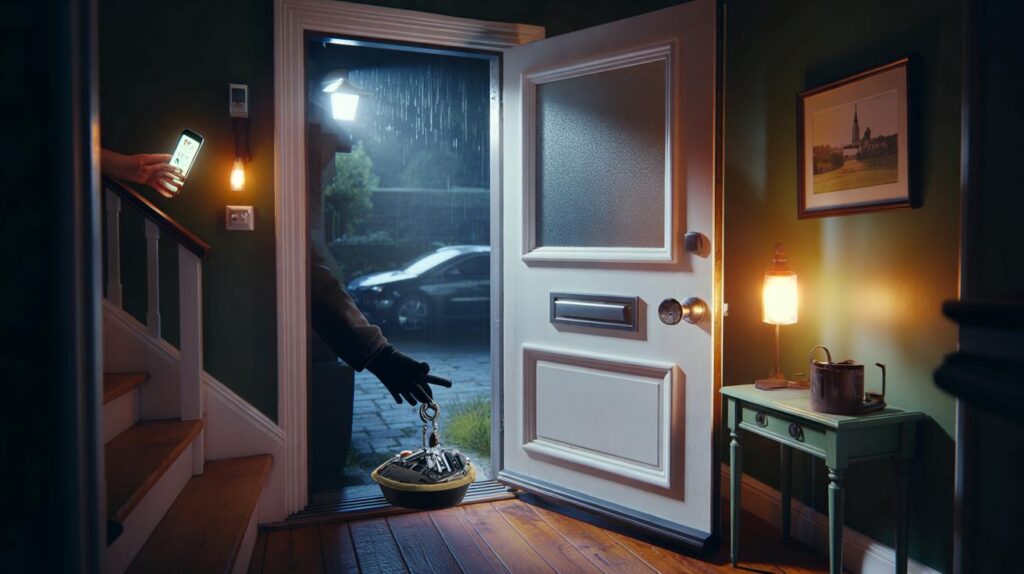
You’re in, lights low, cup still warm. A soft click at the letterbox, a shadow moving past the glass, and your front door suddenly feels paper thin. That shiver has a name now: “homejacking” — when offenders enter while you’re home, often to grab car keys fast and go. It’s not the horror-film scenario people picture. It’s quieter, quicker, closer.
The street was asleep when the letterbox rattled. I froze mid-step, phone in my hand, kettle still purring in the background. Beside me, the hallway felt like a stage, the front door a prop that could fail without warning.
We’ve all had that moment when a familiar sound turns strange and your body switches to alert before your brain catches up. The silence that followed felt almost theatrical, like someone holding their breath just out of sight. The silence after the knock felt louder than any alarm. Then, a new sound — faint, deliberate, unmistakable. The handle turned.
Homejacking, decoded
Homejacking isn’t a legal term in the UK, and it’s miles away from the movie idea of a “home invasion.” It’s usually a quick in-and-out while you’re inside, targeting car keys, wallets, or a handbag by the stairs. Offenders want speed, not drama. They’ll slip a hand through the letterbox, test a latch, lift a key bowl, and be gone before you find your slippers.
The danger isn’t what’s stolen. It’s that thin membrane between ordinary life and a face-to-face encounter. That’s why the fear lingers after the locks are changed.
There’s a pattern you hear from neighbourhood teams in towns from Leeds to Lewisham. A thief slides a tool through a letterbox at 02:17, lifts a set of keys, and the SUV is rolling by 02:20. A side window left on the latch becomes the weak link, not the front door everyone watches. Some forces have flagged car-key burglaries as a growing slice of night-time crime, especially as modern vehicles resist on-street theft.
One couple in Bristol told me they slept through the whole thing. No broken glass. No heavy boots. Just a missing key bowl and a van that never came back. The speed was the most frightening part.
Why do offenders try homes while people are in? Because keys and wallets live indoors and alarms often sit switched off at night. The reward-to-risk ratio makes sense to them. A quiet hall, a reachable letterbox, and a car outside worth five figures. That calculus changes the moment your home becomes noisy and time-consuming.
Think layers, not absolutes. Time and sound are the enemy of quick crime. A lock that resists attack for two minutes, lighting that floods a path, and a camera that chirps to your phone can turn an easy job into a gamble. Design out the hurry and you squeeze the payoff.
Practical ways to protect your home — and yourself
Build a two-minute night routine. Start at the back door, work clockwise, and finish at the stairs. Doors locked with a British Standard deadlock (BS 3621) or a TS 007 three-star euro cylinder, windows on key-lock, letterbox with an internal cage, alarm part-set so downstairs zones are live. It’s a walk, not a lecture. Keep a cheap door wedge by your bedroom. Keep a fully charged phone at the bedside. **Layered security wins.**
Keys matter. Don’t park them in the hallway or on a hook by the door. Use a simple tin or a drawer away from the letterbox. For cars with keyless entry, drop the fobs in a Faraday pouch at night. Motion-activated lights that trigger as someone steps towards the door can buy you attention and time. Video doorbells catch faces, but they’re as much about deterrence as evidence. Let gates latch; let hedges sit low at the front so sightlines are clear.
Fear asks you to do everything; daily life begs for something doable. Let’s be honest: no one actually does that every day. So choose the handful that stick.
When things feel wrong, don’t play hero. If someone is in your hallway, step back, retreat to a room with a solid door, and call 999. **Call 999 before you call anyone else.** Use few words: your address, what you hear, the nearest landmark. If you do speak through the door, keep the barrier between you and them. Many officers will say the same thing in private and in briefings.
“We want you safe, not brave,” a neighbourhood officer in south London told me. “Lights on, voice up, phone in hand. Make it noisy and dull for them.”
- Fit anti-snap cylinders (TS 007 3-star) or a 1-star cylinder with a 2-star handle
- Add a letterbox cage and avoid key bowls near the door
- Part-set your alarm at night and learn the quick-cancel code
- Keep a torch in the bedroom, not the kitchen
- Store car keys out of sight; use a Faraday pouch for keyless fobs
Living ready, not paranoid
There’s a difference between living scared and living prepared. You don’t need a panic room. You need a plan you’ll actually use and a home that’s just awkward enough to make someone move on. **Keep car keys out of sight and out of reach.** Teach a simple family script: “Bedroom now. Door closed. Phone on speaker.” Give it a try once, then make tea and laugh about how silly you felt.
Your home won’t ever be perfect. Perfection isn’t the point. The point is to add minutes, add light, and add a voice that says “No” from behind a door. A little friction changes a lot of choices. And if you’ve felt that prickle in the hallway already, you know the stakes aren’t about things. They’re about the air you breathe in your own kitchen.
| Key points | Details | Interest for reader |
|---|---|---|
| What “homejacking” really is | Quick entry while occupants are home, often for car keys and wallets, not a drawn-out “home invasion.” | Cuts through myths and focuses on the real risk you can plan for. |
| Layered security beats gadgets | Good locks, part-set alarm, lighting, and simple routines add time and noise. | Practical steps that work tonight, not just expensive tech. |
| What to do in the moment | Retreat, close a door, call 999, use your voice, stay behind barriers. | Gives a calm, repeatable script when adrenaline spikes. |
FAQ :
- Is homejacking the same as aggravated burglary?Not exactly. “Homejacking” is media shorthand. Aggravated burglary is a specific offence involving a weapon. Many car-key burglaries happen quietly, without threats, but the risk of contact exists.
- Should I hand over the keys if confronted?Your safety comes first. Property can be replaced. Create distance, keep a door between you and them, and call 999. Avoid chasing outside.
- Where should I keep car keys at night?Out of sight and away from the door, ideally in a drawer or tin. For keyless fobs, use a Faraday pouch to block relay signals. Balance against fire safety, so don’t hide emergency exit keys completely.
- Do dogs, lights, or cameras really help?They help as part of a mix. Motion lights and doorbells add noise and attention. A dog can deter, though it’s not a plan. The combo that adds time and uncertainty works best.
- How do I talk to kids without scaring them?Keep it simple and game-like: “If the buzzer sounds, we go to the bedroom, shut the door, and ring Grandma.” Practise once, praise lots, then switch the mood with a story or snack.



Does part-setting an alarm really work if I have a cat that roams downstairs at night? Any tips for avoiding false alarms without leaving the hall unprotected?
Great read—clear and practical. The two-minute routine is the first advise I’ve seen that I might actually do nightly. Bookmarked.