
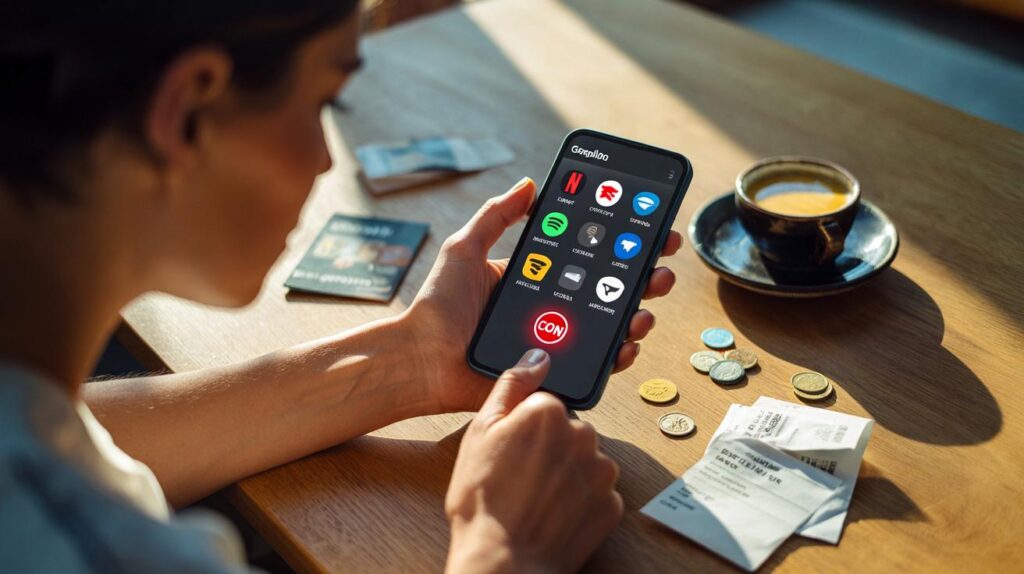
Your bank statement knows you better than your camera roll. Tucked between the food shop and the train fare, tiny charges whisper through: the audiobook you forgot, the cloud storage you never use, the “trial” that turned into a monthly drain. It’s not one big leak. It’s a slow drip that soaks your budget, and the worst bit is how normal it feels.
It started on a grey Sunday, the sort that makes you tidy drawers and face the things you’ve put off. I opened my banking app, just to peek, and there it was: £7.99 to a name I didn’t recognise. Then £2.49, then £11.99 for a “membership” I barely remembered starting. The charges were small. The list was not. I searched emails, scrolled receipts, felt a pinch of embarrassment that I’d let this slide. *How did it get this messy?* The coffee went cold. A thought landed like a pebble: What else is quietly billing you?
The invisible drip-drip of subscriptions
Most of us think we’ve got one or two recurring costs beyond rent and bills. Music, maybe a TV service, that’s it. Then you actually look, and the picture shifts. Streaming, cloud, fitness, data backups, language apps, news, photo filters, pet insurance, VPNs, password managers, donations — it stacks up. The modern subscription economy is designed to feel feather-light, almost weightless. That’s the trick. You don’t feel the weight until your budget stops breathing.
Take Maya, 31, who swore she had “two subs, tops”. A quick sweep found eleven: TV bundle, music, meditation app, premium weather, a running plan, photo storage, Adobe, a newsletter she never reads, a parking app, a “discount club” she didn’t recall joining, and device insurance on a phone she no longer owns. She wasn’t careless. She was busy. Free trials rolled over. A retention offer popped up. “Just £1.99 extra for premium support.” She didn’t say yes. She just didn’t say no loudly enough.
Why does this happen? Because subscriptions live everywhere. Apple IDs and Google Play. Direct Debits and Continuous Payment Authorities on your card. PayPal’s pre-approved payments. Amazon channels. Gym contracts that politely require a letter. Merchants hide behind cryptic descriptors. Emails get buried under delivery updates. Cancellation paths stretch like maze corridors. And our brains, frankly, are wired for inertia. Better to “deal with it later” than argue with a chatbot at 10pm.
How to find every active subscription in minutes
Start with a power sweep. Open your email and use layered searches: “receipt”, “renewal”, “subscription”, “trial”, “auto-renew”, “membership”, “thank you for your purchase”. Sort by “from” to cluster merchants. Then jump to Settings on iPhone: Apple ID > Subscriptions. On Android: Google Play > Payments and subscriptions. Check PayPal’s “Payments with automatic billing”. Hit Amazon: Your Account > Memberships and Subscriptions. In your banking app, search for repeating merchants and words like “Direct Debit”, “CPA”, “subscription”. Screenshot everything you find into one album.
Next, run the 90/365 test. Scan the last 90 days for repeats. Then scan back a full year to catch annual renewals that sting out of nowhere. Look closely at small numbers. £1.99 looks harmless, yet five of those is a lunch. Check family and shared plans where costs hide in one person’s account. Export transactions to a spreadsheet if that’s your style, sort by merchant, and the patterns jump out. Let’s be honest: nobody does that every day. Do it once, thoroughly, and you’ll feel the room clear.
Now cancel with intent. Use in-app “Manage” pages where they exist; you often need to cancel where you bought it. Apple-bought subs cancel on Apple. Google on Google. PayPal on PayPal. Direct Debits can be cut from your bank, which stops payment fast and puts control in your hands. If a merchant demands a call, note the date and time, and ask for written confirmation.
“Treat cancellations like admin for your future self,” says a consumer adviser I spoke to. “Today’s five minutes is next month’s breathing space.”
- Fast checklist: email sweep, app store checks, PayPal pre-approvals, Amazon channels, bank repeats.
- Cancel at source; screenshot confirmations; keep a tiny log.
- Set a calendar ping 3 days before any upcoming renewal.
- If you’re offered a discount, pause and ask: will I use this weekly?
https://youtu.be/P7FMujd2tF8
From clutter to clarity
On a practical level, this is money back in your pocket. On a human level, it’s noise removed from your head. We’ve all had that moment where a random charge makes you feel a bit foolish; that feeling passes when you take control. Keep what you love and use. Pause the rest. Rotate subscriptions with the seasons. Leave one slot open for curiosity, then close it when the novelty fades. The goal isn’t austerity. It’s attention.
| Key points | Details | Interest for reader |
|---|---|---|
| Find every active contract fast | Email keyword sweep, app-store subscription pages, PayPal pre-approvals, bank repeats | Saves hours and exposes hidden drains quickly |
| Cancel where you bought it | Apple/Google/Amazon/PayPal vs Direct Debit vs card CPA, with screenshots as proof | Prevents failed cancellations and surprise renewals |
| Make it stick | Calendar reminders, a 90/365 review, keep a one-page log, rotate subscriptions | Keeps future bills clean without daily effort |
FAQ :
- How can I cancel hidden subscriptions fast?Run a layered email search, check Apple/Google subscription pages, review PayPal pre-approved payments, and scan your bank for repeats. Then cancel at the source and save confirmation screenshots.
- What’s the difference between Direct Debit, standing order, and recurring card payment?Direct Debit lets a company pull variable amounts with your consent; you can cancel from your bank. Standing orders are fixed payments you set and control entirely. Recurring card payments (CPAs) charge your card; cancel via the merchant or ask your bank to block the merchant.
- Can I cancel a free trial on the last day?Usually yes, but time zones and processing delays can bite. Aim to cancel 24 hours before the cut-off. Some app stores require at least a day’s notice to stop the next cycle.
- What if the company ignores my cancellation?Escalate: contact support in writing, cite the date/time, and request a refund for post-cancellation charges. If it’s a Direct Debit, the UK Direct Debit Guarantee may help you reclaim.
- Any tools that flag subscriptions automatically?Many UK banks and budgeting apps surface recurring merchants and insights. You’ll also find subscription managers in iOS/Android settings, PayPal, and some fintechs that spot repeats via open banking.



This is the kick I needed. The layered email search + Apple/Google pages + PayPal sweep took 15 mins and found 9 subs I’d totally fogotten. The 90/365 test is genius; it caught an annual “pro” plan renewing next week. I cancelled at source and took screenshots, then made a tiny log and set calender pings. Oddly calming. Cheers!