
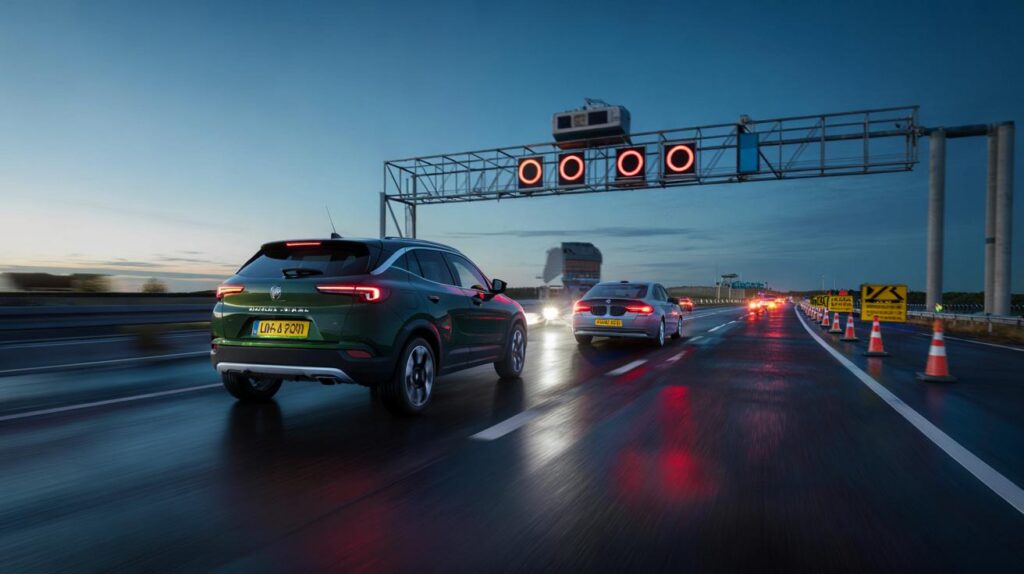
A few miles of roadworks and a flashing gantry turned a routine motorway run into a costly lesson for two drivers.
Magistrates in Bath heard how a 43-year-old from Swindon hit 72mph under a 60mph variable limit on the M4/M5 corridor. A Cardiff motorist, 28, faced a separate bill after clocking 58mph in a signed 50mph zone on the same network.
What happened on the M4 and M5 that day
Kelly Stubbs, 43, from Mill Lane, Swindon, drove a Vauxhall Mokka Ultimate Turbo northbound on the M5 between junctions 17 and 16 before continuing on the M4 between junctions 19 and 20. The journey took place on 31 August 2024 during a period of variable speed limits.
Gantry signs showed a 60mph limit. Police-approved cameras recorded her speed at 72mph. The system captured the offence and linked it to the vehicle’s registration.
Gantry cameras registered 72mph in a signed 60mph zone between the M4’s junctions 19–20 and the M5’s junctions 16–17.
Nearly a year later, on Tuesday 26 August, Stubbs appeared at Bath Law Courts. She pleaded guilty to exceeding a variable speed limit.
The cost of 12mph over the limit
The bench fined Stubbs £146 and endorsed her licence with three penalty points. She must also pay a £58 victim surcharge and £110 in prosecution costs. The combined total comes to £314.
Bill for the Swindon driver: £314 and three points for 72mph in a 60mph variable limit.
How magistrates reach these figures
Courts use national sentencing guidelines. For lower-end speeding, fines usually fall within Band A, set as a percentage of weekly income, then adjusted for factors such as an early guilty plea. The victim surcharge currently adds 40% of the fine, and standard prosecution costs apply in most cases. The court then imposes three points for speeds in this bracket.
Another driver caught on the same corridor
In a separate case, Rei Diko, 28, of Pen Y Lan Road, Roath, Cardiff, drove a BMW 420 eastbound between M4 junctions 20 and 19, and along the M5 between junctions 15 and 17. Cameras measured 58mph with a 50mph limit in force.
Magistrates fined him £220, applied an £88 surcharge and £110 costs, and endorsed three penalty points. His total bill reached £418.
Cardiff case: 58mph in a 50mph zone led to £418 in penalties and three points.
Two cases, one message: variable limits carry weight
| Driver | Age | Home area | Vehicle | Route | Limit | Recorded speed | Fine | Surcharge | Costs | Points | Total |
|---|---|---|---|---|---|---|---|---|---|---|---|
| Kelly Stubbs | 43 | Swindon | Vauxhall Mokka | M5 J17–16, M4 J19–20 | 60mph | 72mph | £146 | £58 | £110 | 3 | £314 |
| Rei Diko | 28 | Cardiff | BMW 420 | M4 J20–19, M5 J15–17 | 50mph | 58mph | £220 | £88 | £110 | 3 | £418 |
Why the red-ring gantries matter
Red-ring speed signs on motorway gantries display mandatory limits. Highways equipment adjusts these limits for queues, incidents or roadworks. The cameras, often HADECS-type units, enforce every active limit. The kit operates in all lanes and in all conditions. When signs show a lower speed, enforcement shifts accordingly.
The enforcement threshold you might not know
Police generally follow the 10% + 2mph guidance. For a 60mph limit, that suggests enforcement from 68mph. For a 50mph limit, it points to 57mph. Stubbs at 72mph and Diko at 58mph both sat above those figures. Forces can set stricter policies if risk dictates, so drivers should not rely on a cushion.
60mph limit: action often starts at 68mph. 50mph limit: action often starts at 57mph.
What drivers can do now
Frequent changes, busy junctions and late lane merges raise the chance of mistakes. A few habits reduce the risk and the cost.
- Scan gantries early and often; treat red-ring limits as fixed until the next sign.
- Use cruise control or speed limiter when entering a variable limit stretch.
- Watch for camera “check marks” or road-side units near gantries, not just fixed yellow boxes.
- Leave space; smooth traffic needs fewer harsh slowdowns and fewer sudden limit changes.
- Expect lower limits around junctions 15–20 on the M4/M5, where incidents and works often occur.
Licence points and real-world costs
Three points stay on a driving record for four years and count for totting-up for three years. Insurers often raise premiums after a speeding endorsement. The increase varies by age and postcode. Some drivers report single-digit percentage rises; others see more if they already hold points.
Police sometimes offer a speed awareness course instead of points for lower-end offences within a set range and if you have not taken a course in the last three years. Acceptance depends on force policy, speed, and previous history. Cases that reach court generally fall outside that process.
How fines are built: a quick example
Courts start with a percentage of weekly income for lower-end speeds. A typical Band A fine is around 50% of weekly income, then reduced for an early guilty plea. The surcharge adds 40% of the final fine. Standard costs often apply.
Example: a driver with a weekly income of £500 might see a starting point of £250. An early plea can reduce this to about £167. Add a 40% surcharge (£67) and £110 costs. The total lands near £344, before any additional court fees. Actual figures vary with means and case details.
Smart motorway context on the M4/M5
The M4/M5 interchange carries heavy, mixed traffic toward Bristol and South Wales. Variable limits aim to keep flows stable and reduce collisions. Cameras activate with the red-ring numbers and continue enforcement until the next gantry changes the display or clears it. Drivers who miss one sign can trigger a violation within seconds.
These two cases show the range of outcomes: £314 and three points for 12mph over in a 60, and £418 and three points for 8mph over in a 50. The bills differ because fines scale with income and plea timing. The points match because the speeds fall in the same band.



Would I risk £314 and 3 points for 12mph over? Hard no. One flash, months of pain with insurance.