
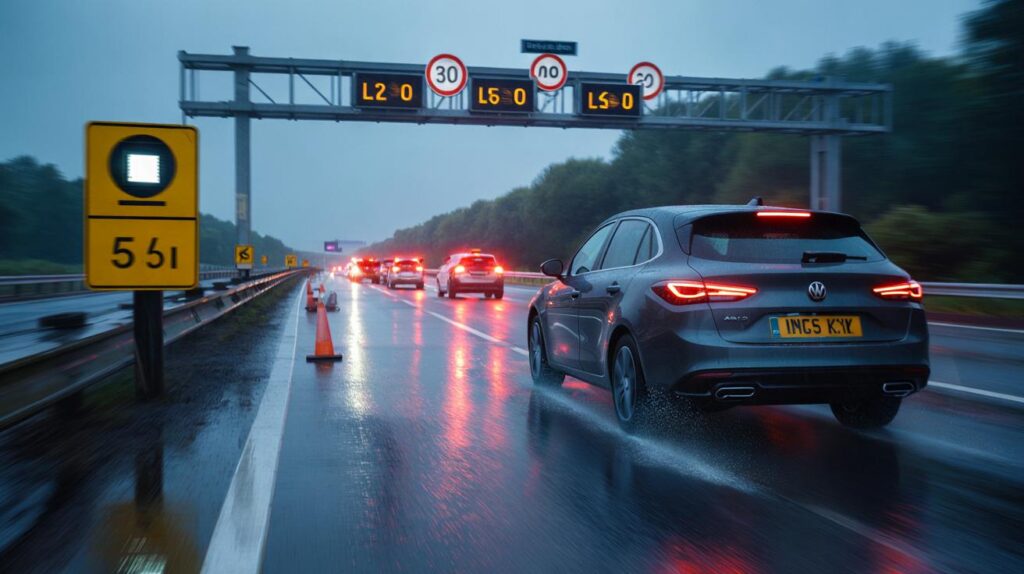
Caught at 71mph on the M4 and leaving court with a fine and a driving ban. It sounds harsh, almost unbelievable, yet it happened — and it’s becoming a quiet, growing reality on stretches of the motorway where the rules shift, the gantries glow, and a split-second decision spirals into months off the road.
It was one of those dreary M4 mornings where rain doesn’t fall so much as drift. The motorway hummed, a steady conveyor belt of steel and patience. Ahead, the gantry flickered to 50, a neat reminder, easy to miss in the spray and the rush. A camera blinked. No drama, no wail of sirens — just that sharp, clinical flash that makes your stomach sink even before you’ve processed why.
Days later, a letter. A charge. Then a magistrates’ bench. The number that started it all? Seventy-one.
When 71mph stops being “normal” and starts being a court date
On a clear motorway, 71mph barely feels like speed. It’s the pace of Britain on a weekday, the quiet compromise between arriving on time and not pushing your luck. Yet the M4 is stitched with variable limits, average-speed zones, and cameras that never blink. **Seventy-one in a 50 doesn’t sound dramatic — until you’re sat in court explaining it.**
Picture a contractor heading home from a night shift, rolling past Newport with coffee and a ticking clock. The gantry shows 50 through works, the kind that seem to go on for miles, the kind your brain files as “temporary”. He sits at 71 because the traffic does, because the lane feels wide, because everyone else seems to be doing it too. The camera is patient. The post is punctual.
Here’s the plain truth of the law. Variable limits are not suggestions; they’re statutory, enforced as firmly as any painted sign on a post. The informal “10% plus 2” guideline won’t save 71 in a 50 — it’s far past the cushion. That reading lands in a band where a hefty fine is likely and a short disqualification is firmly on the table. The maths looks cold because it is.
What actually gets punished — and why this case stung
Every motorway holds two realities: what feels safe and what’s legal. When gantries drop to 50, the system assumes risk you can’t see — engineers on the verge, a spill, a breakdown in a blind spot. That’s why the cameras stay live even when the road seems empty. One moment of 71mph is all the law needs to measure intent, not context. *It can feel brutal because the judgement arrives long after the moment has passed.*
The driver in this case — a regular commuter, not reckless, not drunk, no road rage — ended up with a fine linked to income and a short ban. A few weeks. Enough to derail childcare, cancel jobs, and make ordinary life complicated. We’ve all felt that moment when a tiny decision takes on ridiculous weight. **Let’s be honest: nobody checks every gantry, every minute, with monk-like focus in the rain.**
Why such a punch for 71? Because in a 50 zone, 21mph over taps into a harsher band. Courts look at speed over the limit, not the absolute number. They also care about where you did it — smart motorway, roadworks, near a slip road. A clean record helps, sure, yet the range still includes disqualification. If you’ve already stacked points, totting up can tip you over the edge. That’s how a forgettable morning becomes a season without a licence.
How to keep your licence where limits change without warning
There’s a simple habit that works on the M4’s variable stretches: scan, slow, set. Scan the gantry two up ahead, not the one right above you. Slow gently, early, so you’re never the only car braking hard. Set the limiter or cruise control at two or three under the displayed limit to absorb gradients and speedo quirks. It feels cautious; it saves you weeks of admin and a hole in your wallet.
Phones help as silent copilots. Many navigation apps show the current limit in real time and ping when you drift over. Calibrate your speedo against GPS once on a long, flat run to understand its usual overread. If your car has a speed limiter, use it in busy, camera-lined stretches. Tiny tools, big difference. **Small margins decide whether you get a letter or carry on with your day.**
If you do get flashed, act quickly. Name the driver inside the window, consider a speed awareness course if offered, and check the photos for clarity and signage. Say what you need to say, then stop. Don’t write a novel when a paragraph will do.
“People think 71mph sounds harmless,” a veteran traffic patrol officer told me. “But the limit is the limit. In a 50, that’s not drift, that’s a choice. Cameras can’t read excuses — they only read numbers.”
- Look two gantries ahead, not one.
- Set a limiter two or three under the displayed limit.
- Use lane discipline to reduce speed creep.
- Rely on GPS readouts for a sanity check.
- If the sign’s blank, treat it as national speed limit — until it isn’t.
What this 71mph ban really tells us
This wasn’t a boy-racer story. It was a working-person story, a family-person story, an “I thought I was fine” story. And it shows how motorways now rely on tech, not discretion. Cameras don’t get bored. They don’t wave you on with a warning. They catch the moment and hand it over to a system that runs on bands and brackets.
There’s a fairness question humming beneath all this. Legal? Yes. Proportionate? Ask the person riding the bus for a month to keep their job. That tension won’t vanish as Britain leans harder into variable limits and average speed enforcement. **We either learn to read the gantries like a second language, or we keep reading letters we wish we hadn’t opened.** It’s not glamorous. It is real.
| Key points | Details | Interest for reader |
|---|---|---|
| 71mph can be a ban | In a 50mph variable zone, 21mph over triggers tougher sentencing bands | Explains how a “normal” speed led to a court ban |
| Smart limits are binding | Gantry displays carry legal weight, with active enforcement on the M4 | Shows why the flash arrived even in light traffic |
| Practical methods help | Scan–slow–set routine, limiter use, GPS cross-checks | Concrete steps to avoid points, fines, and bans |
FAQ :
- Is 71mph on a motorway illegal?On a 70mph limit, most forces apply thresholds, but 71 can still be recorded. In a 50mph variable zone, 71 is a clear offence.
- What’s the penalty for 71 in a 50?Often a Band B/C outcome: sizeable fine based on income, points or a short disqualification, depending on the court’s view.
- Will I get banned for a first offence?It’s possible at 21mph over in a restricted zone, especially with aggravating factors. Clean history helps yet doesn’t guarantee points over a ban.
- Do speed cameras allow any leeway?Guidelines suggest a small margin, but it’s not a right. Enforcement policies vary and variable limits are tightly policed.
- Can I challenge a variable speed ticket?Yes, if signage, calibration, or identity is in doubt. Evidence must be solid; otherwise, fines and costs can rise if you lose.



Brutal, but the law is the law. 71 in a signed 50 is always going to bite.
If everyone around is doing 70 through “temporary” works, what exactly is safer about picking off one car? Feels like enforcment by spreadsheet, not context.