
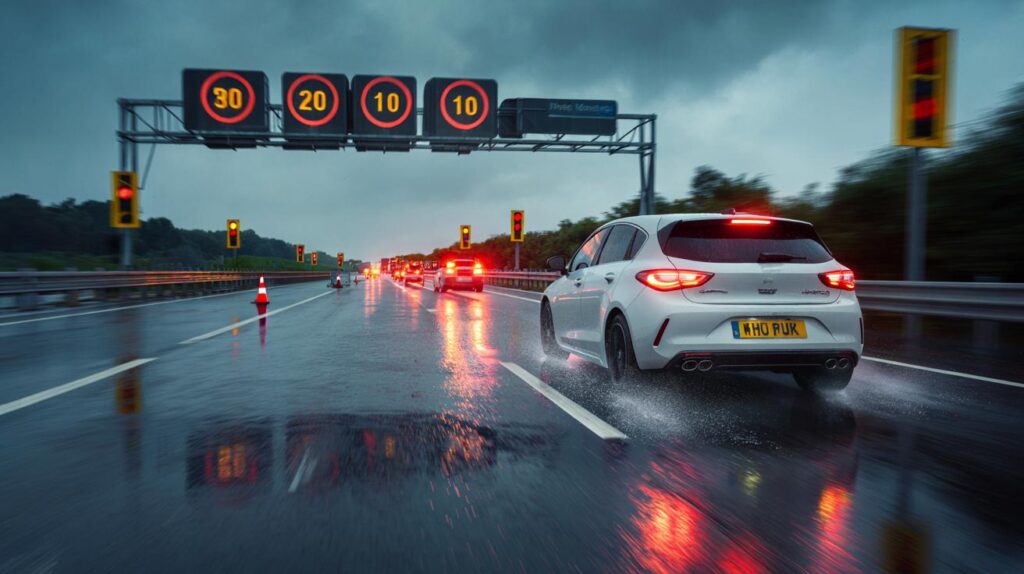
A driver clocked at 71mph on the M4 sounds like a shrug — barely over the national limit. It wasn’t. Variable limits were live, cameras were watching, and a routine journey turned into an expensive lesson with a driving ban attached. Here’s how a perfectly ordinary number became anything but.
The rain started halfway to Reading, the kind that slides across the windscreen rather than falls. On the gantry, the white circles glowed a stern 40, while brake lights shivered ahead like a red ribbon. A white hatchback ghosted past in the right lane, the hum of tyres rising, that faint metallic flash from the camera like a tiny clap. A few weeks later the letter thudded on the doormat, thick paper, black type, a sentence in numbers. Seventy-one in a forty. Band C. Court. Licence on the line. The driver stared at the kitchen tiles, as if the grout could give a better answer than the page. A small misread, a big bill.
When 71mph becomes a ban on the M4
On a motorway, 71mph reads like a rounding error. It isn’t when the limit changes. Motorways like the M4 run on variable speeds, and a 40mph order is not a polite request. Hit 71mph in that zone and you’re 31mph over — squarely in the “Band C” range for sentencing. **71mph can legally mean a ban when the limit is 40.** Magistrates can impose six points or disqualify you for seven to 56 days. The national limit on a clear stretch might be 70, but smart motorway rules don’t care about what the weather was five junctions back. They care about the sign above your head.
You see it most in the stretches west of Heathrow and around Reading where gantries come thick and fast. Overnight roadworks funnel lanes. A red X blinks above Lane 3 after a stranded van. Average-speed cameras knit the road into a sequence of silent checks. One driver told me they “just kept with the flow” at 71, thinking the 70 rule still applied. The camera didn’t blink; it didn’t need to. The system logged plate after plate until the average landed. In that split second, 71 felt ordinary. Weeks later, the ordinary fell apart.
The law is blunt about it. The Sentencing Council’s guidance sets fine bands by how far over the posted limit you were, not what you believed the limit to be. Band C fines usually run 125% to 175% of weekly income, capped by law, with a 40% victim surcharge and court costs on top. Six points or a short ban often follow at this speed, and speed awareness courses aren’t offered that high. It feels clinical because it is. Camera evidence, sign compliance, and your mitigation, if any. That’s the scale the court uses, and it tips quickly when the numbers are clear.
How to not join the ban club
There’s a small habit that helps: scan the road like a long sentence, not a single word. Read two gantries ahead, then your mirrors, then the brake lights beyond the car in front. Use your speed limiter when limits drop; it’s the most overlooked button in a modern car. Pre-programme two presets — one at 50, one at 40 — and tap down when those white circles switch. **Speed cameras don’t take days off, and they don’t get bored.** Average-speed zones reward calm, steady driving; they punish last-second braking and panicked dashes between lenses.
Common slip-ups are boringly human. People see a 40 and assume it’s “advisory”, or they lift off but don’t actually change their speed. Some slow only when a camera housing appears, then speed up again, forgetting that the “average” in average-speed does exactly what it says. Others treat a red X as if it’s only meant for lorries. We’ve all had that moment where the road feels familiar and the brain starts to drive on guesswork. Let’s be honest: nobody really does that every day. The fix is small: treat every gantry like a fresh rulebook, even if you drove this stretch yesterday.
This isn’t about fear, it’s about rhythm and attention. Driving bans aren’t just a legal hit; they rewire your life — work, school runs, your sense of freedom.
“On the M4, the number on your dash means less than the number on the gantry,” a former traffic officer told me. “If it says 40, it’s 40, whether you agree or not.”
- Glance three gantries ahead and say the limit out loud if you’re tired.
- Use your car’s limiter in 40 and 50 zones; set-and-forget beats white-knuckle braking.
- Hold one speed in average zones; treat each camera as a comma, not a finish line.
- Respect red X closures — they often protect breakdowns and emergency crews.
- If uncertain, drop 5mph; time lost beats points gained.
The cost, the lesson, the road we share
What sticks after a ban isn’t the number — 71 — but the way it sneaks into your week. You find yourself timing trains, borrowing lifts, feeling the edge of the map contract. Friends are kind, then busy. Work flexes until it can’t. And the M4 keeps moving, as indifferent as the camera flash on that wet morning. **The number on the sign is only half the story; the context writes the rest.** Was there a breakdown? Roadworks? A storm rolling in over the downs? That’s why variable limits exist, and why they bite when ignored. Share this with the mate who scoffs at 40 on a motorway. Not to scold, but to spare them the kitchen-table letter, the quiet dread, the weeks recalibrating life around a choice that took less than a minute.
| Key points | Details | Interest for reader |
|---|---|---|
| Variable limits change everything | 71mph in a 40 is Band C with points or a short ban | Explains how a “normal” speed led to a ban |
| Average-speed cameras are relentless | They record across zones, not just at one box | Shows why late braking doesn’t work |
| Practical habits cut risk | Use limiters, read gantries, respect red X | Actionable ways to avoid fines and bans |
FAQ :
- Why can 71mph lead to a ban on the M4?Because on smart stretches the posted limit can drop to 50 or 40; 71mph in a 40 is 31mph over, which sits in Band C where courts can impose six points or a short disqualification.
- How big is the fine for 71mph in a 40 zone?Guidelines point to 125–175% of weekly income, plus a victim surcharge (usually 40% of the fine) and court costs. The court can reduce for an early guilty plea.
- Will I get points or a ban — which is worse?At that speed, magistrates choose between six points or a disqualification of 7–56 days. A ban bites fast; points linger, and insurers can penalise both.
- Do average-speed cameras flash?Often not. They use linked ANPR cameras to calculate your speed between points, so you may never see a flash even if you’re being recorded.
- Can I appeal or offer mitigation?You can explain circumstances in court — signage visibility, an emergency, clean record — but mitigation won’t undo a clear, signed limit. It may influence the length of a ban or the size of the fine.



Harsh but fair? 71 in a 40 is a big gap, but a ban for a first slip-up feels heavy.
Genuine question: were the 40 gantry signs lit and visible in that rain? If the lane had a red X, that should be crystal too. Otherwise it’s a signage issue, not just speed.