
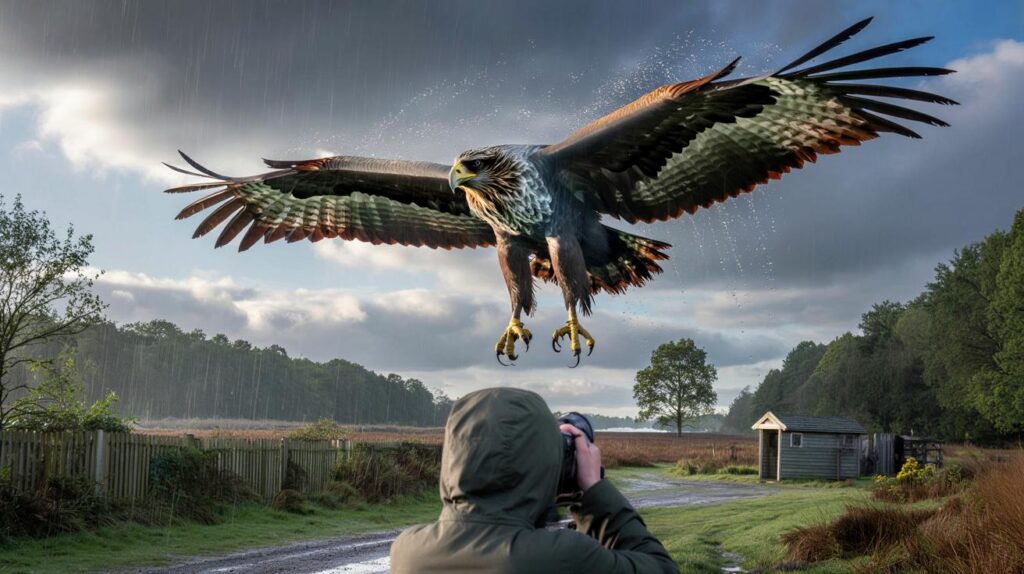
A sudden squall swept across Ringwood last week, but a striking winged silhouette held its line against the rain.
At Liberty’s Owl, Raptor and Reptile Centre, a white‑tailed eagle powered through a brief downpour as a local camera club member framed the moment. The shower passed, the sun returned, and the UK’s largest bird of prey kept flying as if nothing had changed.
Rain, light, and a rare close look
The burst of rain lasted only minutes, yet it delivered drama. The juvenile white‑tailed eagle spread a vast 2.5‑metre wingspan and banked into the wind. The air shimmered with spray. The bird’s flight stayed flat and purposeful, its long, rectangular wings locked and level. Then the clouds broke, and the scene turned bright again.
Under a five-minute downpour in the New Forest, a juvenile sea eagle showed the calm power that defines the species.
Photographer Miles Herbert, a member of the Daily Echo Camera Club, captured the encounter at full stretch. One frame caught the bird facing the lens, the heavy yellow bill centred and the rain beading across the feathers. Another revealed the full breadth of those outstretched wings, held like a glider’s plane.
What you’re likely to see — and what sets it apart
White‑tailed eagles, also called sea eagles, dwarf most British raptors. The broad body and flat, plank‑like wings make them stand out even at range. In close views the detail tells its own story: a blocky yellow bill, strong yellow feet, and the bright tail that gives the species its name. Juveniles show darker, mottled plumage and take several years to acquire that crisp white tail.
- Wings held flat when soaring, giving a broad, rectangular outline.
- Chunky yellow beak and powerful yellow talons visible even at moderate distance.
- White tail in adults; juveniles are darker and more mottled.
- Steady, unhurried wingbeats; a silhouette more like a flying door than a falcon’s arrow.
Behaviour also helps. Unlike golden eagles, which favour upland prey, white‑tailed eagles regularly take fish and waterbirds. Along coasts and estuaries they will drop from height and slam into the surface, talons extended, to lift a fish clear of the waves. Inland, they will seize rabbits and hares, or harry birds into the open.
Protected status and how to watch without harm
These eagles carry Schedule 1 protection. Disturbance is a criminal offence, especially around nesting sites and roosts. The law reflects their sensitivity and the long road back from local extinction.
Schedule 1 protection means keeping a respectful distance, avoiding nests, and letting the bird dictate the encounter.
Practical fieldcraft for readers
- Use binoculars or a long lens rather than edging closer.
- Stay to marked paths near wetlands and keep dogs under close control.
- If the bird watches you repeatedly, shifts position, or calls, you are too close — step back.
- Share precise nest locations cautiously to avoid drawing crowds.
From wiped out to wingbeats over Wight
White‑tailed eagles once ranged widely across southern England. By the early 1900s they were gone, driven out by persecution and habitat pressure. Modern sightings in the south owe much to a reintroduction led by the Roy Dennis Wildlife Foundation and Forestry England. The five‑year programme began on the Isle of Wight in 2019, releasing young birds to establish a coastal foothold again.
That work has already marked a milestone. Two eagles released in 2020 reared a male chick, the first of the species born in England since 1780. The date matters. It sets a new line on the timeline and signals that territories, courtship, and nesting behaviour are taking hold where they had vanished for centuries.
Why a rainy image matters to you
A single photograph can reset how people think about a species. Seeing a vast raptor shrug off a squally shower says something simple and tangible about resilience. It also puts scale in context. A 2.5‑metre wingspan is wider than many small cars. When a bird that size sweeps across a New Forest sky, you notice. For residents and visitors, the sight adds weight to local nature recovery stories, turning policy and programmes into feathers and muscle in real air.
What to expect if you visit
Liberty’s Owl, Raptor and Reptile Centre in Ringwood houses an array of birds of prey. Among them are an Alaskan bald eagle, a peregrine falcon, and a white‑headed vulture. Each species offers a different lesson in flight and adaptation. The bald eagle carries the heavy, hook‑billed shape of a fish specialist. The peregrine shows speed and tight turns. The vulture’s expansive wings and bare head fit a scavenger’s role. Together, they make a useful reference set for anyone learning to tell silhouettes apart.
Photography notes from a five‑minute storm
Short showers can deliver the best drama. Rain sharpens contrast, darkens backgrounds, and lifts droplets around a moving subject. A sea eagle’s level wings and steady beat give the camera a clean line to follow, even when the light dips. Wait for the break in the cloud and you will often get a rim of brightness on the bird’s back as the sun reappears.
- Use a fast shutter to freeze rain and wing edges; increase ISO if the light drops.
- Track the bird early, half‑press to lock focus, and fire as it banks.
- Shoot in short bursts to preserve detail while the lens clears water.
- Keep a lens cloth tucked under a jacket to wipe between sequences.
What this means for local wildlife watchers
If you live around the New Forest or the Solent, look up when showers pass. Large raptors often use the change in wind and pressure to move. Watch open water, estuaries, and big fields that offer safe lift. If you see a bird that looks almost rectangular with long, flat wings and a heavy bill, you may be looking at a sea eagle easing across new ground carved out by patience and planning.
Further context for curious readers
White‑tailed eagles are social in winter and can gather where food is reliable. They will also travel widely when young, testing coastlines and river systems before settling. That roaming habit explains scattered sightings across southern counties since the Isle of Wight releases began. As territories stabilise, encounters may grow more regular around favoured roosts and feeding areas.
For families and keen walkers, sharpening identification skills adds value to every trip. Start with size and wing shape, then check bill colour and tail pattern. Add behaviour to the mix. If a vast raptor tilts over choppy water and punches down with outstretched talons, you have a strong clue. The next time a five‑minute shower sweeps across the New Forest, you might be the one lining up the shot as a 2.5‑metre wingspan cuts through the rain.



That 2.5‑metre wingspan is wider than my hatchback—no wonder it shrugged off the squall 🙂 The rain-to-sun transition sounds cinematic, and the fieldcraft tips are ace. Miles, that head‑on frame with the beading rain must look insane.