
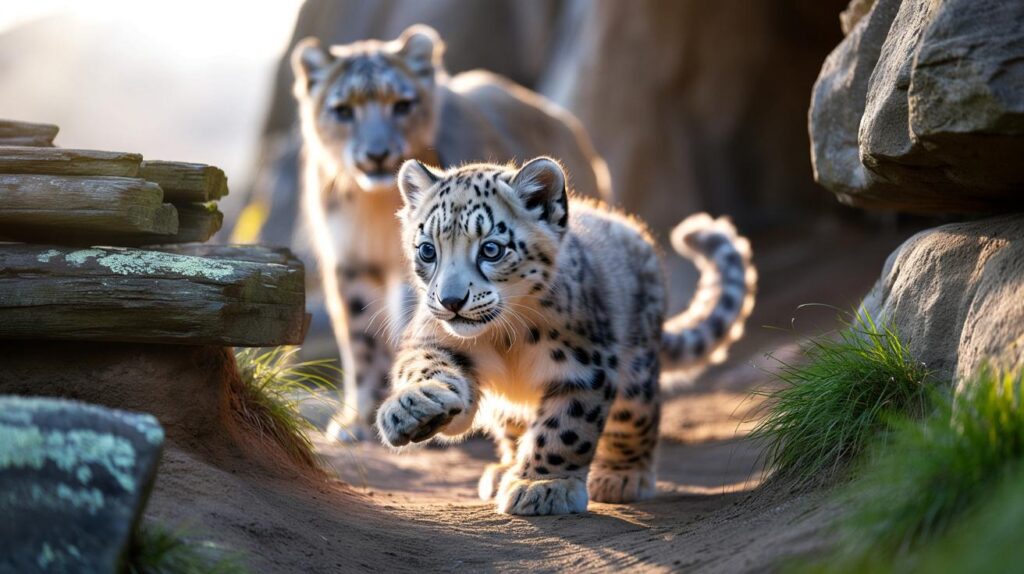
For weeks, a den camera in Cheshire has held viewers spellbound. A small shape stretched, blinked and padded into brightness.
The shy star of those pixelated moments now has a name. Chester Zoo has confirmed that its rare snow leopard cub will be known as Bheri, a choice shaped by thousands of public suggestions and a nod to the species’ mountain homeland. As Bheri sampled the outdoor enclosure for the first time, keepers described a bold youngster shadowing her mother, Nubra, and learning the slopes of her new world.
A name with mountain roots
Zoo staff sifted through a flood of proposals from members of the public before settling on Bheri. The name mirrors the cub’s origins: Bheri is also the name of a river that threads through Himalayan valleys, where wild snow leopards prowl steep cliffs and scree.
Bheri: a Himalayan-flavoured name chosen from thousands of public suggestions, echoing the species’ high-altitude home.
Keepers say Bheri has shown early confidence, following Nubra out of the den and testing the rocks, ramps and ledges of the enclosure. Early play has focused on pouncing, tail-chasing and careful balancing—behaviours that fine-tune a snow leopard’s remarkable agility.
Millions watched the den
Chester Zoo’s live den stream drew a vast online audience in recent weeks, with viewers waiting to catch a glimpse of the cub tucked alongside her mother. The moment Bheri stepped into daylight became a shared experience for people far beyond the zoo’s gates.
- Viewers followed Bheri’s growth from blinking newborn to nimble climber.
- Keepers offered regular updates, explaining what to watch for as mother and cub bonded.
- The first outdoor excursion triggered a surge of comments and name suggestions.
Why snow leopards matter
Snow leopards prowl a vast arc of mountains from the Himalayas across Central Asia, yet people seldom see them. Their dense, smoke-grey coats blend into rock and snow. Their long tails act as counterweights on ledges and blankets in blizzards. Wide, furred paws distribute their weight like natural snowshoes. These adaptations make them supreme climbers on some of the world’s harshest terrain.
Only about 4,000 snow leopards are thought to survive in the wild, and the species is classed as Vulnerable on the IUCN Red List.
Their numbers face pressure on several fronts. Rising temperatures shift prey and push herders higher, increasing the chance of conflict. Mining and roads fragment habitat. Poachers target pelts and bones. When snow leopards take livestock, retaliatory killing follows.
The main threats, at a glance
- Habitat loss and fragmentation driven by infrastructure and industry
- Climate change reshaping alpine ecosystems and prey patterns
- Illegal trade in skins and body parts
- Human–wildlife conflict linked to livestock losses
Chester Zoo’s team supports conservation beyond its own fences. The cub’s birth sits within the European Endangered Species Programme, a coordinated effort that pairs zoos to maintain genetic diversity. At the same time, the zoo collaborates with partners such as the Snow Leopard Trust and local communities in Kyrgyzstan to calm tensions between people and predators, protect grazing grounds, and gather data through camera traps.
Breeding in zoos builds a safety net. Fieldwork with communities reduces conflict where the cats actually live.
Mother, cub and the first lessons of life
Nubra, a seasoned mother, has shepherded Bheri gently but firmly. Early days for snow leopard cubs revolve around warmth, milk and sleep. Curiosity soon takes over. In the enclosure, keepers have introduced rock piles and scent trails to encourage confident climbing and careful stalking. These activities nurture balance, coordination and problem-solving—traits that keep wild snow leopards alive on knife-edge cliffs.
Visitors may see Bheri in short bursts. Cubs of this age tire fast and retreat to dens to rest. Keepers manage access so mother and cub choose when to show and when to vanish behind logs and ledges.
| Species | Snow leopard (Panthera uncia) |
| Name | Bheri |
| Sex | Female |
| Born | In recent weeks at Chester Zoo |
| Mother | Nubra |
| Conservation status | Vulnerable (IUCN Red List) |
What the name signals to the public
By choosing Bheri, the zoo anchors a playful moment to a hard question: can these mountain cats survive human pressure? A name with a Himalayan echo creates a talking point for keepers, teachers and families visiting the enclosure. It pushes attention beyond cuddly footage towards the snow lines where survival hangs on climate, pasture and tolerance.
From screens to slopes: turning attention into action
Online fascination can do real work when it directs support to field projects and smart husbandry. Across Central Asia, community-led schemes lower losses and change attitudes. Livestock insurance cushions herders after depredation. Predator-proof corrals reduce night-time raids. Crafts cooperatives and wildlife-friendly tourism create income tied to living cats, not dead ones.
- Livestock insurance: payouts reduce the urge for retaliation after a kill.
- Predator-proof corrals: simple builds stop night-time losses in winter corrals.
- Community rangers: local guardians monitor wildlife and deter poachers.
- Education: school programmes normalise coexistence and pride in native species.
Responsible breeding in European zoos complements this work. The Endangered Species Programme avoids inbreeding through planned pairings and shared records, while behavioural research improves welfare. Cubs like Bheri act as ambassadors for a species that most people will never see in the wild. The goal is not to replace wild populations but to ensure a healthy, genetically robust reserve and to fuel long-term public support.
What to know before you visit
Snow leopards rest during the day and grow active at cooler times, especially in summer. Patience pays. Scan the higher platforms first; look for a curved tail draped over a ledge. If Bheri is off show, keepers may be giving the pair quiet time. Short viewing windows help cubs build confidence without stress.
Beyond the cub: getting the facts straight
Snow leopards are often mixed up with clouded leopards. The two are different species that live in different habitats. Snow leopards favour alpine and subalpine zones from roughly 3,000 to 5,500 metres, while clouded leopards inhabit lower-elevation forests in South and Southeast Asia. The confusion matters because conservation tactics differ. Alpine cats need intact high pastures, secure transboundary corridors and herder-friendly policies; forest cats require anti-logging enforcement and protection of canopy-rich reserves.
If you follow Bheri’s story, place it alongside the bigger picture. The number 4,000 is an estimate based on difficult mountain surveys, so local gains or losses can hide behind averages. Climate models forecast shifts in suitable habitat over coming decades, which means corridors between ranges matter as much as protected cores. Supporting projects that stitch landscapes together—between Kyrgyzstan, Tajikistan, China and beyond—makes the difference between isolated pockets and a living metapopulation.
From a den in Cheshire to cliffs in Kyrgyzstan, one cub points to a shared responsibility for cold, high places.



Can’t wait to see her first wobbly steps 🙂 Huge congrats, Chester Zoo—and mama Nubra!
Beautiful story, but what concret actions can viewers take beyond watching—donate to the Snow Leopard Trust, support predator‑proof corrals, or volunteer locally?