
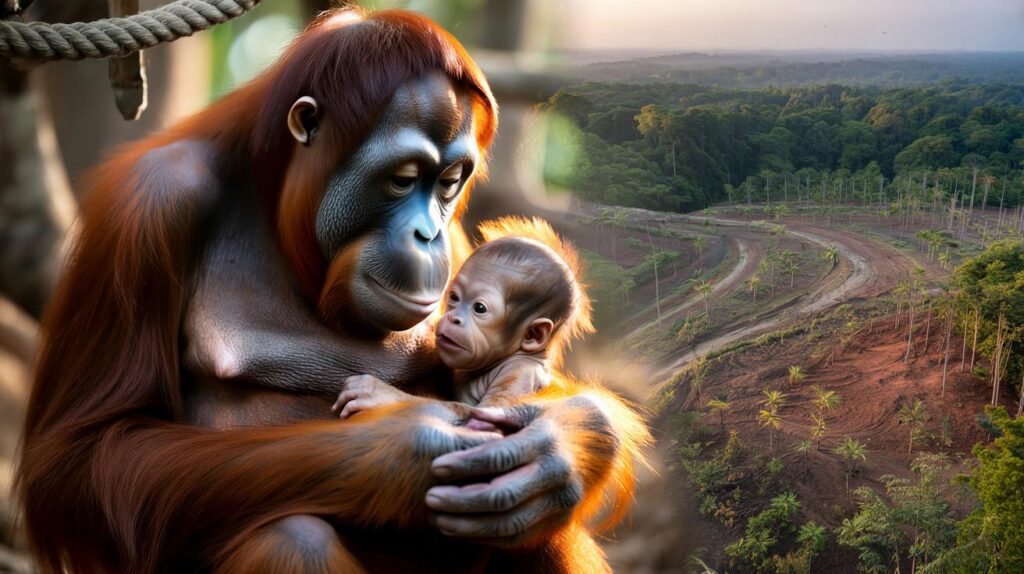
Before dawn at Chester Zoo, a small newcomer clung to mum Leia, stirring hope among families, keepers and conservation partners.
In the early hours of Tuesday 7 October, the UK’s most-visited zoo quietly welcomed a Bornean orangutan infant after an eight-and-a-half-month pregnancy. Staff say mother and baby look strong and settled, a calm start for a species under heavy pressure in the wild.
A fragile arrival with global meaning
The newborn, described by keepers as tiny but vigorous, spent its first days chest-to-chest with Leia. That close contact matters. Orangutan mothers carry infants constantly for months, feed them frequently, and guide them through a long childhood that lasts up to eight years. The sex of the infant has not yet been confirmed, but the early signs point to a healthy, attentive pairing.
Bornean orangutans are one of only three orangutan species on Earth. All three are ranked as critically endangered by the International Union for the Conservation of Nature, the highest threat category before extinction in the wild. Every successful birth in accredited zoos adds resilience to an insurance population that supports long-term species recovery.
Every healthy Bornean orangutan birth buys time for a species losing habitat faster than it can adapt.
Chester Zoo is uniquely placed in the UK, caring for both Bornean and Sumatran orangutans. That dual expertise feeds into coordinated breeding plans across Europe, linking animal care with frontline conservation projects in Southeast Asia.
Why this birth matters
Borneo’s tropical forests, the only natural home for the Bornean orangutan, have been shrinking at a pace that alarms scientists. Since 2000, more than 40% of some forest landscapes have been cleared or degraded, largely through unsustainable palm oil plantations, logging and agricultural expansion. Conflict with people and illegal hunting add further strain.
In that context, a single birth in Chester becomes more than a happy moment for visitors. It strengthens a safety net designed to maintain genetic diversity, deepen husbandry knowledge, and reinforce education about choices people make on British high streets every day.
When forests fall, orangutans vanish. When consumers pick certified products, forests are more likely to stand.
Key facts at a glance
| Species | Bornean orangutan (critically endangered) |
| Birth date | Early hours of Tuesday 7 October |
| Mother | Leia |
| Pregnancy | Approximately eight and a half months |
| Habitat pressure | Over 40% forest loss in parts of Borneo since 2000 |
| UK context | Chester Zoo cares for both Bornean and Sumatran orangutans |
Inside the orangutan nursery: what keepers see
Early hours matter. Newborn orangutans rely on skin-to-skin contact, warmth and steady milk intake. Keepers observed Leia maintaining constant body support, adjusting her posture to shield the infant and allowing frequent feeds. Such behaviour builds the bond that underpins an orangutan’s slow development, which includes years of learning how to forage, nest, and navigate the canopy.
For a critically endangered primate, these first interactions are not just tender moments. They are the foundation of survival skills that an individual needs for decades. Orangutans can live 40 years or more, so every early habit has long-term consequences.
Pressure on Borneo’s forests
Deforestation on Borneo has come in waves. Palm oil demand expanded rapidly after 2000, opening large tracts of lowland rainforest. Logging roads cut deeper into intact areas. Agricultural fronts moved in, and with them came more frequent human-wildlife encounters. Poaching and illegal capture compounded the losses.
Conservationists do not frame this story as inevitable decline. Certified sustainable palm oil, better land-use planning, and wildlife corridors have started to stabilise key landscapes. Where companies commit to zero-deforestation supply chains and smallholders receive support, forest edges become less dangerous places for orangutans to live.
Protecting habitat is not abstract: it is a chain of choices made by growers, brands and shoppers.
From Merseyside to Sabah: a 20-year link
For more than two decades, Chester Zoo and partners in Malaysian Borneo have worked to restore and reconnect rainforest along the Kinabatangan River. That collaboration — including corridor planting, community engagement and conflict reduction — helped the area gain recognition as a UNESCO Biosphere Reserve, a status that encourages sustainable development alongside conservation goals.
Local partners, including the NGO HUTAN, have shown that village-led initiatives can reduce crop losses while keeping wildlife moving safely through mixed landscapes. These projects test solutions that can scale beyond one river system, linking science, livelihoods and practical fieldwork.
What you can do today
The choices people make in supermarkets, bathrooms and kitchens add up. Palm oil sits in biscuits, spreads, soaps and shampoos. Buying certified sustainable options supports producers who keep forests standing and biodiversity intact.
- Check labels and company pledges for certified sustainable palm oil.
- Pick products from brands with public, time-bound zero-deforestation commitments.
- Cut food waste; less waste reduces pressure to convert more land.
- Support organisations creating wildlife corridors and restoring degraded forest.
- Share accurate information with friends and schools; small shifts change demand.
Families visiting the zoo can also learn how enrichment, diet and veterinary care mirror natural challenges. That knowledge turns a day out into informed action at home.
What ‘critically endangered’ really signals
The IUCN category marks species at extremely high risk of extinction in the wild. Assessments weigh population trends, habitat loss, fragmentation, and rates of decline across generations. For slow-breeding animals like orangutans, even small annual losses carry heavy long-term effects because births cannot offset deaths quickly. That is why each healthy infant matters far beyond one enclosure.
Beyond the headlines: the hard numbers behind hope
Forty percent forest loss since 2000 in parts of Borneo shows how quickly a canopy can unravel. Yet the same period produced tools that bend the curve: satellite monitoring, certification standards, and community forestry agreements. When producers meet rigorous criteria and buyers stick to them, deforestation drops. When governments recognise high conservation value forests, road plans shift and corridors remain open.
Orangutans respond when habitat improves. Females raise infants more successfully where fruiting trees are diverse and logging pressure is low. Males travel further and cross ground less often when canopy continuity increases. These are measurable outcomes, not wishful thinking.
How this birth fits a bigger plan
Accredited zoos run coordinated breeding programmes that match genetics, track health data and share husbandry advances. Chester Zoo’s work with both Bornean and Sumatran orangutans feeds into that network. When animals thrive under human care, keepers refine techniques that can later assist rescues, rehabilitation centres and release projects in range countries.
A thriving infant in Chester can improve survival odds for a rescued juvenile in Sabah years from now.
Practical next steps for readers
Set a challenge for your household this week: switch five regular items to certified sustainable alternatives. Check biscuits, spreads, instant noodles, shampoo and washing-up liquid. Track the swaps and note which brands are transparent about sourcing. Share the list with a neighbour or school group. Collective action shifts shelf space and supply chains.
If you plan a visit, take a notebook. List three behaviours you see from Leia and her infant — feeding, nest-building, or social signals. Later, compare your notes with trusted sources on orangutan behaviour. Turning curiosity into observation builds understanding, and understanding fuels better choices as a consumer and a voter.



What a beautiful write‑up. Reading about Leia keeping her newborn chest-to-chest gave me goosebumps. With over 40% of some Borneo forests gone since 2000, it’s heartening to see practical advice here. For shoppers: how do we reliably spot Certified Sustainable Palm Oil on UK shelves? RSPO logo? Any brands you’d personaly reccomend that truly have time-bound zero‑deforestation pledges? Also curious whether the infant’s sex has been confirmed yet, and when visitors might expect a first public peek without stressing mum.