
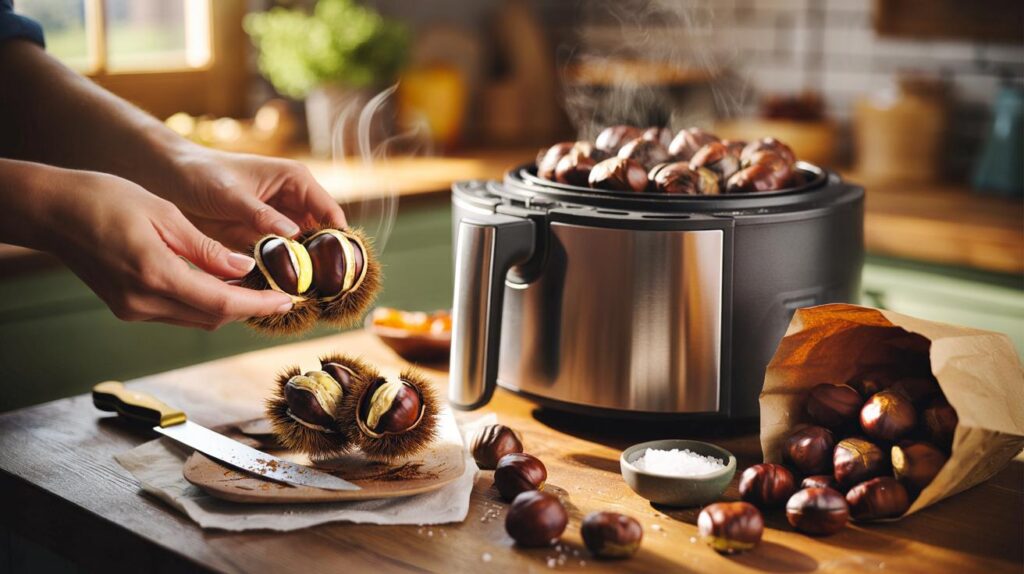
Cold evenings arrive, markets glisten, and kitchens hum. A small change in routine could warm hands and hearts fast.
Across Britain, home cooks are turning to the airfryer for a quicker way to prepare tender, sweet chestnuts. The result feels almost like a parlour trick: shells crack open on their own, the inner skin slips away, and the centres turn silky in mere minutes. Here is how the method works, why it’s catching on, and what to do with that 500g bag you brought home.
Why people are talking about airfryer chestnuts
A tray of chestnuts once meant an oven preheated for ages or a pan set over a smoky flame. An airfryer cuts that faff. Set it to 200°C, cook for around 15 minutes, and you get a basket of nuts that peel cleanly and taste richly autumnal. You avoid cold fingers by the window and you avoid overcooked, chalky centres.
Score a cross, soak for 30 minutes in cold water with 1 tablespoon of coarse salt, then airfry at 200°C for 15 minutes.
The salt-water soak loosens the inner pellicle. Scoring vents steam, which helps the shell lift away without a fight. Warm air circulates evenly, so the chestnuts soften to a creamy bite while the shells split neatly along your knife marks.
Pick the right chestnuts
Good results start with good nuts. Choose heavy, glossy chestnuts with unbroken skin. Ask for similar sizes so they cook at the same pace. If you can, look for French produce from Ardèche, Limousin or Corsica, prized for sweetness and gentle texture. Avoid dull, shrivelled or punctured shells.
- Weight test: a heavy chestnut usually signals a full, moist interior.
- Surface check: smooth, shiny shells with no mould at the tip.
- Size match: keep a uniform batch for even cooking.
- Quick float test at home: discard any that float after a minute in water.
Step-by-step: from knife to basket
Score safely
Set each chestnut flat-side down on a sturdy board. With a sharp, pointed knife, cut a small cross into the rounded top. Keep your fingers tucked. This simple cross gives the steam an exit and shows you where the shell will open.
Soak for easy peeling
Tip the scored chestnuts into a big bowl of cold water. Stir in 1 tablespoon of coarse salt and leave for 30 minutes. The soak hydrates the inner skin and seasons the nut lightly.
Cook fast, rest briefly
Drain well and load the basket in a single layer, cuts facing up. Airfry at 200°C for 15 minutes. If a tester knife slides in without resistance, you’re ready. If not, add 2–3 minutes. Wrap the hot chestnuts in a clean tea towel for 1–2 minutes; the residual steam loosens the last bits of skin.
When the blade slides in cleanly and shells gape along the cross, you have soft centres and effortless peeling.
Time, temperature and yields
| Batch size | Temperature | Time | What to expect |
|---|---|---|---|
| 250 g | 200°C | 12–14 min | Quick snack; very tender centres |
| 500 g | 200°C | 15–17 min | Even cook; shells split wide |
| 700 g | 200°C | 18–20 min | Stir once if crowded; test two or three |
Flavour ideas that work
Fresh chestnuts shine with minimal embellishment, yet a few additions steer them towards sweet or savoury in seconds.
- Maple and sea salt: toss with 1 teaspoon maple syrup and a pinch of flaky salt.
- Butter and thyme: melt a small knob of salted butter with fresh thyme leaves.
- Cinnamon and demerara: dust warm nuts lightly and serve with hot chocolate.
- Chilli and honey: drizzle 1 teaspoon honey and a pinch of mild chilli flakes.
- Cheese and pepper: grate Parmesan over hot nuts and crack black pepper on top.
- Fig and blue cheese: pair peeled nuts with fig conserve and a crumbly blue.
Storage, freezing and second-day uses
Once peeled, store chestnuts in an airtight container in the fridge for 2–3 days, tucked with a slightly damp kitchen towel to keep them soft. Reheat for 2–3 minutes in the airfryer at 160°C. For longer keeping, freeze peeled nuts flat on a tray, then bag them. They go straight into soups, stuffings and stews.
Leftovers bring depth to many dishes. Fold into a mushroom gratin. Blitz with stock for a velvety soup. Mash with a splash of milk and a hint of vanilla for toast. Stir into autumn salads with roasted squash, bitter leaves and a citrus dressing.
Cost, energy and kit
An average 1,500W airfryer running for 15 minutes uses about 0.38 kWh. At 28p per kWh, that’s roughly 11p per batch. A 2,000W oven could eat more than four times that once you add preheating. You save time and you save a few coins while keeping the kitchen warm and tidy.
About 11p in energy for 500 g at 200°C for 15 minutes; no preheat, minimal washing up.
Use a sharp pointed knife and a solid chopping board. A heatproof bowl or tray helps when you rest the cooked nuts under a towel. Don’t crowd the basket; warm air needs space to circulate.
Risks and mistakes to avoid
- Skipping the cross: unscored chestnuts can burst under pressure.
- Overcrowding: a deep pile steams unevenly and delays the split.
- Underdrying after the soak: drain well so the basket doesn’t pool.
- Old nuts: light, rattling shells point to dried-out interiors.
- Horse chestnut confusion: never cook conkers; only edible sweet chestnuts belong in the basket.
What makes the shells lift off
Two forces help. Water sneaks between skin and flesh during the soak, loosening the pellicle. Then, under heat, expanding steam pushes out along the scored cross. The shell and inner skin tear along the weakest line and open like a hinge. That is why a short rest under a towel finishes the job: trapped steam softens any clinging fibres.
Seasonal tips and nutritional notes
Peak season runs from mid-October to early November. Buy little and often, and keep chestnuts cool and dry at home. If you like to forage, learn the difference between a spiky burr of edible chestnuts and the smooth, shiny conkers of horse chestnut trees. When in doubt, buy from a greengrocer.
Chestnuts bring gentle sweetness, fibre and complex carbohydrates. They contain less fat than most nuts and pair well with fruit, dairy and robust greens. For a quick breakfast spread, purée warm chestnuts with a splash of milk and cocoa, then keep the jar chilled for a couple of days.



At last, chestnuts that undress themselves—scandalous and delicious 🙂 My old oven method always left me with blistered thumbs; this feels like a magic trick.