
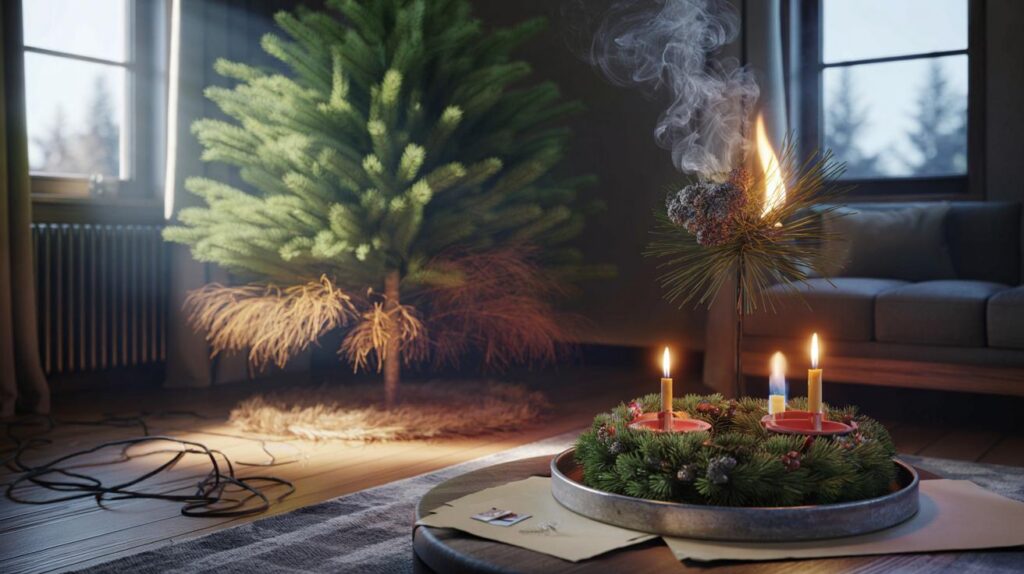
Every December, we fuss over the obvious flames and forget the fuel. Real candles on a wreath feel risky because you can see the fire. A dry Christmas tree looks harmless, yet it quietly turns your living room into a vertical bonfire in waiting. This piece is a candid look at Christmas fire safety—and why the dry tree, not the wreath, is the bigger danger.
The flat smelled of cinnamon and cold air when the front door opened and the kids tumbled in with glitter on their coats. The fairy lights hummed softly, the telly muttered, and on the coffee table a wreath with two stubby candles waited for a photo before dinner. The tree stood by the radiator, proud but tired, dropping needles like confetti after the wedding.
I touched a branch and the needles snapped cleanly, like dry spaghetti. The wreath felt cool and damp, its pine still springy, its little flames snuffed after the picture. The tree wore a halo of light, but felt tired in the air. One of these is a tinderbox hiding in plain sight.
Only one turns a room in seconds.
Why a dry tree behaves like a blowtorch
A Christmas tree isn’t one object. It’s thousands of tiny, resin-rich needles with huge surface area, stacked vertically and fed by air from below. When those needles dry out, they ignite fast and shed embers like sparks off a bonfire. The heat climbs the branches, the room gets involved, and the flames jump to anything that will join the party.
Safety videos show it cleanly. In side-by-side tests, a well-watered tree smoulders, spits, then gives up; a dry tree becomes a roaring column in under a minute. Firefighters talk about “flashover” — the moment everything in the room radiates enough heat to ignite together. With a dry tree, that moment arrives with brutal speed, and the numbers on the stopwatch feel unfair.
So why isn’t a wreath with real candles the bigger fear? A wreath is low, horizontal and fuel-poor. The cut greenery holds moisture, the flame is small, and the heat release rate is modest unless it touches something else. You can knock a candle over and make a mess, yes, but the wreath itself doesn’t offer the same ladder of fuel. The tree does — and it sits inside a web of electrics that can start the whole show.
How to stop your tree turning dangerous
Start at the shop. Pick a fresh tree with needles that bend before they break and branches that feel heavy, not brittle. At home, cut 2–3 cm off the base and mount it in a stand that holds at least 3–4 litres; a two‑metre tree can drink more than a litre a day at first. Keep it watered so the reservoir never runs dry, and keep the tree at least a metre from radiators, stoves and sunny windows.
Use LED lights with a proper safety mark and a cool touch. Switch them off at the wall when you go out or go to bed, and don’t bury extension leads under rugs. We’ve all had that moment when you promise yourself you’ll move the tree tomorrow and forget by tea-time. Let’s be honest: nobody really does that every day. So build in simple habits you’ll keep, not heroic ones you won’t.
What about the wreath with real candles? Treat it like fire, not decoration. Place it on a solid, non‑flammable surface, trim wicks short, and keep it far from curtains, cards, paper and shelves.
“The candle isn’t the villain,” a station officer told me. “It’s what the flame is allowed to touch — and whether the fuel is bone-dry.”
- Keep candles in sturdy holders, wider than the candle itself.
- Never leave them unattended, even for a “quick dash to the kitchen”.
- Snuff, don’t blow, to stop sparks drifting onto greenery.
- Refresh or re‑soak wreath greenery every few days to keep it supple.
- Move the wreath if you’re tempted to place cards around it. Don’t build a paper nest.
What this means for your home this Christmas
Wreath candles feel dramatic because flame makes us pay attention. The dry tree doesn’t get the same respect, and that’s where risk grows quietly. **A watered tree with cool LED lights, away from heat, behaves like a well‑mannered guest.** A dry tree with weary wiring behaves like a fuse.
There’s no need to ditch tradition or fear the glow. Change the odds. Water daily, keep cables tidy, and give the tree space to breathe. If the wreath is part of your ritual, make it a timed event at the table, then snuff it and move on. The whole season pivots on small choices repeated often.
One more thing. That “I’ll do it later” promise is how little hazards become stories on the six o’clock news. The tree wants a drink, the lights want an early night, and the room wants a metre of distance. **What you water thrives. What you ignore dries out.** Share that with the person who plugs everything in and the one who loves a candlelit photo. It’s a house pact worth making.
| Key points | Details | Interest for reader |
|---|---|---|
| Dry tree risk | High surface area, vertical fuel, rapid flashover potential | Explains why danger escalates fast |
| Wreath with candles | Small flame, limited fuel, moisture slows ignition | Reframes perceived versus actual risk |
| Action steps | Fresh cut, daily water, cool LEDs, 1 m clearance | Simple habits that cut risk sharply |
FAQ :
- How do I know my tree is too dry?If needles snap rather than bend and shed heavily when you brush a branch, it’s drying out. The stand running empty even once is a red flag, as the cut seals and uptake drops.
- Are LED lights really safer on a tree?Yes. LEDs run much cooler, draw less current and reduce heat on branches and connectors. They also pair well with modern timers so the tree isn’t lit overnight.
- Is a real‑candle wreath ever “safe” around children and pets?No open flame is risk‑free. Use it only when supervised, out of reach, and for short, intentional moments. Consider LED “real flame” candles for the rest of the time.
- What about artificial trees — can they burn?They can. Many are flame‑retardant, not flame‑proof. Keep them away from heaters and use quality lights. The absence of resin helps, but poor wiring still starts fires.
- What should I do if my tree catches fire?Get everyone out, close doors behind you to slow the spread, and call 999. If a small base fire starts and you have a water extinguisher to hand, a quick burst can help — but don’t take risks.



Eye-opening piece. I’d always worried about the visible flame, not the fuel. The blowtorch analogy and the flashover explanation definately land. I’m moving our tree away from the radiator tonight and switching to LED timers. Thanks for the practical, non-preachy tips.
Genuine question: isn’t this a bit overblown? We’ve had a dry-ish tree near a radiator for years and never had an issue, while wreath candels feel way scarier. Are the side‑by‑side tests representative of typical homes or worst‑case lab setups?