
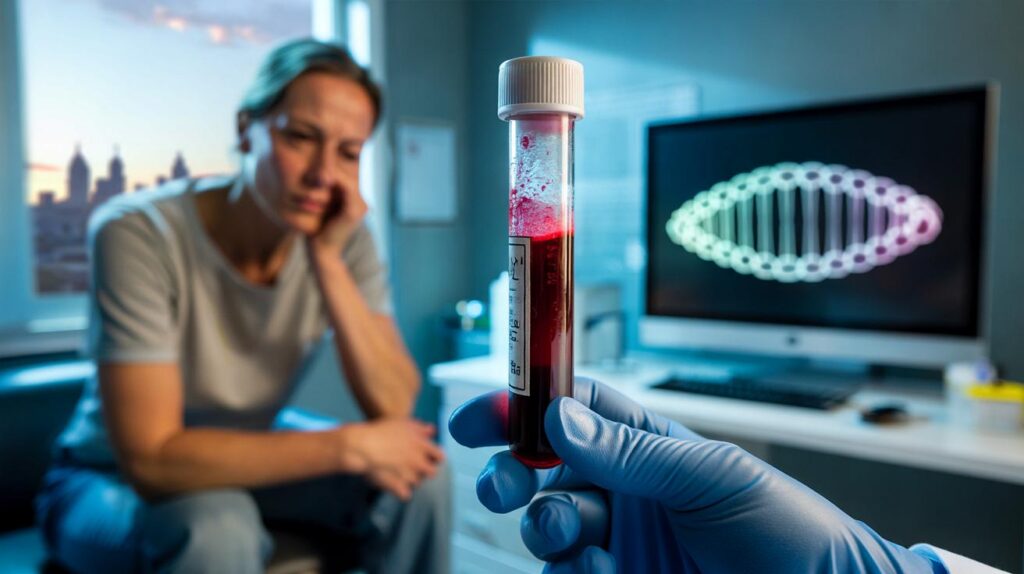
Years of uncertainty shadow people with chronic fatigue. Fresh laboratory data now hints at a different future and faster answers.
Researchers in Britain say a simple blood draw may finally give doctors an objective way to diagnose myalgic encephalomyelitis/chronic fatigue syndrome, a condition that has long relied on symptoms and exclusion tests.
What the new blood test claims to do
Scientists at the University of East Anglia and biotech firm Oxford Biodynamics report a first-of-its-kind diagnostic assay for ME/CFS. The test uses EpiSwitch 3D Genomics technology to read distinctive DNA folding patterns in blood cells. The team says their model separates people with ME/CFS from those without the condition.
They report 92 per cent sensitivity and 98 per cent specificity. Those figures suggest the assay correctly identifies most people who have the illness and rarely labels healthy people as ill.
Researchers report 92% sensitivity and 98% specificity by spotting unique DNA folding patterns in a standard blood sample.
How the science works
DNA does not sit in a straight line inside cells. It loops and folds, bringing far-apart sections into contact. These 3D shapes influence which genes switch on or off. EpiSwitch maps these chromatin loops to build a fingerprint of disease.
In ME/CFS, the researchers say they found a consistent pattern across patient samples. They built a classifier from that pattern and tested it against controls. The approach aims to turn a complex biological signature into a binary lab result.
| Feature | Detail |
|---|---|
| Technology | EpiSwitch 3D Genomics |
| Target signal | DNA folding (chromatin loop) patterns |
| Sample type | Peripheral blood |
| Reported sensitivity | 92% |
| Reported specificity | 98% |
Why this matters for patients and families
More than 400,000 people in the UK live with ME/CFS. Many wait years for a firm diagnosis. Symptom-based pathways can miss the condition or mislabel it as anxiety, depression or deconditioning. An objective test could reduce delays, shrink stigma and open doors to appropriate support.
An objective marker could shorten diagnostic journeys, reduce disputes over benefits, and speed access to tailored care.
- Faster triage in primary care, with clearer referral decisions.
- Better separation from lookalike conditions such as fibromyalgia, POTS and sleep disorders.
- More precise recruitment for clinical trials, improving treatment research.
- Stronger evidence when patients seek workplace adjustments or benefits.
How reliable are the results
Sensitivity, specificity and what they mean for you
Sensitivity shows how often the test finds the condition when it exists. Specificity shows how often it gives a negative result when the condition is absent. Both numbers matter. A highly sensitive test reduces missed cases. A highly specific test reduces false alarms.
For illustration, imagine 1,000 people tested in a clinic where 10 per cent actually have ME/CFS. With 92 per cent sensitivity, the test would pick up about 92 of the 100 true cases and miss about eight. With 98 per cent specificity, it would incorrectly flag about 18 of the 900 without the illness. Doctors would then interpret results alongside symptoms and other findings.
Even strong lab metrics require clinical judgment. No single test should replace a thorough history and examination.
Validation, regulation and adoption
Clinicians now call for independent teams to replicate the result in larger and more diverse groups. They also want to see how the assay performs against conditions with overlapping symptoms, including long Covid and autoimmune disease.
Any clinical rollout needs regulatory review, laboratory accreditation and clear reporting standards. NHS services would also need costings, procurement and training. The developers have not provided public pricing, and laboratories will need to establish turnaround times and quality controls.
What doctors may change in practice
GPs could use the test to support diagnosis when symptoms match current guidance. The 2021 NICE guideline for ME/CFS focuses on energy management, symptom relief and shared planning. It advises against therapies that push patients to increase activity in a fixed way. A validated diagnostic assay would not change those principles. It could strengthen confidence in the diagnosis and reduce unnecessary investigations.
Specialist clinics could use a positive result to structure care plans sooner. Negative results could prompt broader checks for thyroid disease, anaemia, sleep apnoea, adrenal issues, infection, POTS or mental health conditions.
Who should seek testing
People with prolonged, unexplained fatigue and post‑exertional symptom exacerbation should speak to their GP. That hallmark pattern—worsening symptoms after routine physical or mental effort—helps distinguish ME/CFS. A test may help when symptoms persist for months and other causes look unlikely.
Key questions readers ask next
- Will this diagnose long Covid? The assay targets ME/CFS biology. Some long Covid cases share features, but the test is not designed to label long Covid.
- Can the test track recovery? It is a diagnostic tool. Researchers still need to show whether the signal changes with treatment or time.
- How soon could I access it on the NHS? Adoption depends on replication, regulation, cost-effectiveness and commissioning decisions.
What this could change beyond the clinic
Objective biomarkers can shift research. A reliable test lets scientists build cleaner cohorts, stratify patients and measure how experimental treatments affect biology. Drug developers can move faster when they can define a target population with a lab result, not just symptom checklists.
Insurers, employers and schools often struggle to assess functional limits in ME/CFS. A validated lab marker will not capture daily fluctuations, yet it can help formalise the diagnosis. That can support reasonable adjustments, from flexible hours to exam accommodations.
Risks, limits and practical tips
A positive result does not tell you which treatments will help. It does not grade severity. A negative result does not rule out all fatigue disorders. Patients should avoid unregulated direct‑to‑consumer offers that skip clinical oversight. Ask who runs the laboratory, what accreditation it holds and how doctors will interpret the report.
If your GP offers the test in future, ask three things: what question the test answers, how the result changes your plan, and what next step follows a positive or negative report. If those answers sound vague, request a clearer pathway or a specialist referral.
A test that shortens the journey matters most when it plugs into a plan: pacing, symptom care and tailored support.
One final term to know is post‑exertional malaise. Many patients call it a crash. Symptoms sharpen after minimal effort and can peak a day later. Keeping an activity diary can help you spot patterns. That record gives your clinician context for any future biomarker result and guides safer pacing strategies.



At last, something objective for ME/CFS! If EpiSwitch can really pick up those chromatin loop ‘fingerprints’ with 98% specificity, that could cut years of doubt and mislabelling. I’m cautiously excited—please let independent teams replicate this fast. Also curious about turnaround times and lab accreditation; folks have been burnt by hype before. This definitly feels like progress.