
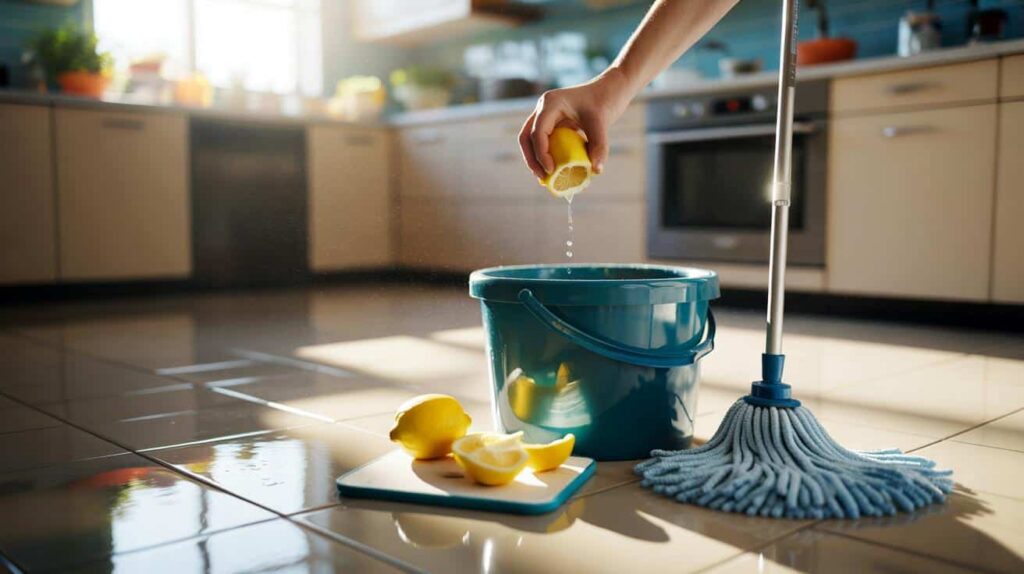
One simple tweak to your bucket routine changes that pattern.
If greasy film, shoe marks, and kitchen smells come back too fast, your mop mix may be the culprit. A tiny adjustment, using a pantry staple, breaks down residue, freshens the room, and helps floors stay clean longer without heavy chemicals.
Why floors get dirty faster than you think
Every step brings in grit, oils, and fine dust. Cooking adds an invisible haze of fats that cling to hard floors. Many soaps leave a sticky film, which attracts new soil and turns dull in a day or two. That cycle makes you mop again sooner than you need to.
To break the loop, you want three things: a mild degreaser, a low-residue rinse, and a fast dry. That combo removes grime, stops the sticky after-effect, and reduces re-soiling.
The pantry add-in that keeps floors cleaner longer
Lemon brings a useful blend of citric acid and natural solvents. In the right dose, it cuts grease, lifts mineral smudges, and neutralizes cooking odors without a heavy scent. Because it leaves less residue than many soaps, floors stay fresher between mops.
Use 2–3 tablespoons of fresh lemon juice per gallon (about 4 liters) of warm water for routine mopping.
Citric acid loosens the bond between grime and the surface. That helps your mop pick up more in a single pass. The light acidity also reduces the cloudy film that makes tile and vinyl look streaky. In kitchens, where splatters are stubborn, lemon’s degreasing edge shines.
How to mix a lemon mop solution
- Fill a bucket with warm water: 1 gallon/4 liters.
- Add 2–3 tablespoons of lemon juice. For heavy grease, add 1 teaspoon of mild dish soap.
- Stir gently. Avoid froth; bubbles leave film.
- Use a well-wrung microfiber mop. Damp, not dripping.
- Mop in small sections. Rinse and wring often.
- Dry-buff with a clean microfiber towel to prevent streaks.
For odor control, rub a cut lemon over a rinsed mop head, then rinse lightly. The fibers hold a fresh scent without perfume.
When to rinse
If you added dish soap or your floor feels tacky, do a quick second pass with plain water. On lightly soiled floors, a rinse isn’t needed; the low-lemon mix dries clean.
Where lemon works — and where it doesn’t
Acidic solutions pair well with many synthetics and glazed surfaces. They can harm cement-based or calcareous stone. Check the guide below and always spot-test in a hidden corner.
| Floor type | Use lemon mix? | Notes |
|---|---|---|
| Ceramic or porcelain tile | Yes | Safe on glazed tile. Rinse if grout is cement-based and stained. |
| Vinyl, LVT, linoleum | Yes, diluted | Wring well. Avoid pooling at seams. |
| Sealed laminate | Yes, very light | Minimal moisture; dry immediately. |
| Sealed hardwood | Better to avoid | Acids can dull finishes; use pH‑neutral cleaner. |
| Marble, travertine, limestone | No | Acid etches; choose stone-safe, pH‑neutral formulas. |
| Terrazzo or granito | No | Many contain cement or stone chips; acid can pit or haze. |
| Concrete (sealed) | With caution | Test sealers first; some react to acids. |
Skip lemon on terrazzo, granito, marble, and any unsealed natural stone. Use a pH‑neutral cleaner instead.
Pro moves for a streak-free, longer-lasting clean
Prep like you mean it
Vacuum or dust-mop first to remove grit that causes scratches and makes streaks. Dry soil steals shine more than wet messes do.
Try the two-bucket method
Keep one bucket for the lemon mix and one with clear water. Rinse the mop in clear water, wring, then dip into the mix. You stop re-depositing dirt.
Mind the mop material
Microfiber grabs oils better than cotton. It wrings drier and leaves fewer streaks. Replace heads when they feel waxy, since trapped oils smear back onto floors.
Control moisture
Water can seep into seams and under edges. A damp mop cleans best and dries faster, which helps floors stay spot-free.
If your floors can’t handle acid
Some surfaces need neutral care. You still can get that longer clean-window with smart swaps.
- Sealed wood and laminate: mix 1 teaspoon of pH‑neutral floor cleaner or castile soap per gallon of warm water. Wring hard, then dry with a towel.
- Stone floors: use a stone-safe, pH‑neutral cleaner. Buff dry to protect the patina.
- Stained grout: use oxygen-based powder in warm water. Apply, wait 5–10 minutes, scrub lightly, rinse.
- Greasy kitchens without acids: add a teaspoon of isopropyl alcohol to neutral cleaner. It speeds drying and boosts degreasing.
Why lemon helps floors stay clean longer
Grease holds dust. Lemon reduces that oil film, so less dust sticks after you mop. The mild acidity also counters minerals in tap water that cause spots. Because the solution rinses clean at low doses, it doesn’t leave a sticky layer that grabs dirt the next day.
Smart extras that extend the clean-window
- Use two doormats: one outside, one inside. Shake them weekly to keep grit off floors.
- Adopt a shoe drop zone. Less outside soil means fewer scratches and less mopping.
- Wipe pet paws after walks. A 10‑second habit saves 10 minutes of mopping.
- Dust high to low before you mop. Falling dust won’t land on a fresh floor.
- Mind dilution. More lemon isn’t better; too much acid can dull finishes.
Bonus: make a zero-waste lemon cleaner base
Save peels after cooking. Cover them with hot water in a jar, add a pinch of salt, and let sit overnight. Strain. Use 1/2 cup of this infused water per gallon of mop water. You’ll get light degreasing and a fresh scent from scraps you would throw away.
Troubleshooting common floor problems
- Cloudy tile after mopping: reduce lemon to 1 tablespoon per gallon and buff dry. Hard water spots often need less acid, not more.
- Sticky feel underfoot: skip dish soap next time or add a plain-water rinse. Stickiness pulls in dust.
- Dark grout lines: clean with oxygen-based cleaner monthly. Daily mopping won’t fully lift embedded soil.
- Flat shine on vinyl: confirm your mop head is clean. Oil-loaded heads smear and kill the sheen.
Start small, test a corner, and watch how your floor responds. The best mix is the lightest one that still lifts the grime.
Want to estimate your needs? A typical kitchen of 120 square feet uses about 1/2 gallon of solution with a damp microfiber mop. A living room of 200 square feet uses roughly 3/4 gallon. Mix only what you’ll use so the lemon stays fresh. If you mop weekly, swap in the lemon mix for kitchens and entry tiles, and stick with neutral solutions for wood and stone. That split strategy keeps every surface cleaner for longer, without guesswork.


