
You open a cupboard and a cloud of lemony chemical scent jumps at you. The bottle promises “freshness”, but the sting on your hands tells a different story. What if the clean you’re chasing didn’t come from liquids at all, but from a force that already lives in your home—quiet, invisible, and strangely musical? The notion feels futuristic, almost cheeky. Yet it’s here, and it works.
Morning, kettle on, sunlight slicing across the sideboard. I tap a silver spoon on a bowl and watch the dust lift, just slightly, like a breath held and released. Later, a neighbour shows me a humming box in her workshop—the small sort jewellers use—and dunks a grimy watch strap in warm water. In a minute, the liquid blushes brown without a drop of detergent. I didn’t quite believe her until the clasp came out shining. I went home and listened to my kitchen. Then I pressed play.
The strange way sound actually lifts dirt
Sound is just pressure moving through air or water, but your eyes can’t follow it. In liquid, high-frequency waves make microscopic bubbles appear and collapse again, and those tiny implosions tug at grease and grit. Engineers call it acoustic cavitation, which sounds like a sci-fi subplot, yet it’s the same physics that rattles grime out of a bike chain or lifts tea-stains from a mug. In air, vibration won’t “wash”, but it can loosen the stuff that clings on. A lampshade that won’t give up its dust will sometimes surrender after a gentle, steady buzz.
The example that won me over isn’t glamorous. A local bike mechanic keeps an inexpensive ultrasonic bath behind the counter. He drops in a derailer caked from winter roads, adds only warm water, and taps the button. For three minutes the unit purrs, and a smoky cloud of dirt blooms in the tank. When it emerges, the metal looks true again. Hospitals use bigger versions to pre-clean instruments, and repair shops swear by them for carburettors and camera parts. We’ve all had that moment when elbow-grease feels futile; this flips the story.
Here’s the logic in plain terms. Most home ultrasonic baths run around 40 kHz—a pitch you won’t hear, but your items will feel. The energy focuses in water, where cavitation can get into threads, hinges and textured surfaces that cloths miss. It’s not magic, and it won’t sterilise a thing on its own. What it does is dislodge. Dirt lifts sooner, with far less scrubbing, and you skip the cocktail of perfumes and solvents. That’s the whole point: make water act like a nimble set of tiny fingers, not like a perfume trying to bully a smell into submission.
Your home, cleaned by hums and tiny shakes
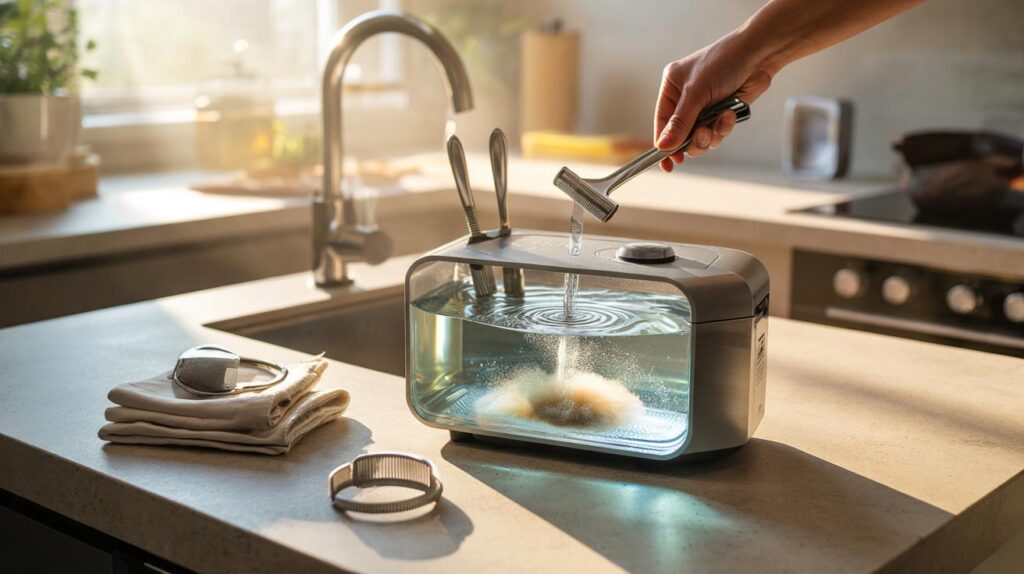
Start simple. Place a countertop ultrasonic cleaner on a stable surface and fill it with warm water—no detergents, no fizzing tablets. Lower in what can safely bathe: stainless steel cutlery, razor heads, metal tap aerators, glass oven knobs, silicone rings, and some plastics. Run short cycles and watch the bloom of grime roll away. Lift out, rinse under the tap, then dry with a microfibre cloth. For things you can’t dunk, use a small “sonic scrubber” tool on the surface with plain water; that rapid oscillation fattens your effort, so the stain yields with less pressure and no spray bottle in sight.
There are guardrails. Don’t put in porous stones, pearls, wood, or anything glued that you can’t afford to unglue. Avoid painted surfaces unless you’re willing to test a hidden corner. Keep water just warm, not hot, and go for several short pulses rather than marathon runs. And listen to the machine—if it rattles like a bag of forks, you’ve overloaded it. You’re not chasing a laboratory shine, only that quiet satisfaction of seeing real metal again. Soyons honnêtes : nobody really does this every day.
You can shift habits with small, low-drama moves. Rotate tap aerators through the bath once a month, soak shower-head parts to clear limescale crusts, and rescue kitchen scissor joints that feel gummy. The hum takes the drag out of it, and you trade blue liquids for calm water.
“Ultrasound is not a disinfectant; it’s a delivery of energy,” says Dr Emily Shaw, an acoustic engineer. “Used with plain water, it frees the dirt that water alone struggles to reach. That’s the win at home.”
- Starter kit: a small ultrasonic cleaner, a gentle sonic scrubber, microfibre cloths, and soft brushes.
- Good targets: cutlery, glasses, razor heads, metal fixtures, silicone rings, plastic vent covers.
- Avoid: pearls, opals, wood, glued trim, painted pieces, electronics.
- Golden rule: short cycles, warm water, rinse, dry.
What happens when your clean starts to sound like music
There’s a different kind of sonic trick that has nothing to do with baths and bubbles. Use rhythm to move work forward. Put on a 120–140 BPM playlist—the pace of a brisk walk—and give each track a task: one song per sink, one per shelf, one per room corner. A steady beat helps you keep strokes light and even, which pairs well with vibrating tools and plain water. Make the sound a timer you enjoy, not a drill sergeant. You’ll stop over-scrubbing, and the job feels finished before your shoulders complain. A home that hums back at you is oddly motivating.
| Point clé | Détail | Intérêt pour le lecteur |
|---|---|---|
| Ultrasound dislodges, not disinfects | 40 kHz baths use cavitation in warm water to lift grime from crevices | Cleaner results without chemical mixes or harsh scrubbing |
| Pick safe targets | Metals, glass, silicone, some plastics are ideal; avoid pearls, wood, glued parts | Protects valuables while still getting a deep clean |
| Use rhythm as a tool | A 140-BPM playlist paces tasks and reduces fatigue | Makes cleaning feel lighter and faster, even product-free |
FAQ :
- Can sound really clean without any product?Yes—ultrasound in water loosens dirt and film so it rinses away. It won’t sterilise, but it removes grime that cloths miss, especially in hinges and threads.
- Is it safe for jewellery and glasses?Generally for metal bands and plain glass lenses. Skip pearls, opals, and glued settings. If your glasses have special coatings, check the manufacturer guidance first.
- What about electronics like phone cases or earbuds?Hard plastic cases without electronics can bathe briefly. Never immerse earbuds or anything with batteries or circuitry. Wipe those with a lightly damp cloth instead.
- Do I need hot water or detergent?No. Warm water amplifies cavitation enough for home use. Detergent can help, but this approach focuses on sound and water only to keep things product-free.
- Will loud music clean my room?Not really. Speakers can vibrate objects, but they won’t wash surfaces. Use music as a motivator and timer, while the real “clean” comes from ultrasound and gentle tools.



Super article! J’ai testé un petit bain ultrason pour mon dérailleur: 3 minutes à l’eau tiède, pas une goutte de produit, et la soupe grise qui en sort… bluffant. À la maison, j’ai refait mes aérateurs et un vieux bouton de four en verre: cycles courts, rinçage, microfibre, c’est net. Le “sonic scrubber” sur un abat‑jour a aussi décollé la poussière avant un simple coup de chiffon. J’apprécie l’idée de la playlist tempo: ça m’empêche de frotter comme un bourrin et d’abuser des parfums.
Question peut‑être bête: si l’ultrasons “délodge” seulement, comment gérez-vous les bactéries? Un rinçage + séchage suffit-il vraiment pour une planche à découper plastique, par ex.? J’hésite à mettre mes ustenciles dedans. Vous faites un passage à l’eau très chaude après ou c’est inutile?