
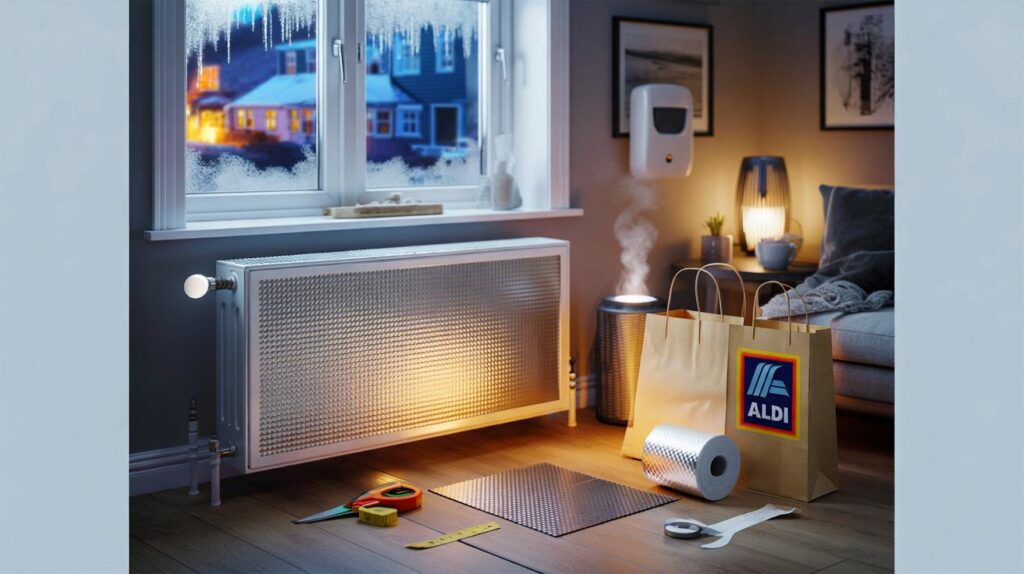
As the mercury dips, households are hunting cheap fixes that stretch warmth longer and keep living rooms cosy after dark.
Aldi is preparing a fresh wave of winter Specialbuys, headlined by a £9.99 radiator reflector that echoes a long-standing Martin Lewis energy-saving tip. The budget sheets promise to bounce heat back into rooms rather than letting it leak into chilly external walls.
The £9.99 panel and why it’s grabbing attention
From Thursday 23 October, Aldi will stock radiator reflectors in all UK stores for £9.99. The kit includes self-adhesive strips for quick fitting and a bubble-foam core designed to add insulation. There’s enough material for up to three radiators. Aldi says the reflective surface is engineered to redirect up to 86% of infrared heat back into the room.
The £9.99 sheets are designed to sit behind radiators on external walls, cutting heat losses and keeping rooms warmer for longer.
MoneySavingExpert founder Martin Lewis has repeatedly endorsed the principle of using reflective panels behind radiators. He does not push a particular brand, but his advice is simple: if a radiator sits on an outside wall, a reflective layer behind it can help stop warmth from bleeding into the brickwork. Some frugal households swear by kitchen foil as a stopgap, yet purpose-made panels should perform better and are easier to fit neatly.
How radiator reflectors work
Radiators heat rooms mostly by convection, with a meaningful chunk radiated into nearby surfaces. On external walls, part of that energy gets soaked up by cold masonry and lost to the outdoors. A reflective layer creates a thermal and radiant barrier so more warmth returns to the room.
- Best suited to radiators fixed to external walls.
- Cut panels to size; leave a small gap from the top so air can circulate.
- Use the included adhesive strips; stick to the wall, not the radiator.
- Keep panels flat to avoid dust traps and hotspots.
- Do not cover radiator vents or valves; maintain clear airflow.
Tenants often like this approach because it is low-impact, affordable and can be removed with minimal marks if installed carefully. Homeowners can combine reflectors with other low-cost measures such as draught-proofing doors and fitting thicker curtains.
Could it save you money?
Every home behaves differently, so savings vary with property age, insulation levels and how long the heating runs. Think of reflectors as a “loss reducer”: they aim to trim wasted heat, which can shorten boiler runtime or allow a lower thermostat setting.
To sketch the scale, use your own numbers. If your heating typically uses 10 kWh on a cold day and a reflector reduces losses by a modest 5% across several radiators, that’s 0.5 kWh not wasted. Multiply by your unit price to estimate a daily saving. It won’t transform bills on its own, but the payback on a £9.99 sheet can be quick if it nudges the thermostat down or shortens boiler cycles during long winter runs. Treat these figures as illustrative, not guaranteed.
Small efficiency tweaks add up: a degree off the thermostat, fewer boiler cycles, less heat soaking into cold walls.
Other budget warmers hitting the shelves
Aldi’s seasonal line-up targets “heat the human, not the home” tactics and quick comfort fixes. Selected highlights include compact heaters, heated bedding and moisture control for damp rooms.
| Available from | Product | Price | Headline detail |
|---|---|---|---|
| 23 Oct | Radiator reflector | £9.99 | Reflective surface claims up to 86% infrared bounce-back; covers up to three radiators |
| 23 Oct | Multi-purpose insulation wrap | £9.99 | Three layers of bubble-foil to help retain heat around the home |
| 23 Oct | Oscillating ceramic tower heater | £24.99 | Quoted running cost 53p per hour; oscillation aims to spread warmth |
| 23 Oct | Ceramic personal heater | £14.99 | Compact unit; quoted running cost 32p per hour |
| 23 Oct | Dehumidifier (2L tank) | £39.99 | For rooms up to 15 m²; helps tackle damp and mould |
| 26 Oct | Heating blanket | £24.99 | Four heat layers, LED hand controller; machine washable at 30°C |
| 26 Oct | Heated mattress pad (single/double/king) | £14.99–£24.99 | Dual zones on larger sizes; three heat settings; detachable controller |
| 26 Oct | Heated airer (upright/winged) | £79.99/£34.99 | Indoor drying without cranking the radiator; useful in damp weather |
| 26 Oct | Premium hot water bottle | £6.99 | Standard and long body-wrap styles with plush covers |
Specialbuys often sell fast. If you’re keen, shop early on release day at your local store.
Where this fits in the home-heating puzzle
Running a whole-house central heating system remains one of the largest winter costs. The Aldi range leans into targeted heat: warm the person or the spot you occupy, and limit losses where they occur. A heated blanket or mattress pad uses a fraction of the power of space heating, and many people find they can dial the room thermostat down when using them in the evening. Ceramic heaters are best for short bursts in small rooms; watch the quoted running costs if you plan to leave them on for hours.
Humidity matters too. Damp air feels colder and encourages condensation on windows and external walls. A small dehumidifier can pull moisture out of problem rooms, helping them feel more comfortable at lower temperatures and reducing mould risk.
Safety and smart use
- Plug portable heaters directly into a wall socket, not an extension reel.
- Keep heaters clear of curtains, sofas and bedding; never cover them.
- Fit radiator reflectors only behind the appliance, not on it; keep valves accessible.
- Use timer and thermostat controls so heat is on only when needed.
- For rented homes, test adhesive on a small patch and remove panels with care.
A few extra ways to stretch warmth
Pair the £9.99 reflector with low-cost wins: self-adhesive draught strips around doors, a brush strip on letterboxes, and thermal-lined curtains, especially on north-facing rooms. Shut internal doors to trap heat where you are. If your radiators have thermostatic valves, set rarely used rooms lower and keep main living spaces moderate rather than hot.
If you’re weighing portable heaters, match output to room size. The smaller ceramic unit is suited to a box room or home office; the tower version pushes air further but costs more per hour. For evenings on the sofa, a heated throw or hot water bottle delivers direct comfort at minimal cost, making it easier to keep the boiler ticking over at a gentler setting.
Those with persistent damp patches should pair dehumidification with ventilation: brief window purges after showers and cooking, lids on pans, and regular checks of trickle vents. Less moisture means less heat wasted evaporating condensation and a home that feels warmer at the same thermostat setting.



Thanks for breaking this down—£9.99 for up to three radiators sounds like a quick win. If it even trims 5% off, that’s a fast payback in my drafty terrace. Will try it on the two rads on external walls and report back.
Does anyone have real numbers? “Up to 86% infrared bounce-back” feels like marketing fluff. My 1930s semi leaks heat like mad; a thin bubble-foil sheet won’t fix poor insulaton. Prove me wrong with a kWh meter, not vibes.