
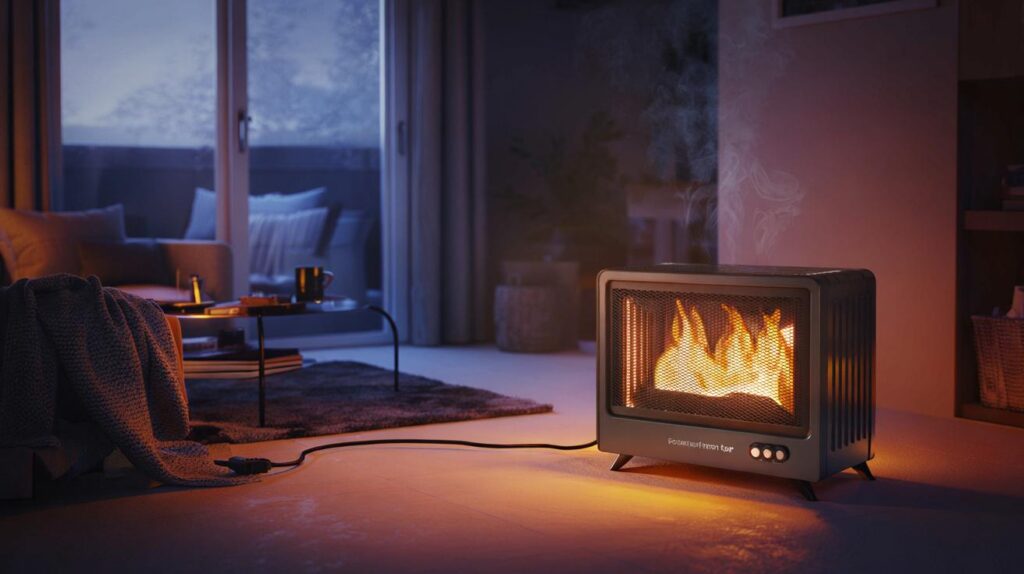
As the light fades and the air turns crisp, we reach for habits that make rooms feel safe and human.
You want warmth without upheaval, and character without a builder’s bill. A compact flame‑effect fan heater now promises both mood and heat, rolling ambience and practicality into a neat plug‑in box you can move from room to room.
A living glow without ash, smoke or a flue
The latest 2‑in‑1 flame‑effect fan heater brings the look of a real fire to homes that cannot fit a chimney. It uses LEDs and mirrored depth to mimic dancing flames. The effect is soft, low‑glare and surprisingly convincing. You get that hearth‑side feel on a Tuesday evening without stacking kindling or scrubbing a grate.
The unit stays compact, with clean steel lines and a deep black finish that suits modern flats as well as cottage‑style rooms. It sits easily in a corner, under a shelf or near a reading chair. No installers, no permits, no soot. You plug it in and choose heat or just the decorative glow.
Under €190 buys a plug‑and‑play heater that throws a cosy glow and adds real warmth at the push of a switch.
Why the flame effect changes how a room feels
Moving light relaxes the eye and signals comfort. A warm hue lowers perceived coolth, so you often turn the thermostat down a notch without feeling deprived. That helps zone heat the space you use, rather than the whole house. The look also fits the slow‑decor mood: fewer items, more texture, gentler light.
Power on demand: 1000 w or 2000 w
The heater offers two settings. At 1000 w, it sips energy for background warmth. At 2000 w, it boosts the temperature quickly when you come in from the cold. This flexibility suits early mornings, late‑night films or a quick warm‑through before guests arrive.
Running costs stay easy to grasp. At a typical electricity price of €0.25 per kWh, 1000 w costs about €0.25 per hour; 2000 w is about €0.50 per hour. Use the lower setting to maintain comfort, then pulse the higher one as needed.
| Mode | Output | Suggested room size | Est. cost per hour (at €0.25/kWh) |
|---|---|---|---|
| Eco | 1000 w | Up to 12 m² | €0.25 |
| Boost | 2000 w | Up to 20 m² | €0.50 |
Two heat levels, overheat protection and a realistic flame scene make it more than a seasonal ornament.
Setup that takes seconds
Place the heater on a flat surface, plug it into a standard socket and select either flame‑only, 1000 w or 2000 w. There is no vent to route and no maintenance routine beyond the odd dust. An automatic overheat cut‑out adds peace of mind for families and renters.
- Keep at least 1 metre clearance in front and 30 cm at the sides.
- Avoid bathrooms and damp zones unless the manual lists a suitable IP rating.
- Do not drape fabrics over the unit or block the air intake.
- Use a wall socket rather than a coiled extension lead.
- Position away from young children’s reach and pet beds.
Who it suits and why the price lands well
Tenants and flat‑dwellers gain a fire‑side look without a landlord’s nod. Home workers warm a small office without firing the boiler. Holiday‑home owners value the portability. If you like ambience, the flame mode runs without heat, so summer evenings still benefit from the glow.
The model widely sold under the Homday name comes with a two‑year guarantee and a ticket price under €190 at retailers such as Gifi. That figure puts it well below most electric stoves that mimic logs, and far under the cost of a wall‑hung electric fire. The design plays nicely with contemporary black accents and more rustic wood‑and‑linen palettes.
A sub‑€190 ticket, a 2‑year guarantee and the dual role of heater and mood light make the case strong for budget‑minded homes.
How it stacks up against other heaters
Oil‑filled radiators hold heat longer after switch‑off but respond slowly. Convection panels warm air gently yet lack visual appeal. Infrared heaters warm people and surfaces directly, which can feel intense. A flame‑effect fan heater wins on speed and atmosphere. It may not store heat, but it raises comfort fast and adds character while it runs.
What the numbers look like for a typical week
Say you use 1000 w for two hours on five evenings. That is 10 kWh. At €0.25 per kWh, the week costs about €2.50. Switch to 2000 w for the same pattern and you reach 20 kWh, or roughly €5. On a mixed plan, many households run flame‑only for the first hour, then 1000 w, and pulse 2000 w for 15 minutes when the cold bites.
Buying checks to make before you pay
- Look for an overheat cut‑out and a stable base. A tip‑over switch is a welcome extra on any fan heater.
- Confirm the flame effect can run without heat if ambience matters to you.
- Check the dimensions against your intended spot, including cable reach.
- Make sure your socket circuit can comfortably handle 2000 w on top of other loads.
- Read the warranty terms. Two years is a fair benchmark at this price.
Key features at a glance
- Flame‑effect display for a fire‑side look with zero smoke.
- Two heat settings: 1000 w and 2000 w.
- Flame mode can be used without heat for year‑round mood lighting.
- Compact, black steel design that fits tight spots.
- Plug‑in simplicity; no installation and minimal upkeep.
- Automatic protection against overheating.
- Indicative price: under €190. Typical guarantee: 2 years.
Extra ways to get more from it
Pairing the heater with a timer plug helps trim costs. For a 2000 w draw on 230 v, the current is about 8.7 A. That sits within the rating of a 10 A EU socket or a 13 A UK plug, yet avoid cheap extension leads. A smart plug with a 16 A rating and thermal monitoring offers a safer margin.
Placement matters. Facing the seating area reduces drafts. Close doors to confine the warm air. Thick curtains after dark reduce heat loss through glass. If you own central heating, try lowering the thermostat by 1 °C and use the heater to boost only the room you occupy. Many households see a notable dent in monthly bills with this zone‑first habit.
For care, vacuum the intake grille monthly and wipe the exterior with a dry cloth. Store it dust‑free once spring arrives. Treated well, a simple resistive heater often runs for many seasons without complaint, and the flame module uses modest power, so you can keep the glow on while the meter barely moves.



Can it genuinely raise an 18–20 m² lounge by a few degrees on 2000 w, or is the “Boost” just for spot heat? Also, what’s the fan noise like (dB) and does the flame effect dim fully for movie nights? A tip‑over switch is definately a must for me.