
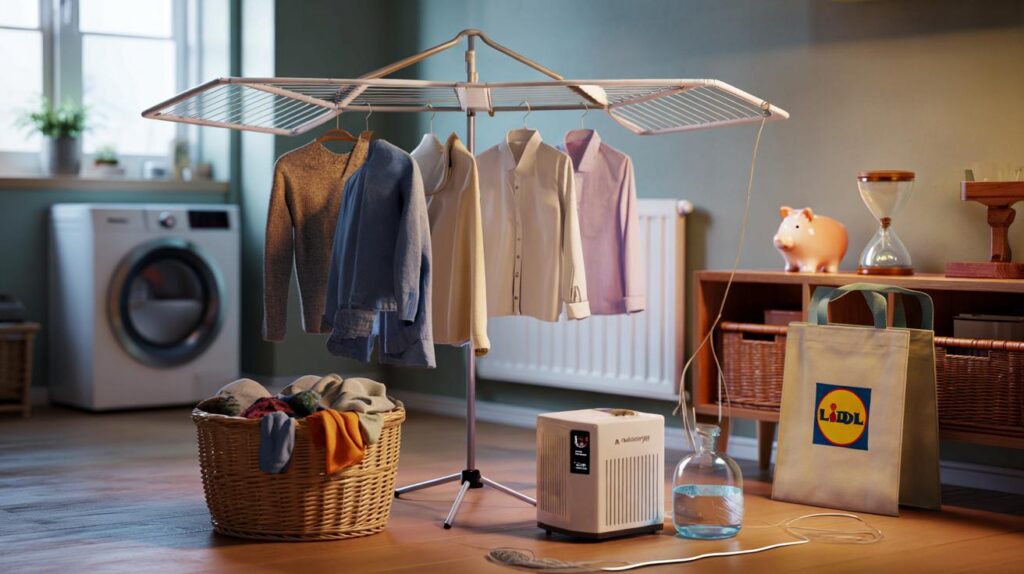
Shorter days, colder rooms and damp socks are back. Households hunt for quicker ways to tackle piles of washing without blowing the budget.
With line-drying becoming hit-and-miss and radiators already in demand, a powered clothes airer has jumped to the top of many shopping lists. The latest talking point is a Minky heated airer sold by Lidl for £39.99, pitched as a faster, gentler way to dry laundry indoors without the sting of a full tumble cycle.
What a heated airer actually is
A heated airer looks like a folding clothes rack, but the rails warm up when plugged in. That low, steady heat moves moisture out of fabrics more quickly than an unheated rack. The Minky model in Lidl offers 12 metres of drying space across two folding wings and a central section, with a stated load capacity of up to 16kg of wet washing.
It sits where you need it, then folds flat once the lot is dry. That matters in smaller homes where each square foot has to work hard. Fans also value how it treats fabrics. Unlike a hot drum, a warmed rack avoids harsh tumbling, so woollens, school uniform and delicate blouses keep their shape and handle for longer.
Brand guidance suggests around 8p per hour to run. At Lidl, the price is £39.99, undercutting similar listings by about £20.
How the sums stack up
The headline claim that draws attention is running cost. The quoted 8p per hour aligns with a typical heated airer draw in the 230–300W range on a common household electricity tariff. That’s a fraction of what many families spend on a conventional tumble cycle.
| Method | Typical power or energy | Estimated running cost | Likely time for a load | Fabric care notes |
|---|---|---|---|---|
| Heated airer (Minky 12m) | ≈230–300W | ≈8p per hour | 4–6 hours for mixed items | Low, even heat; gentle on wool, silk, embroidery |
| Heat pump tumble dryer | ≈1.0–1.5 kWh per cycle | ≈35p–65p per cycle | 2–3 hours | Cooler than old dryers; kinder than vented models |
| Condenser/vented tumble dryer | ≈2.0–3.0 kWh per cycle | ≈90p–£1.50 per cycle | 1–2 hours | Hotter cycle; can roughen fibres and shrink delicates |
| Clothes on radiators | Boiler works harder | Hidden gas/electric cost; condensation risk | 8–24 hours | Uneven heat; increased damp and mould potential |
If your mixed load takes five hours on the rack, the heated airer would cost around 40p on the brand’s figures. Against a £1.50 tumble cycle at older rates, that’s up to £1.10 back in your pocket per load. If you already own an efficient heat pump dryer, the saving narrows, but many households still value the gentler treatment and the option to run both methods depending on the fabric.
Expect the biggest gains on heavy cottons and denim. Lower heat means longer dry times than a tumble, but far less wear and tear.
What you get for £39.99
The Lidl offer centres on a Minky-branded, 12m heated airer with wing rails and a broader middle section. You can lay items flat to avoid stretching or slide shirts onto hangers and rest them across the rails to keep creases at bay. The unit folds away into a slim profile for cupboards or behind a door. Similar models are listed around £59.99 at other retailers, so the shelf ticket is eye-catching.
Capacity matters as much as wattage. Up to 16kg of wet laundry is effectively two everyday machine loads. If your washer has a 7–8kg drum, that means the entire day’s wash can go on in one session, rather than rotating racks and radiators all evening.
Drying times and how to speed them up
Drying speed depends on fabric thickness, room temperature and airflow. The following tweaks make a clear difference.
- Run a high spin at the end of the wash, up to the highest speed your garments allow on their care labels.
- Space items with a finger-width gap so warm air can move. Double up only for socks and smalls.
- Use a breathable cover designed for heated airers to trap warmth while allowing vapour to escape.
- Pair with a small dehumidifier nearby. Many units draw 150–250W and can halve drying time while reducing condensation.
- Flip heavy items like jeans after two hours, then again near the end, to prevent cold spots in seams and waistbands.
- Hang shirts on hangers over the centre rails, button the top, and gently smooth collars and cuffs to reduce ironing.
Condensation, safety and fabric care
Any indoor drying raises humidity. That can fog windows and feed mould on cold walls. Choose a ventilated room, crack a window for 10–15 minutes during the first hour, or run extraction where available. A dehumidifier next to the rack collects water before it hits your paintwork and usually costs pennies per hour to run.
Keep leads tidy and clear of walkways. Do not overload beyond the stated 16kg; wet cotton is heavier than you think. Avoid draping sopping-wet garments that can drip into sockets. Never use in bathrooms or on unstable floors, and let the rails cool before folding. For delicates, use mesh laundry bags or lay items flat to protect knitwear.
Who this suits
Families trying to cut weekday chaos
School uniforms and PE kits need quick turnarounds. A heated rack can run every evening without the rumble and heat spikes of a tumble dryer, and you can direct warmth to exactly where it’s needed.
Flat dwellers with no outdoor space
When line space is limited or banned on balconies, a foldable heated airer fills the gap. It stores neatly and runs quietly, which helps in shared homes.
People protecting delicate fabrics
Silk blouses, wool jumpers and technical gymwear last longer when dried at lower temperatures. Gentle heat keeps fibres springy and colours truer.
Why many shoppers are eyeing Lidl’s option now
Price is the hook. At £39.99, Lidl’s ticket undercuts similar Minky units often listed around £59.99. For households that balk at buying a new appliance in autumn, a sub-£40 fix looks manageable. The middle-aisle warning still applies: stock can be limited, and these tend to sell quickly once colder weather bites.
A quick way to sense-check your savings
Work from your tariff. If your unit rate is 28p per kWh and the airer draws 250W, each hour costs about 7p (0.25 kWh × 28p). A five-hour session is roughly 35p. Compare that with your dryer’s manual or smart plug readings. If you log 2.5 kWh per tumble at the same tariff, that’s 70p. Over four loads a week through winter, the difference mounts into double digits.
Small extras that can level up performance
A breathable fitted cover concentrates warmth and shortens cycles. A plug-in energy monitor shows true consumption in your home. A clip-on fan at a low setting, aimed across the rails, speeds evaporation in still rooms. And a simple routine helps: wash in the morning, rack by lunch, turn once mid-afternoon, and fold away before bed.
The bottom line for your laundry room
If you lack space or appetite for a tumble dryer, a heated airer is a tidy halfway house—faster than a cold rack, cheaper than a hot drum, and kinder to the clothes you reach for most. For the price of a family takeaway, Lidl’s £39.99 Minky-branded version brings 12 metres of rail space, a quoted 8p-per-hour running cost, and enough capacity to handle two standard loads. Pair it with sensible ventilation and a dehumidifier on the dampest days, and you turn autumn’s laundry headache into a manageable routine.



If this really dries a mixed load in 5-ish hours for about 40p, I’m in. My radiators are already a sock museum. Do the wings get hot enough for towles without crisping them? Also, that fold-flat bit sounds handy for tiny flats 🙂