
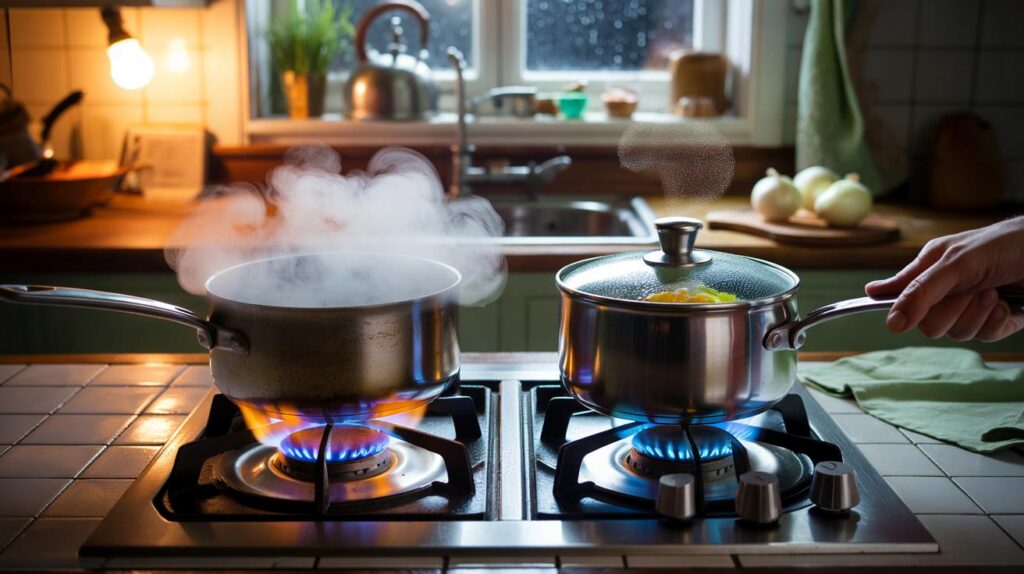
A wok’s worth of steam is bill money vanishing into thin air. Your hob roars, the kitchen fogs, and the smart meter ticks up like a metronome. The answer is so plain it almost feels insulting: put a lid on.
The scene was a Tuesday night, the sort that smells of onions and rain. In a small British kitchen, a pot of rice thundered away, lidless, throwing little clouds into the lamplight. The gas meter chattered with every bubbling breath.
We dropped a lid onto the pan and turned the flame down. The steam softened, the bubbles mellowed to a hush, and the meter slowed as if someone had taken a foot off the accelerator. Dinner didn’t slow. It got calmer. And then something quietly radical happened.
The lid did the heavy lifting.
Steam you can see, money you can’t
Watch a lidless pan and you’re seeing heat escape in real time. Those drifting plumes are hot gas carrying away energy you’ve paid for. Close the circle with a lid and the heat rebounds, folds back into the liquid, and shortens the job.
In kitchen tests, a litre of water hits a boil markedly quicker with a lid. Some labs put the time saving at around a third, which aligns with home trials where a covered pan boiled in 7 minutes instead of 11. That’s not just time; it’s fuel. When that initial boil meets a lower flame and a lid stays on, total energy used can fall by nearly two-thirds compared with a rolling, open boil on high.
Here’s why. Boiling without a lid drives evaporation, and evaporation is greedy. The energy locked in turning water to vapour is enormous—more than heating the same water by tens of degrees. Trap that vapour and you cut the loss. You also calm convection, stop splashing, and keep the hot air where it belongs: right above your food. Less heat escapes into your kitchen, so more of it actually cooks.
The lid habit that changes the bill
Start with a lid on from cold. As soon as the first reliable bubbles appear, turn the heat down and keep the lid on to hold that simmer. For starchy pots—pasta, potatoes—tilt the lid a finger’s width to vent, or use a glass lid with a small vent hole. **Small bubbles beat big boils.** They cook just as surely and cost you far less.
Match pan to burner. A flame licking the sides is waste you can literally see. On induction, drop the power early; the lid traps heat so well that residual energy keeps things moving. We’ve all had that moment when the pasta foams up like a science experiment. Slide the pan off the heat for a few seconds, lift the lid, stir, then settle it back. *The quiet fix is the one you barely notice.*
Let’s be honest: nobody really does that every day. Real kitchens are messy and rushed, lids go missing, and we cook by habit. Build one new reflex: lid on, heat down, simmer steady. You’ll feel it in the room and on the bill.
“Covering a pan isn’t fancy, but it is physics. Keep the heat where the food is, then use less of it.” — Maya Patel, community cookery tutor
- Use a lid: fits the pan, even if it’s borrowed from another pot.
- Turn down the dial: once boiling, a low simmer is plenty.
- Right ring, right pan: keep flames under the base, not up the sides.
- Angle for starch: a small vent stops boilovers without losing heat.
- Finish off-heat: with a lid, rice, pasta and greens keep cooking gently.
Why this “boring” trick feels big
Energy prices made everyone a little bit of an engineer. A lid is a miniature engineering upgrade that costs nothing and compounds daily. It shaves minutes here, quarter-hours there. It cools your kitchen in summer and warms your food faster in winter. Pair it with batch-cooking, with pressure cooking, with using the kettle to preheat pasta water, and the effect multiplies. **Two-thirds less energy** for a simple meal is not a moonshot. It’s the difference between roaring heat and thoughtful heat. That’s the kind of habit people share, and the kind that sticks.
| Key points | Details | Interest for reader |
|---|---|---|
| Covering the pan slashes heat loss | Lids trap steam and radiant heat, cutting evaporation | Meals cook faster, with less fuel |
| Boil, then simmer low | Bring liquid to a boil covered, reduce to gentle bubbles | Near two-thirds energy saving versus open, rolling boils |
| Right pan, right hob | Flame under the base; vent starchy pots slightly | Fewer boilovers, steadier cooking, calmer kitchen |
FAQ :
- Will a lid make food soggy?Not if you control the heat. A gentle simmer under a lid keeps moisture in the food, not splashing out. For crisp finishes, remove the lid near the end.
- What about pasta foam and boilovers?Leave a small gap or use a vented lid. Stir once when it returns to the boil, then keep it to a quiet simmer.
- Does this help on induction as much as gas?Yes. Induction is efficient at the hob, but a lid still prevents heat leaving with the steam, so you can cook at lower power.
- Do I need special lids?No. Any lid that fits works. A baking tray or even a larger plate can cover in a pinch—just mind heat and handles.
- Isn’t a pressure cooker better?Pressure cookers are champions for stews and pulses. For everyday pans, a simple lid gets you a big share of the savings with zero extra kit.



I put a lid on my pasta pot and dropped the heat to a whisper—my smart meter stopped sprinting. Dinner was ready faster and the kitchen wasn’t a sauna. Honestly, feels obvious in hindsight but I’d gotten used to the roaring boil. This is the kind of boring habit that sticks. Definitly adding “lid on, heat down” to my weeknights.