
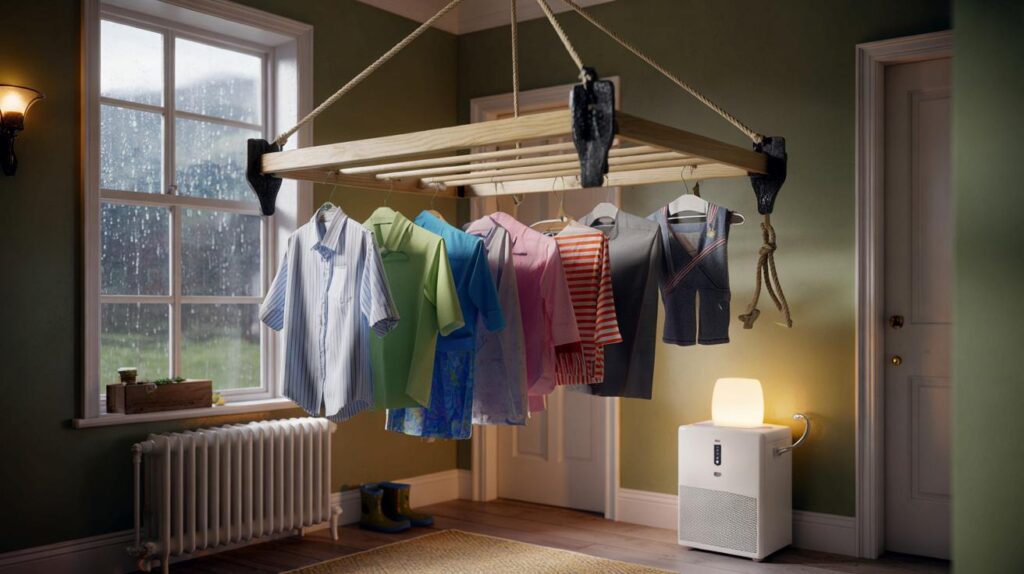
Winter laundry is testing patience and budgets. A time‑honoured ceiling device is being touted as a practical fix.
Shops report rising interest in ceiling pulley airers, with The Range promoting a £114.99 model that promises quick, tidy drying without stealing floor space. Families facing steep electricity bills and cramped rooms want a reliable way to clear clothes faster while keeping radiators free and hallways walkable.
What is The Range ceiling pulley airer?
It’s a traditional wooden‑and‑iron rack that lifts to the ceiling on a rope and pulley. You load damp garments at shoulder height, then hoist them up where the room’s warmest air naturally gathers. Six sturdy pine laths provide generous hanging room for shirts, towels and bedding, while the black powder‑coated cast‑iron ends add a neat, heritage look.
Price point to note: £114.99 for a ceiling‑mounted rack designed to dry a family wash in roughly 2–4 hours.
How the warm‑air trick works
Warm air rises and lingers near the ceiling, so lifting laundry above head height shortens drying times without running a tumble dryer. The rack sits out of the way, freeing floors and radiators. Air circulates around the garments, and that convection does the heavy lifting.
Realistic drying times
Users report typical drying in about three hours for a mixed load when the heating is on or the room is already warm. Heavier fabrics take longer. Light synthetics can finish sooner. A dehumidifier or slightly open window helps pull moisture out of the air and speeds the last stretch.
Expect a range: two hours for light fabrics in a warm, well‑ventilated room; four hours or more for thick cottons and denim.
Why it appeals to busy homes
- No floor clutter: nothing to trip over, nothing blocking doorways.
- Faster turnover: warm‑air pocket at ceiling height shaves hours off drying.
- Lower running costs: no dedicated heating element to power.
- Kid‑ and pet‑friendly: wet clothes stay out of reach.
- Radiators stay clear: better room heat, fewer damp patches behind clothes.
Cost, energy and possible savings
The pull‑up rack itself uses no electricity. Any cost comes from how you already heat the room. For many households, that translates into meaningful savings against tumble‑dryer cycles.
| Method | Typical energy per load | Approximate cost per load | Notes |
|---|---|---|---|
| Vented/condensing tumble dryer | 3–5 kWh | £0.90–£1.50 | Fast, but energy‑hungry; creases fabrics. |
| Heated electric airer | 0.5–1.5 kWh | £0.15–£0.45 | Slower than a dryer; still draws power. |
| Ceiling pulley airer | 0 kWh (device) | £0.00–£0.20 | Relies on existing room heat and ventilation. |
Heavy‑use families running 20–25 dryer cycles a month could be spending £18–£38 on electricity alone. Replace most of those with ceiling‑airer drying, and the upfront £114.99 can pay back within a winter, depending on habits, tariffs and load size.
Installation and safety
The Range supplies illustrated instructions and a fitting kit. It can be mounted to solid ceilings, and brackets can be arranged for sloped ceilings. The key is secure fixings into joists or other solid structure, not just plasterboard.
Before you drill
- Locate joists with a reliable stud finder and confirm by test pilot holes.
- Measure lifting height so the loaded rack clears heads, doors, lights and smoke alarms.
- Plan rope route and cleat position so you can raise and lower safely without strain.
- If unsure about fixings, use a qualified tradesperson.
Once installed, the rack lifts smoothly. Load evenly, place heavier items near the ends for balance, and keep the rope cleated securely. Avoid installing directly above cookers or hobs where grease and steam can settle on fabrics.
Moisture, mould and ventilation
Indoor drying adds humidity. The ceiling airer reduces puddling and cold‑surface drip, but you still need airflow. Crack a window for 15 minutes, use trickle vents, or run a dehumidifier to keep relative humidity near 50–60%. That helps prevent condensation on windows and black spots on walls.
Two allies make a big difference: a short daily window‑open routine and a small dehumidifier on laundry mode.
Performance tips that save minutes
- Maximise spin: use 1200–1400 rpm on the washing machine to shed more water.
- Hang smart: spread items so fabrics don’t overlap; use hangers for shirts to reduce creases.
- Rotate once: after an hour, give bulkier items a quick shake and swap positions.
- Pair with heat you already use: position above a hallway radiator or in the warmest room.
- Mind fabrics: microfibre and synthetics dry fastest; dense cottons need extra space.
Who will get the most from it
Flats with limited floor space, households with small children, and anyone fed up with clothes horses blocking the living room stand to benefit. It also suits period homes where a traditional look works with the decor. For frequent washers—sports kits, school uniforms, baby clothes—the constant cycle of hanging and clearing is easier when the rack parks overhead.
What it will not fix
Ceiling airers do not press garments, and they cannot overcome a cold, stagnant room. If you keep windows shut and the heating off, heavy cottons will linger damp. In very tight spaces with poor ventilation, consider a compact dehumidifier to avoid condensation. For bulky duvets, a commercial dryer may still be the faster choice.
A closer look at value
At £114.99, the outlay is similar to a mid‑range heated airer but with none of the running cost and less clutter. The payback depends on how often you currently tumble dry, your tariff, and how warm you keep the house. For a family doing 25 dryer cycles a month at £1.20 each, switching most cycles to ceiling drying could free roughly £30–£38 per month during winter—enough to offset the purchase within a season.
Renters and restrictions
If you cannot drill into ceilings, ask your landlord about fixing into joists with removable plugs and making good at move‑out. As a no‑drill alternative, pair a standard airer with a dehumidifier and a small desk fan pointed at the ceiling to mimic convection. It is not as tidy, but it accelerates evaporation without a dryer.
Practical add‑ons to consider
- Dehumidifier with laundry mode: speeds finishing and keeps windows clear.
- Moisture meter or hygrometer: shows when a room needs venting.
- Clip hangers and pegs: maximise lath space for socks and smalls.
- Over‑door hooks: turn doors into hanger rails for shirts to reduce crowding on the rack.
Care, maintenance and longevity
Wipe laths occasionally to keep them smooth, especially after drying newly washed dark denim or towels that shed lint. Check rope and pulleys twice a year for wear. If mounting in kitchens, wash down nearby walls periodically to keep condensation and cooking residue at bay. With solid fixings and occasional checks, the hardware should see you through many winters.
A quick scenario to map savings
Imagine two adults and two children, 25 washes a month, previously using a tumble dryer for each load at about £1.20. Switching 20 of those to a ceiling airer and keeping five for urgent turnarounds drops the monthly spend from £30 to roughly £6, with the £24 difference helping to cover heating you would run anyway. Over a four‑month heating season, the saving sits around £96—nearly the purchase price—before counting gentler fabric wear and fewer shrinkage mishaps.



I grew up with a ceiling pulley (proper old-school Sheila Maid) and this reads spot on. 3 hours is realistic if the room’s already warm and you crack a window. Price is steep tho—£114.99—but less floor clutter and fewer crispy radiator shirts sounds worth it.
Does the “£38 a month” saving include the extra gas/elec to heat the room? If I’m boosting the boiler anyway, that’s not free. Show the calc for 20–25 loads and typical tariffs, otherwise it feels a bit optimistic, tbh. Also, 2–4 hrs for denim? hmm.