
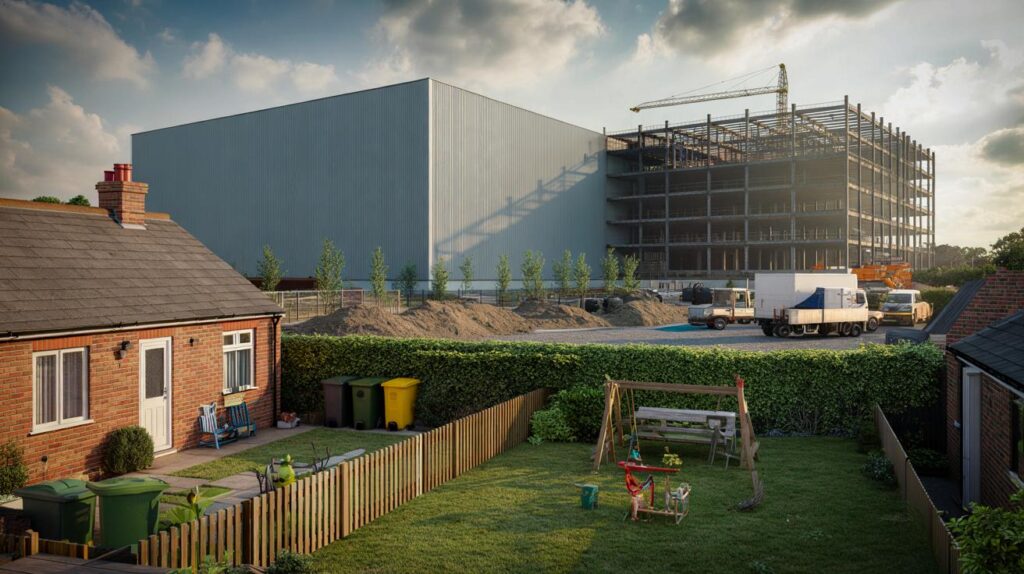
On a quiet Greater Manchester estate, neighbours say a new skyline has arrived overnight, changing gardens, routines and expectations.
Beyond tidy hedges in Tyldesley, two vast warehouse frames now dominate the horizon. Families on the Henford Estate describe an unsettling sense of scale and proximity, with some weighing up whether to move as construction advances on a 350,000 sq ft industrial park.
What has actually been approved
Plans show an industrial hub featuring four large distribution buildings. Two of them can reach up to 18.3 metres (around 60ft) under the permission agreed by the local planning committee. Developer PLP is building in phases. Delivery firm Whistl has signed a 15‑year deal for one unit, roughly 140,000 sq ft in size. Several back fences on the estate sit within tens of metres of the site boundary; residents say the nearest structure stands about 30 metres from their homes.
The project comprises four sheds on a 350,000 sq ft plot, with two permitted at up to 60ft tall directly behind existing housing.
| Key measure | Figure |
|---|---|
| Total site floorspace | Approx. 350,000 sq ft |
| Maximum approved height | 18.3m (about 60ft) for two buildings |
| Nearest reported distance to homes | About 30m |
| First tenant and lease | Whistl, 15-year term on 140,000 sq ft unit |
| Number of planned buildings | Four |
What neighbours say they are living with
Long-time residents describe a landscape that changed in a matter of weeks. People who moved here for quiet cul‑de‑sacs and open views now talk about overshadowing, privacy loss and the feeling of being dwarfed by steel. Several households say expectations were for smaller “low-rise” units, and that the approved heights came as a surprise once the frames went up.
A newly formed campaign group drew more than 200 people to a meeting, where neighbours compared notes on construction noise, ground vibration and the outlook from their gardens. One resident in his seventies said retirement plans now look different. A young family worries about resale prospects. Another homeowner says cracks and a dip in a floor appeared earlier this year and wants clarity on whether construction activity played a part.
Residents describe an “instant horizon shift”: fences, then hedges, then a grey wall that seems to soak up the daylight.
- Light and outlook: fears of reduced sunlight in gardens and rooms.
- Privacy: windows now face high, industrial elevations.
- Property values: anxieties about reduced buyer interest and lower offers.
- Construction impacts: noise, vibration and dust raised during the works period.
- Traffic and hours: concerns about HGV movements and late shifts once operational.
- Process worries: claims that letters went to only a slice of nearby homes.
What the council says
Officials insist the scheme followed the planning consultation and committee route. The authority says the final plans include landscaping to soften the look of the buildings and screen views from nearby gardens. Officers also say they will monitor the site during construction to check conditions are followed, and point to the investment and jobs expected when the complex opens. The developer declined to comment.
The council cites planting, earth mounds and continued oversight; campaigners say the scale still overwhelms the street scene.
How neighbour notification usually works
In England, a planning authority alerts neighbours in three main ways: letters to properties judged to be affected, a site notice on a nearby lamppost or fence, and a notice on the planning portal. The council doesn’t need to write to every home on an estate. That can feel arbitrary on big schemes, particularly where back fences straddle the red line and the visual reach extends far beyond immediate boundaries. Neighbours can still lodge objections online up to the decision date, and they can speak at committee where rules allow.
Understanding light, rights and overshadowing
Most daylight and sunlight assessments rely on Building Research Establishment guidance (known as BRE 209). Two metrics matter: vertical sky component (VSC) at a window, and annual probable sunlight hours (APSH) for rooms that get sun. If the VSC falls sharply compared with the existing situation, or APSH drops below suggested thresholds, the report should flag harm. Residents can ask the council to share the assessment that informed the approval and request a post‑build check once the cladding goes on.
“Right to light” is separate. It is a property right that can exist as an easement; people usually need specialist surveys and legal advice to claim it. Many suburban cases do not meet the legal tests, but early expert input helps clarify whether a claim has any merit.
What homeowners can do next
Residents who feel blindsided or affected can take practical steps that do not require a solicitor on day one. These steps create an evidence trail and can prompt targeted fixes, such as acoustic fences, extra planting or revised lighting angles.
- Request all decision documents: the committee report, plans, conditions and the landscaping schedule.
- Check the construction environmental management plan for dust, noise and working‑hours limits.
- Keep a diary of impacts with dates, times and photos; log HGV routes and night-time lighting.
- Ask for a pre‑occupation lighting test and a delivery management plan before the unit opens.
- Commission a RICS surveyor if cracks or floor movement appear; notify your insurer early.
- Contact the site manager about specific issues; escalate to planning enforcement if conditions are breached.
Jobs, freight and the street outside your door
Modern fulfilment sheds tend to operate across long shifts. HGVs arrive overnight, vans roll out at dawn, and staff come and go around the clock. Conditions often control when lorries can enter or leave, where they queue and which roads they may use for last‑mile routes. If noise or reversing alarms carry over gardens, acoustic barriers and white‑noise alarms can make a difference. Lighting should avoid spill into bedroom windows; cowls and lower columns help.
On the benefits side, a scheme of this size usually expands local employment options across warehouse operations, maintenance and management. Local training programmes sometimes form part of planning obligations, improving access to first jobs and re‑training. Residents who want to shape those benefits can ask the council about any employment or travel plans tied to the project.
Landscaping: what actually screens a 60ft wall
Planting works best when it mixes fast‑growing species with longer‑lived trees, backed by mounding that lifts the soil line. Evergreen belts keep coverage in winter. Where space is tight, developers can add green walls or break up façades with colour and articulation to reduce the monolithic look. Neighbours should check the planting schedule for species, heights at planting and maintenance obligations over the first five years.
Why campaigners say the scale changed
Several owners argue that the final heights and massing exceeded what early drawings appeared to show. That often happens because outline plans give parameters, not finished elevations, while detailed designs make fuller use of the approved volume later. If residents believe the build diverges from approved drawings, they can ask the council to verify compliance. Minor tweaks can go through non‑material amendments; substantial differences may need a fresh application.
A 200‑strong meeting has turned frustration into organisation: door‑to‑door updates, planning file reviews and site visits.
If you are worried about value
Estate agents say outlook and noise can weigh on offers. Presentation still matters: tidy boundaries, good glazing, and attractive lighting can soften first impressions. If you plan to sell, a buyer’s survey will pick up defects, so early repairs and a file of guarantees help. Where operational impacts become severe, neighbours sometimes negotiate with developers for extra screening or contributions to mitigation. Legal claims for loss in value are complex and rare on private schemes; advice from a property solicitor can set expectations.
A quick checklist for the week ahead
- Download the approved plans and highlight the landscaping plan for your boundary.
- Photograph each main room at the same time of day for a fortnight to record daylight change.
- Note construction hours and compare them with the condition on permitted hours.
- Write to your ward councillors with three specific asks: extra planting, lighting review, and a residents’ liaison contact.
The frames will soon gain cladding, lights and traffic. Neighbours now want the promised screening in the ground before peak winter darkness. They also want firm commitments on HGV routes, operational hours and light spill tests, so that a project sold as bringing jobs does not take the glow out of their evenings.
Technical terms to watch on future documents include “VSC” and “APSH” in daylight studies, “Lmax” and “LAeq” in noise assessments, and “spill” in lighting reports. If those figures shift once the units go live, a case for stronger mitigation becomes easier to make.



How did a 60ft warehouse get approved so close to back gardens—some only about 30m away—without stricter height limits or deeper buffers?
So my garden view is now hedge, fence, and… a giant grey monolith. Brilliant. I always wanted a daily partial eclipse 🙂