
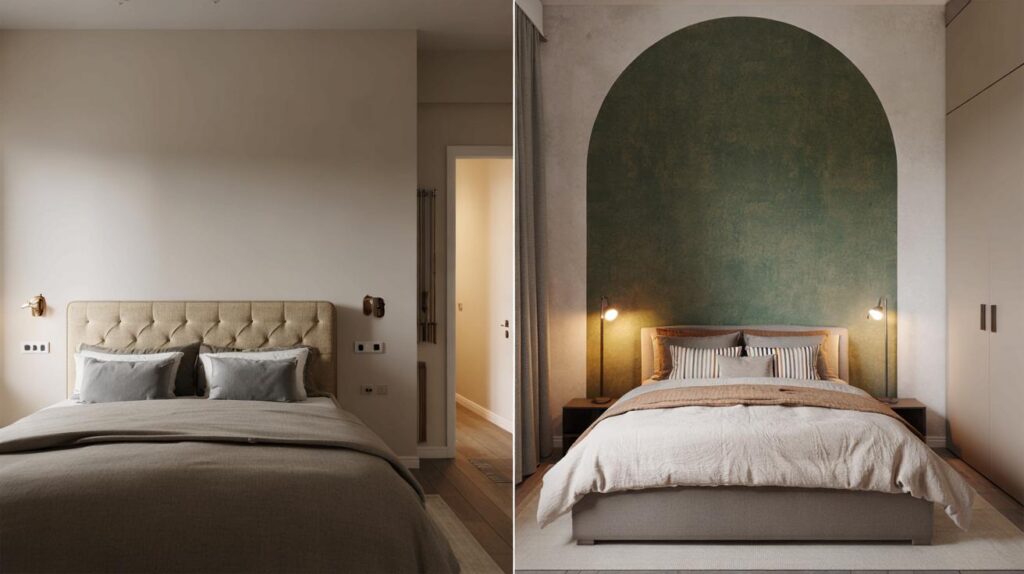
As colder nights draw in, bedrooms come under scrutiny. Small tweaks promise fresher looks, faster. Some surprise, others delight now.
Across showrooms and social feeds, designers are quietly backing away from bulky headboards. The shift is not about fashion alone. Rising costs, tight floor plans and rental restrictions are reshaping decisions, pushing people towards slim, graphic wall treatments that frame the bed without swallowing space or budget.
Designers are ditching bulky headboards
The classic upholstered or timber headboard sits proud by 8–20 cm. In compact UK bedrooms that margin matters. It narrows circulation, complicates sockets and wall lamps, and dominates views as soon as you open the door. Many pieces cost £250–£800 and still look familiar after a few seasons, especially when beds change or paint colours evolve.
Designers now reach for lightweight “zoning” behind the bed to anchor the layout. A vertical band, a panoramic mural or a rounded arch in wallpaper reads as architecture. It sets the tone, directs the eye and makes a standard divan feel finished.
From €39/m² (about £33/m²), many complete projects land under €200, including paste, tools and trimmings.
There is a practical angle as well. Removable wallpapers and pre‑pasted materials minimise damage at end of tenancy. No drill holes. No heavy frames to move. No headaches when skirting or plug heights vary.
What replaces the headboard
Wallpaper zoning that behaves like architecture
A tailored wallpaper zone can stretch the room visually, correct proportions and frame the bed like a built element. It also turns an uneven wall or a minor scuff into a feature rather than a flaw.
- Single drop stripe that sits wider than the mattress by 10–15 cm each side.
- Panoramic mural spanning the full wall to widen a narrow room.
- Half‑height panel topped with a painted rail line to calm tall ceilings.
- Soft arch or scallop silhouette to add curves to boxy layouts.
- Textured lookalikes: grasscloth effect, limewash print, or light oak grain for warmth.
This approach suits renters and owners alike. It travels, it changes with taste, and it clarifies where the bed belongs without adding bulk.
Numbers that matter: cost, time, upkeep
Budget sets the pace. Entry prices across European retailers start near €39/m², roughly £33/m². A typical headboard zone behind a double bed uses 3–5 m², so the outlay often sits between €120 and €200. Pre‑pasted or peel‑and‑stick rolls remove the faff of tubs and trays. Two people working carefully can finish in 90–120 minutes with a smoother, knife and level.
Two hours, no drills, no dust: one wall, one evening.
Care is straightforward. Most modern finishes are wipeable with a soft sponge, which rescues marks from tea, make‑up or a rogue felt‑tip. Many lines resist UV fade, so colours hold even in east‑ or south‑facing rooms. When it is time to refresh, the surface lifts cleanly from well‑prepared paint without tearing plaster.
How to choose a scheme that works year‑round
Autumn brings richer tones, but the best schemes layer warmth without closing the room. Deep green, burgundy and petrol can feel restful if the pattern breathes. Graphic 70s motifs are back, though softened with chalky inks and looser repeats. Neutrals still earn their keep, especially when mixed with texture in bedding and rugs.
Match the zone to the bed’s proportions. A king needs breadth and either a full‑height mural or a panel rising 110–130 cm above the mattress. A single bed benefits from a generous stripe to avoid looking mean. If ceilings are low, use vertical lines or an arch that climbs close to the cornice.
Children’s rooms versus primary suites
Children outgrow themes fast. Try constellations, gentle geometrics or soft woodland prints that mature with the occupant. Choose wipeable finishes and avoid raised textures that trap dust. In primary suites, quiet panoramas and rhythmic geometrics invite sleep. Keep contrast moderate, then bring personality through throws and bedside lamps.
Pairing with textiles and lighting
Balance pattern with tactile, plain fabrics. Washed cotton, linen and short‑pile velvet add depth without noise. Let the wallpaper guide two colours in the bedding, then introduce a third with cushions or a runner. Use warm‑white bulbs at 2700–3000K to flatter skin tones and soften greens and blues.
Pick two elements to match—wallpaper and cushions—and one to contrast, such as a throw or lamp base.
Safety and durability are becoming standard
People want beauty that behaves. Several brands, including Wellpapers, now supply fire‑rated bases, moisture‑resistant finishes for rooms near en‑suites, and UV‑stable inks that maintain tone. Made‑to‑measure panels cut waste and arrive trimmed for the wall. Lead times have shortened too: in many cases printing completes in 72 hours with delivery in 48–72 hours after dispatch.
Risk sits lower than buying a bulky frame. Some retailers offer a 15‑day swap window before installation if the print is not quite right. Digital mock‑ups help visualise scale and colour on your exact wall measurements.
| Feature | Classic headboard | Wallpaper headboard zone |
|---|---|---|
| Depth taken from wall | 8–20 cm | 0–2 mm |
| Typical cost | £250–£800 | €120–€200 for 3–5 m² |
| Install time | 30–60 min, may need drilling | 90–120 min, low‑tool DIY |
| Rental‑friendly | Often leaves holes | Usually removable |
| Maintenance | Vacuum, spot clean fabric | Wipeable surface |
| Customisation | Limited sizes, fabrics | Endless prints, scale control |
Pitfalls and how to avoid them
- Scale drift: small patterns can fizz on large walls; sample at A3 size and view from bed height.
- Socket clashes: map plugs and switches before you cut; keep motifs clear of cut‑outs.
- Surface prep: glossy paint repels adhesive; de‑gloss lightly and dust the wall.
- Bed height: ensure the zone rises above stacked pillows by at least 20 cm.
- Lighting colour: cool bulbs can flatten warm prints; pick warm‑white lamps for evening use.
- Moisture: near en‑suites, choose moisture‑resistant bases and ventilate well after showers.
- Removability: confirm the finish is peelable to avoid torn plaster at move‑out.
Worked example: a small city bedroom
Room: 2.7 m wide by 3.2 m long, 2.4 m ceiling. Bed: 150 cm wide divan. A wallpaper panel 2.2 m high by 2.1 m wide covers 4.62 m². At €39/m² the material cost is about €180 (£152). Add a smoother, knife and paste at roughly £15–£25 if needed. The panel replaces a 12 cm deep headboard, returning about 0.25 m² of floor area and giving 6–8 cm more walkway at the foot of the bed. Wall lights mount directly on the plaster without clashing with a frame, and the door clears the bed by a safer margin.
Beyond the trend: extra gains people rarely count
Acoustics improve with the right pairings. A wallpaper zone plus a heavy curtain and a wool rug will take the edge off echo in new builds. Sustainability is rising on checklists, so look for FSC‑certified bases and water‑based inks. Off‑gassing is lower with these formulas, which matters in tightly sealed homes. If you use peel‑and‑stick, allow fresh paint at least four weeks to cure fully to avoid adhesion issues.
For the creative, seasonal swaps change the mood without replacing furniture. A spring micro‑floral can give way to a winter forest scene in one evening. Keep roll remnants to line bedside drawers or frame as art elsewhere, tightening the scheme and reducing waste. If you need extra resilience, a clear matte varnish designed for wallpaper can add scrubbability in children’s rooms while keeping sheen under control.



Definitley rethinking my chunky upholstered headboard now. If I can gain 6–8 cm of walkway and spend under €200, that’s a win in a tiny UK bedroom. Great breakdown on sizes and patterns!
Does peel-and-stick really come off cleanly after a year or two? My landlord is picky about paint, and I’ve had adhesives tear plaster before. Any brands you’d trust or prep steps beyond a light de-gloss and dusting?