
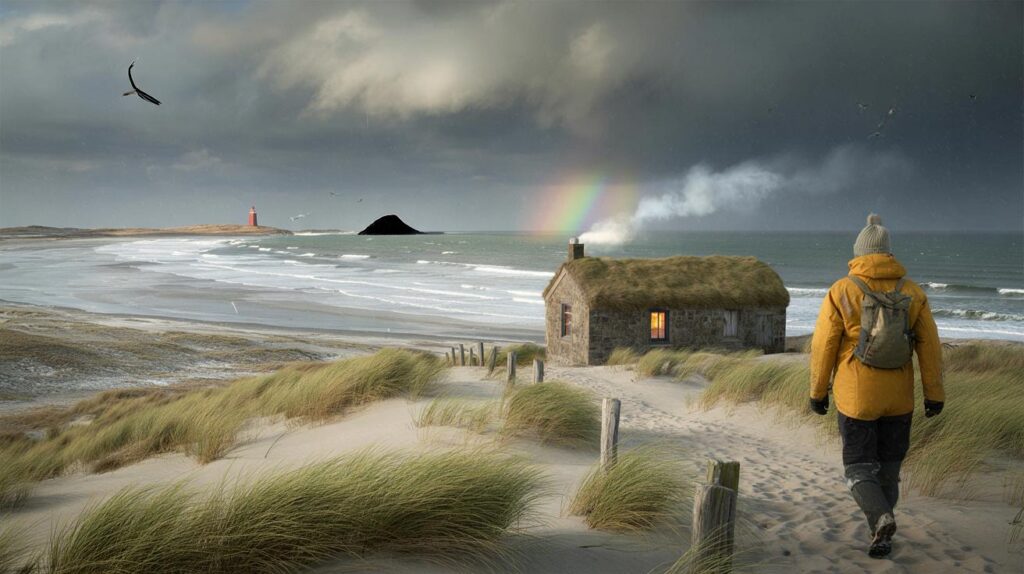
Most people file the North Sea islands under “summer only.” Yet winter brings the drama you secretly want from a shoreline: weather with a voice, light that moves like a dancer, and cabins that smell of woodsmoke and wet wool. Prices drop, crowds thin, and the map begins to feel like a dare. That’s when the islands look back at you, unblinking.
The ferry to Orkney pitched like a tired horse, and everyone laughed as coffee sloshed in cups that were never truly full. On Hoy the wind lifted fine grit from the beach and stung my cheeks, like a brisk hello that went on a beat too long. The café by the harbour had steamed windows, peat smoke looping from the stove, and a windowpane glossed in salt so thick the view looked painted. You wipe it with your sleeve, smile at a stranger, and sip something sweet and hot. Out by the dunes a dark squall pulled its own curtain. Then the sky split.
The North Sea’s winter face: raw, bright, unforgettable
Winter here is not a season, it’s a show. Squalls walk in on cue, light drops a spotlight on a sea stack, and the horizon shifts textures every ten minutes. You notice the colours are deeper, almost edible: tar-black rock, pewter swells, butter-yellow grass, and sudden blue so clean it feels new.
On Texel a January morning began quiet enough for the gulls to nap on the pier. Twenty minutes later, foam raced the wind like kids who’d lost their shoes. A ranger pointed to the lighthouse, its red paint slick as a seal’s back, and said the beam can sweep a clean street across a storm. Daylight can shrink to little more than six hours this far north, which turns every walk into a small story with a clear beginning and end. It concentrates the day, and the mood, in a way summer never quite does.
Winter air is dense and honest. Low sun angles skim shadows across dune ridges and pull relief from cliffs the way a sculptor lifts shape from stone. Spray hangs longer, so rainbows hold their breath between showers. The water looks colder because it is colder, pushing colour toward steel and green. You get space, too. Paths that in July feel like commuter lines become private threads. The wind makes honest work of the day.
How to do winter islands right
Pick your days with the tide tables in one hand and ferry updates in the other. Aim for short, bright moves: a late-morning beach walk, a hut lunch, a lighthouse loop before dusk. Bring layers that trap air: thin wool next to skin, a windproof outer, a cap that stays on. Pack dry socks and a flask. Book shelter with character—Shetland’s camping böds, a reed-thatched Friesenhaus on Föhr, a Danish shelterplads on Fanø—so coming “home” feels like a reward, not a retreat.
Most mistakes begin with wishful thinking. People underestimate windchill and overestimate daylight, then end up racing dusk with a dead phone and numb hands. Keep maps offline, carry a small head torch, and plan a warm stop into every loop. We’ve all had that moment when a squall rolls in and you realise the horizon eats time faster than you do. Let’s be honest: nobody does this every day.
“In winter the islands are honest,” a ferry skipper told me off Rømø. “They don’t pretend to be gentle, and that’s why you’ll remember them.”
- Best window: late Jan to early Mar for sharper light and longer days.
- Gear that matters: windproof gloves, ankle-high boots, a pack liner, paper map.
- Little rituals: a hot flask, a dry hat in reserve, one sweet snack you genuinely love.
- Routes: lighthouse triangles, beach-to-bothy loops, causeway walks at safe tide.
- Backup plan: a hut day with books, cards, and a storm to watch like a film.
Where weather writes the story you came for
Winter islands barge their way under your skin. A German Strandkorb faces a grey sea and somehow feels like a front-row seat to something grand. On Orkney you’ll spy a hen harrier riding a gust as if the wind were a lift. Sylt’s Kampen cliffs glow almost copper at 3pm, and by five you’re clinking cups as the last light drops behind the dune grass. The Dutch Wadden islands hum with birdlife, and the calls carry farther in cold air, which makes a low-tide mudflat sound like a crowd. You start noticing how weather rearranges your plans but also your appetite for patience. That shift sticks. You go home looking for skies with edges, routes with pauses, windows you can leave a little salted. The islands teach you that beauty is not a summer lease—it’s a year-round tenancy you renew with a walk, a watch, a breath. Winter is the real season here.
| Key points | Details | Interest for reader |
|---|---|---|
| Storm-watching as a feature | Short, safe routes built around squalls and light bursts | Turns bad weather into the highlight, not a setback |
| Cosy huts and local shelter | Shetland böds, Frisian houses, Danish shelters, cafe refuges | Warm textures, authentic stays, great value off-season |
| Smart winter logistics | Tide timing, offline maps, layered kit, Plan B days | Confidence to go, fewer mishaps, richer days |
FAQ :
- Which North Sea islands shine in winter?Orkney and Shetland for grandeur, Texel and Terschelling for birds and long beaches, Sylt and Föhr for dunes and design, Fanø and Rømø for wide, driveable sands.
- Is it safe to visit during storms?Yes with respect: stick to waymarked routes, watch cliff edges, follow ferry advice, and keep an eye on tide times.
- What should I pack beyond basics?A windproof layer, dry socks in a zip bag, a head torch, paper map, thermos, and a simple first-aid kit.
- Will places be open?Many cafés, bakeries, and small museums open reduced hours; book huts and check schedules the day before.
- Good for families?Yes if you keep walks short, add warm indoor breaks, and turn weather into a game—spot rainbows, count whitecaps, name the squalls.



This makes winter sound like the season the North Sea was built for. The image of peat smoke and salt-glossed windows got me. Any tips for finding camping böds on short notice in Shetland? I’m definitly tempted to swap summer crowds for squalls and quiet paths.
Looks stunning, but how safe are those causeway walks in a fast-rising tide? Local advice seems to vary, and ferry updates can be patchy—are we not slightly over-optimistic here? Also, clif edges + gale force winds = yikes; are rescues common when ferries are cancellled?