
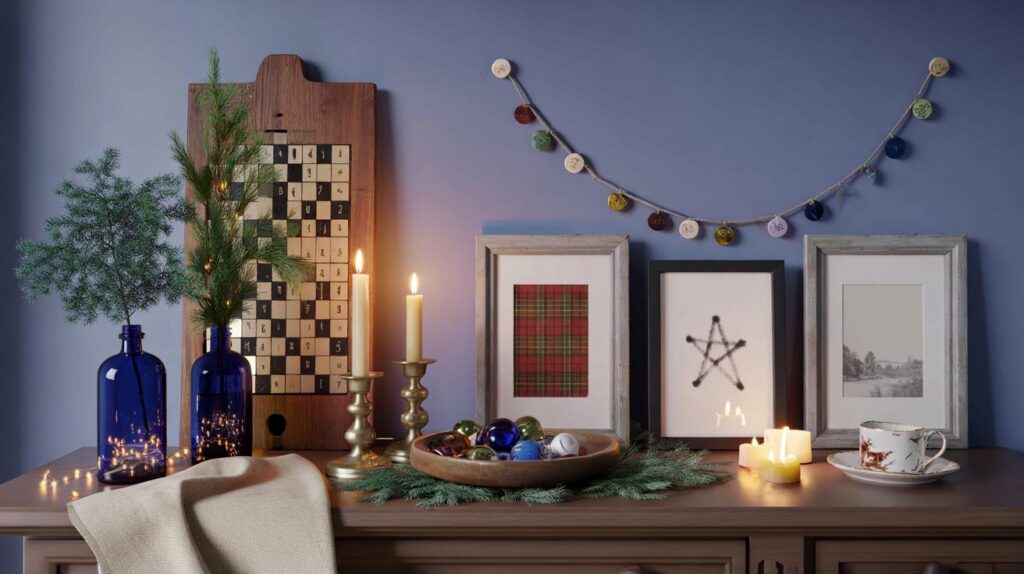
Festive seasons creep up fast. The budget doesn’t stretch, the shops are full of the same glittering things, and your living room looks exactly like last year’s square on Instagram. You want soul, not just sparkle. You want the room to feel like your people live there.
It started on a wet Saturday, the sort that turns pavements into long mirrors. The charity shop bell pinged and the place smelled faintly of wool coats and lavender. I watched a woman in a red scarf turn over a brass candlestick with a thumbprint in the tarnish, as if she could read its past. On the back wall, a box of mismatched baubles glowed like a lucky dip. At home, my own hallway was plain and echoey, still waiting for the season to begin. The radio hummed, the kettle clicked, and I lined up three second-hand frames on the console. Inside them? A scrap of tartan, a postcard, a child’s drawing of a star. One cracked teacup changed everything.
Thrift finds make seasons feel real
Big-box decorations can be beautiful, but they often feel like a costume you wear once. Thrift finds carry fingerprints, dents, and stories. That little wobble in a vintage vase? It makes a candle flicker in a softer way. In December or Diwali, Eid or Easter, those textures tell your room to slow down and breathe. The best part is the hunt. You’re not just buying; you’re discovering. The room feels calmer because each piece has a reason to be there. That’s the quiet kind of magic people notice without knowing why.
A neighbour told me she built her winter mantle from a car boot sale haul: two blue glass bottles, a battered chessboard, and a tin of old buttons. She threaded the buttons on twine and draped them like beads. The bottles took fairy lights, the chessboard went vertical as a backdrop, and suddenly her lounge looked like a storybook. We’ve all had that moment when a small, odd thing clicks into place and the whole scene becomes yours. In Britain, we also throw a lot out at this time of year; charity shops go from sleepy to loud by November. Saving something from the bin while saving money? That feels like a tiny, meaningful win.
There’s a simple design truth at work: repetition breeds calm, and contrast brings life. Choose a colour thread—forest green, deep indigo, candlelight gold—and repeat it across second-hand finds. Match materials into “families”: glass with glass, wood with wood, textiles with textiles. Then introduce one mischief maker, like a joyful gingham ribbon or a single neon ornament. Scale matters too. Cluster small items close together, let larger shapes breathe. That way, your thrifted treasures don’t look like clutter; they read as intention. Think less jumble, more chorus.
Hunt smarter, hack gently, layer slowly
Go in with a mini-map. I use the “three-layer rule”: base, sparkle, story. Base is your foundation—evergreen cuttings, a wool throw, a linen runner, even a sheet of kraft paper folded just so. Sparkle is anything that catches light—mirror trays, old jam jars, brass, pressed glass. Story is what makes it yours—handwritten tags, a recipe card in a frame, a child’s clay star. Keep a small list in your notes app, and carry a tape measure. My other trick is the ten-pound treasure rule: if it costs under a tenner and solves a gap, it comes home. If not, it stays for someone else’s story.
Avoid grabbing every pretty thing. The season nudges us into overdoing it, then we trip over our own decorations. Let’s be honest: nobody really does that every day. If you’re styling a shelf, start empty. Place three items, step back, and live with it for an hour. Then add one more. Patina isn’t dirt; it’s character. A quick clean, a touch of beeswax, and that little scuff becomes poetry. And remember, candles are props, not heaters. Keep flames away from foliage, and use battery tea lights where the cat likes to swish his tail.
“I tell customers to buy for a feeling, not a theme,” said Mags, who runs our High Street charity shop. “A single good frame can carry a whole mantel if what’s inside it is yours.”
- Paint that rescues: tester pots in forest green, oxblood, or midnight blue revive frames and candleholders.
- Gentle glue: low-temp hot glue, removable putty, and washi tape keep displays flexible and renter-friendly.
- Low-cost textiles: cut old jumpers into cosy sleeve covers for jars; turn tea towels into banners.
- Slow decorating: style in small bursts across a week, not one frantic afternoon. You can feel the room exhale when you do.
The joy lives in the layers you keep
Festive decorating isn’t a sprint to perfection; it’s a winter walk with pockets full of finds. When you use thrifted pieces, your home stops trying to impress and starts to welcome. It gives friends something to ask about. It lets children touch things. It also shifts habits. You begin to look at packaging as ribbon, a jam jar as a lantern, a scarf as a table runner. That curiosity spills into the year ahead. And when January arrives, you’ll tuck away a small box labelled with a smile: seasonal swap box. Inside are scraps that hold the scent of cinnamon and rain. You’ll open it next year and remember the bell on the charity shop door, and the way the room felt softer, kinder, yours.
| Point clé | Détail | Intérêt pour le lecteur |
|---|---|---|
| Build a colour thread | Pick one or two hues and repeat across glass, textiles, and ribbons | Creates calm and cohesion without buying new sets |
| Three-layer rule | Base (texture), Sparkle (light), Story (personal) | Makes any surface look intentional in minutes |
| Thrift-first mindset | Shop charity, car boots, and your cupboards before retail | Saves money, cuts waste, and adds real character |
FAQ :
- How do I clean old brass and glass safely?Use mild soap for glass, and a soft cloth with a dab of ketchup or lemon-bicarbonate mix for brass; rinse, dry, then buff lightly.
- What if my thrift finds don’t match?Unify them with one colour accent or shared material, and group by size to keep the look tidy.
- Any quick ideas for renters?Command hooks, washi tape, and removable putty let you hang garlands, frames, and lights without marks.
- How do I avoid cluttered shelves?Work in threes, leave negative space, and rotate pieces weekly rather than displaying everything at once.
- Can kids help without chaos?Give them a mini-zone: a tray to style, a jar to fill, or a string to clip drawings, so their touch is framed and celebrated.



The three-layer rule finally clicked for me—base, sparkle, story. I’ve been over-decorating for years and this makes it feel intentional. Also, the ten-pound treasure rule is definitley going on my Notes app.
Gorgeous ideas, but our local thrift stores are picked clean by November. Any tips for hunting when the stock is meh—like specific days, or what to check first? Also, ketchup on brass sounds… messy. Do you neutralize the acid after so it doesn’t keep etching?